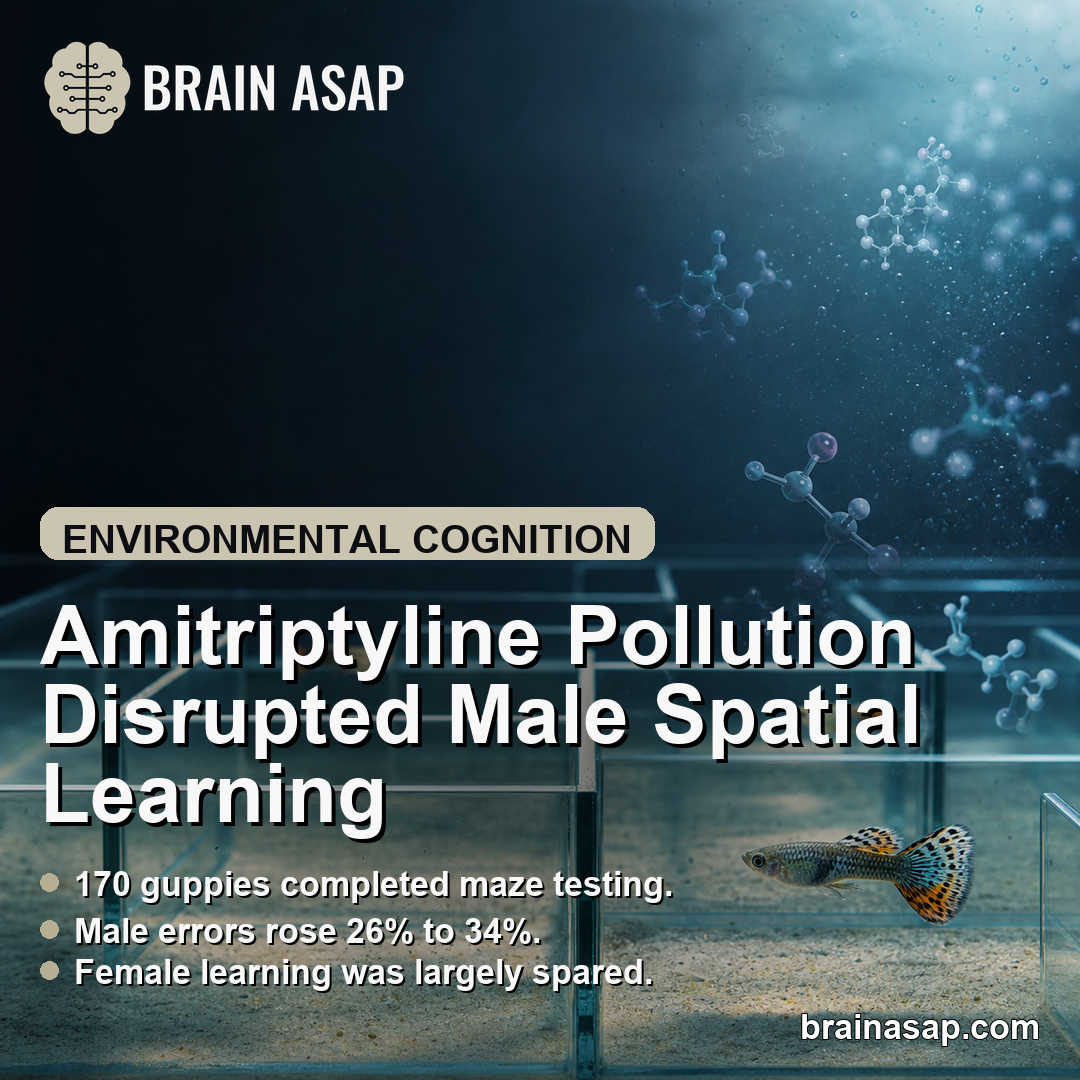
TL;DR: A 2026 study in Environmental Science & Technology found that male guppies exposed for 11 days to environmentally relevant amitriptyline, a tricyclic antidepressant detected in waterways, made more spatial-learning errors in a maze while females were largely unaffected.
Key Findings
- 170-fish learning test: Researchers tested wild-caught male and female guppies across 12 maze trials after excluding fish lost before or during behavioral testing.
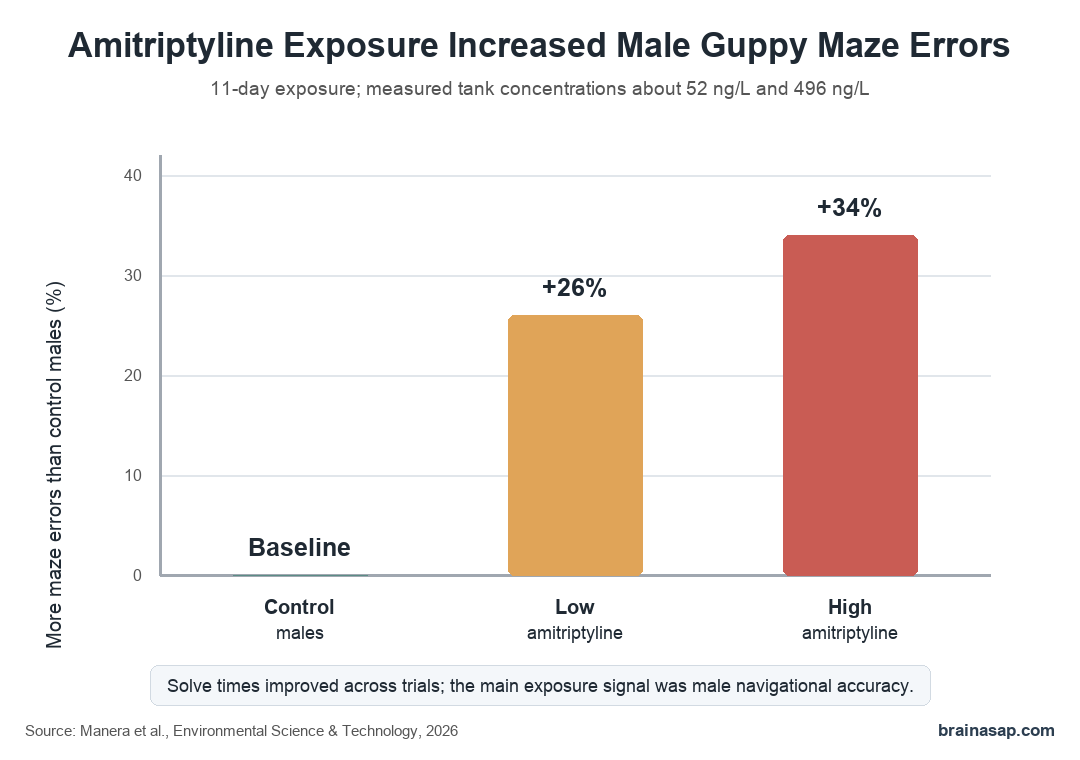
- 11-day exposure: Fish were assigned to freshwater control, low amitriptyline, or high amitriptyline groups, with measured tank concentrations near 52 ng/L and 496 ng/L.
- Male accuracy loss: Male guppies exposed to low and high amitriptyline made about 26% and 34% more navigational errors than control males.
- Female pattern spared: Female guppies showed no strong amitriptyline-related change in maze errors, even though all groups improved with repeated trials.
- Speed was not the issue: Maze solve times declined across trials, and amitriptyline did not meaningfully change solve-time learning curves in either sex.
Source: Environmental Science & Technology (2026) | Manera et al.
Amitriptyline is prescribed for depression and pain, but trace amounts can also leave human wastewater systems and enter aquatic environments. Because the drug acts on serotonin and norepinephrine signaling, it is a plausible neuroactive pollutant for animals that never received a prescription.
The guppy study tested cognition directly rather than only measuring survival, growth, or general activity. Researchers asked whether low-level amitriptyline exposure changed how quickly fish learned a spatial maze and whether males and females responded differently.
Researchers Tested Spatial Learning After Amitriptyline Exposure
The experiment used wild-caught guppies, Poecilia reticulata, collected from Alligator Creek in Queensland, Australia. Researchers began with 180 fish, evenly split by sex, and used 170 fish in the behavioral testing after mortality and pre-test exclusions.
Fish were individually housed and assigned to one of three exposure conditions:
- Freshwater control: no detected amitriptyline, with the assay detection limit at 10 ng/L.
- Low exposure: a measured mean concentration of about 52 ng/L, intended to represent environmentally relevant contamination.
- High exposure: a measured mean concentration of about 496 ng/L, representing a higher but still ecologically motivated exposure level.
Exposure lasted 11 days, and the fish performed the behavioral task in the same exposure water. The design measured behavior under ongoing exposure, not only after a prior drug pulse.
The maze task required each fish to move through a repeated spatial route. Researchers measured solve time and navigational errors across 12 trials, which allowed them to separate general activity speed from accuracy and learning.
All Groups Learned the Maze, but Male Accuracy Changed
Across the full experiment, guppies learned the task. Solve times decreased across successive trials, and navigational errors generally declined with experience.
Amitriptyline did not stop fish from moving through the maze. Instead, it changed the accuracy pattern in males.
Control males became more accurate with repeated trials and eventually made fewer errors than control females. By the final trial, control males averaged 0.92 errors, compared with 1.56 errors in control females.
Amitriptyline exposure weakened that male advantage. Averaged across trials, low-exposed males made 0.42 more errors than control males, and high-exposed males made 0.55 more errors.
In percentage terms, male guppies exposed to low and high amitriptyline made about 26% and 34% more errors than control males.
Female Guppies Did Not Show the Same Error Increase
The sex-specific pattern is the main reason the study is stronger than a simple pollutant-harms-fish headline. Females also learned across trials, but amitriptyline did not strongly change their number of errors.
That means the pollutant effect was not just general sedation, panic, or inability to complete the maze. If exposure simply made all fish worse at the task, both sexes would be expected to show similar impairment.
The observed pattern was narrower:
- Control males: gained an accuracy advantage over females after repeated maze experience.
- Low-exposed males: made more errors than control males and lost much of that advantage.
- High-exposed males: performed worse than females early in the task and showed greater trial-to-trial variability.
Maze solve time also helps interpret the finding. Because solve-time curves were comparable across exposure groups, the error result points more toward disrupted spatial accuracy than slowed movement.
Researchers also reported greater variability in exposed males. That suggests the pollutant did not shift every male by the same amount; it made accuracy less consistent across individuals and trials.
Neuroactive Pollution May Affect Cognition Before Survival
Many environmental toxicology studies focus on death, fertility, or visible health damage. This study examined a subtler endpoint: whether a drug designed to affect human neural signaling can alter learning behavior in wildlife.
Spatial learning matters for fish because navigation supports feeding, predator avoidance, mating behavior, shelter use, and territorial movement. A modest error increase in a maze does not automatically translate into population decline, but it identifies a plausible behavioral route for ecological risk.
The amitriptyline concentrations also matter. The low exposure was not a huge laboratory-only dose; it was chosen to reflect levels that can be found in contaminated aquatic systems.
Three interpretation limits should stay visible:
- Species boundary: guppies are useful for behavior testing, but they are not a direct model for every aquatic species.
- Single pollutant: waterways often contain mixtures of pharmaceuticals, pesticides, metals, and other stressors, while this experiment isolated amitriptyline.
- Laboratory task: a repeated maze measures spatial learning under controlled conditions, not full survival in a complex stream or river.
Even with those limits, the study shows that a human psychiatric drug, at water concentrations relevant to environmental monitoring, can alter a cognitive behavior in a sex-specific way.
The practical takeaway is narrower: amitriptyline is one example of a neuroactive pollutant that can change animal cognition. Future environmental testing should include learning, memory, and sex-specific outcomes alongside broad toxicity and average behavior.
Citation: DOI: 10.1021/acs.est.6c00552. Manera et al. Neuroactive Pollution Disrupts Cognition in Fish by Causing Sex-Specific Effects on Spatial Learning. Environmental Science & Technology. 2026;60:10640-10650.
Study Design: Controlled laboratory exposure study testing spatial learning in wild-caught guppies after 11 days of amitriptyline exposure.
Sample Size: 170 guppies completed behavioral testing across control, low-exposure, and high-exposure groups.
Key Statistic: Male guppies exposed to low and high amitriptyline made about 26% and 34% more navigational errors than control males.
Caveat: The study tested one species and one pharmaceutical under laboratory conditions, so ecological effects in mixed-pollutant waterways need further study.