TL;DR: A 2026 cross-sectional study in Disaster Medicine and Public Health Preparedness found that 159 of 230 Farsi-speaking refugees in German refugee camps screened at high risk for depression, anxiety, and PTSD symptoms, while resilience, psychological flexibility, meaning in life, and social support also predicted posttraumatic growth.
Key Findings
- High distress was common: 159 of 230 participants, or 69.1%, scored above the Refugee Health Screener-15 cutoff for risk of depression, anxiety, and PTSD symptoms.
- Distress thermometer scores were also high: 158 participants, or 68.7%, scored at least 5 on the distress thermometer item.
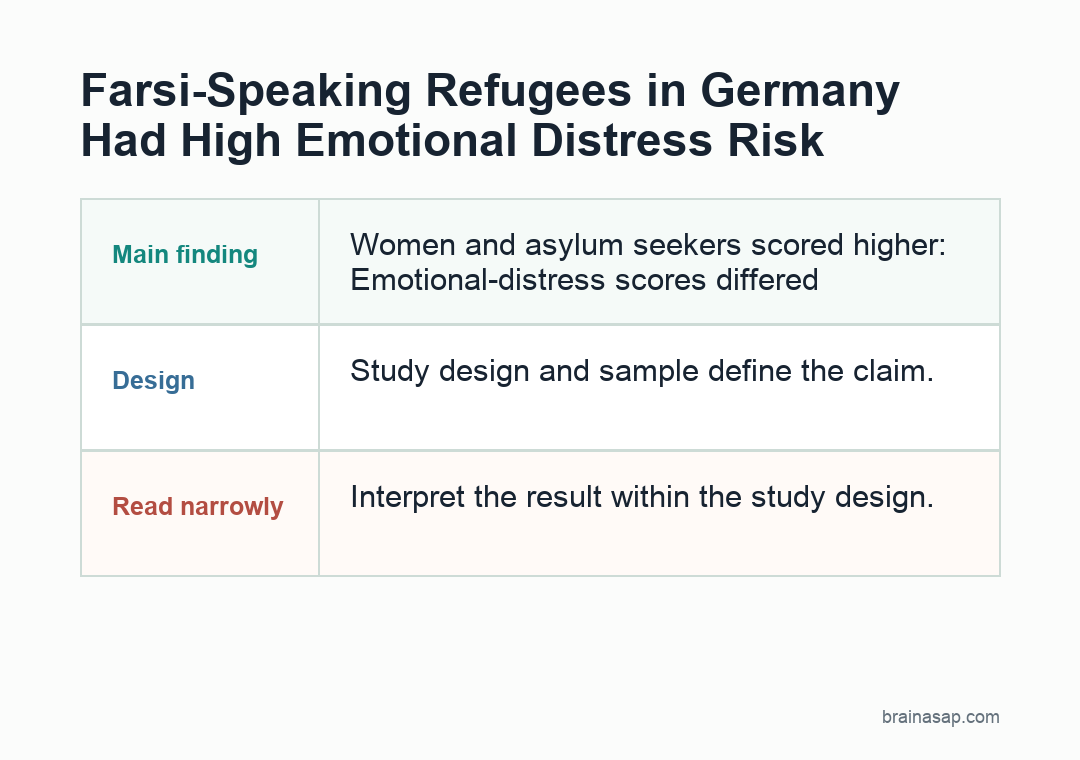
- Women and asylum seekers scored higher: Emotional-distress scores differed significantly by gender and by residency status, with asylum seekers showing more severe distress than refugees with residency.
- Posttraumatic growth was moderate: Participants had moderate average Posttraumatic Growth Inventory scores, meaning distress and growth-related coping could coexist in the same population.
- Protective factors explained 61% of growth variance: Resilience, psychological flexibility, meaning in life, and perceived social support together accounted for R2 = 0.61 in posttraumatic growth.
Source: Disaster Medicine and Public Health Preparedness (2026) | Firoozi et al.
Refugee Mental-Health Risk Was High in German Camps
Researchers studied 230 Farsi-speaking refugees and asylum seekers living in refugee camps in Berlin and Brandenburg. The group included people from Iran and Afghanistan who completed Farsi-language questionnaires between August and November 2022.
The main mental-health screen was the Refugee Health Screener-15 (RHS-15), a questionnaire used to flag likely depression, anxiety, and posttraumatic stress disorder symptoms in refugee populations.
The main screen showed a large risk group: 69.1% of participants crossed the RHS-15 cutoff. A separate distress thermometer item showed a similar pattern, with 68.7% scoring at least 5.
The study does not diagnose every participant with a disorder. Screening risk is not the same as a clinical diagnosis.
Still, the numbers identify a large unmet mental-health burden inside the camp sample.
Researchers Measured Distress and Posttraumatic Growth Together
The study did not treat refugee mental health as only a symptom-counting problem. Researchers also measured posttraumatic growth, meaning constructive psychological change after severe adversity.
Measuring both outcomes matters because trauma-related symptoms and growth-related coping can appear together. A person can have high emotional distress and still report changes in personal strength, relationships, meaning, or appreciation of life.
Participants completed several measures:
- RHS-15: a refugee mental-health screener for depression, anxiety, and PTSD symptom risk.
- Distress thermometer: a 0-to-10 item capturing recent psychological distress intensity.
- Posttraumatic Growth Inventory: a scale for perceived growth after traumatic experience.
- Protective-factor scales: measures of resilience, psychological flexibility, perceived social support, and meaning in life.
Average posttraumatic growth was moderate. The researchers also reported moderate resilience and meaning-in-life scores, high psychological flexibility, and low-to-moderate perceived social support.
Women and Asylum Seekers Reported More Distress
The sample was not uniform. Researchers compared distress scores by gender and residency status, and both comparisons were statistically significant.
Female participants had higher RHS-15 and distress thermometer scores than male participants. Asylum seekers also scored higher than refugees with residency status.
That residency-status pattern is important because postmigration conditions can continue the stress process after people reach a host country. Waiting for asylum decisions, living in shelters, and having limited control over daily life can keep emotional distress active.
The study’s descriptive table also showed substantial traumatic exposure before or during migration:
- Direct trauma exposure: 99 men and 64 women reported personal traumatic experiences.
- War-zone exposure: Combat situations or exposure to a war zone were common in both groups.
- Severe threat events: Participants also reported being close to death, forced to hide, tortured, imprisoned, or losing relatives or friends unnaturally.
- Basic-needs stressors: Some reported lack of shelter, food, water, or medical care during ill health.
These are not small background details. They help explain why a camp-based mental-health screen found such a high risk rate.
Protective Factors Predicted Posttraumatic Growth
Researchers then tested whether four protective factors predicted posttraumatic growth. The model included resilience, psychological flexibility, meaning in life, and perceived social support.
Together, those measures explained 61% of the variance in posttraumatic growth. Resilience, psychological flexibility, and meaning in life were the strongest predictors, while social support also predicted growth but contributed less.
The regression results were:
- Resilience: B = 0.47, standardized beta = 0.34, p < .001.
- Psychological flexibility: B = 0.28, standardized beta = 0.32, p < .001.
- Meaning in life: B = 0.01, standardized beta = 0.22, p < .001.
- Perceived social support: B = 0.11, standardized beta = 0.12, p < .05.
Distress should not be framed as beneficial, and refugees should not be expected to grow through hardship without support. A practical reading is that symptom reduction and growth-supporting care may need to happen together.
Camp Care Should Not Stop at Symptom Reduction
The study’s strongest clinical implication is that refugee-camp mental-health care needs two tracks. One track should identify and treat depression, anxiety, and PTSD symptoms.
The other track should support the psychological resources that may help people rebuild after trauma.
That means programs should not reduce posttraumatic growth to motivational language. In this study, growth was linked to measurable factors: resilience, psychological flexibility, meaning in life, and perceived support.
Practical care targets could include:
- Screening access: routine use of culturally and linguistically appropriate mental-health screening in refugee shelters.
- Trauma-informed care: support that recognizes both premigration trauma and postmigration stressors.
- Meaning-making support: counseling approaches that help people process loss, uncertainty, identity disruption, and future planning.
- Social-support repair: programs that help rebuild trusted connections, especially when family and community networks were disrupted by displacement.
The limitations are also clear. This was a cross-sectional study, so the results cannot prove that resilience or meaning caused posttraumatic growth.
Participants were recruited by convenience sampling from camps in two German states, which limits generalizability. The findings may not transfer cleanly to all refugee groups, other languages, or people living outside shelters.
Even with those limits, the study gives a camp-level risk estimate. A large share of Farsi-speaking refugees in this sample screened at high emotional-distress risk, and the same group also showed measurable variation in growth-related coping resources.
For clinicians and policymakers, the service target is concrete: refugee mental-health programs should screen for distress early and include support for resilience, psychological flexibility, meaning, and social connection.
Citation: DOI: 10.1017/dmp.2026.10363. Firoozi et al. Mental Health and Posttraumatic Growth of Farsi-Speaking Refugees in Germany: A Cross-Sectional Study. Disaster Medicine and Public Health Preparedness. 2026;20:e96.
Study Design: Cross-sectional questionnaire study of emotional distress, protective factors, and posttraumatic growth.
Sample Size: 230 Farsi-speaking refugees and asylum seekers living in refugee camps in Berlin and Brandenburg, Germany.
Key Statistic: 159 of 230 participants, or 69.1%, crossed the RHS-15 cutoff for depression, anxiety, and PTSD symptom risk.
Caveat: Convenience sampling and cross-sectional design mean the study cannot prove causality or represent all refugee populations.