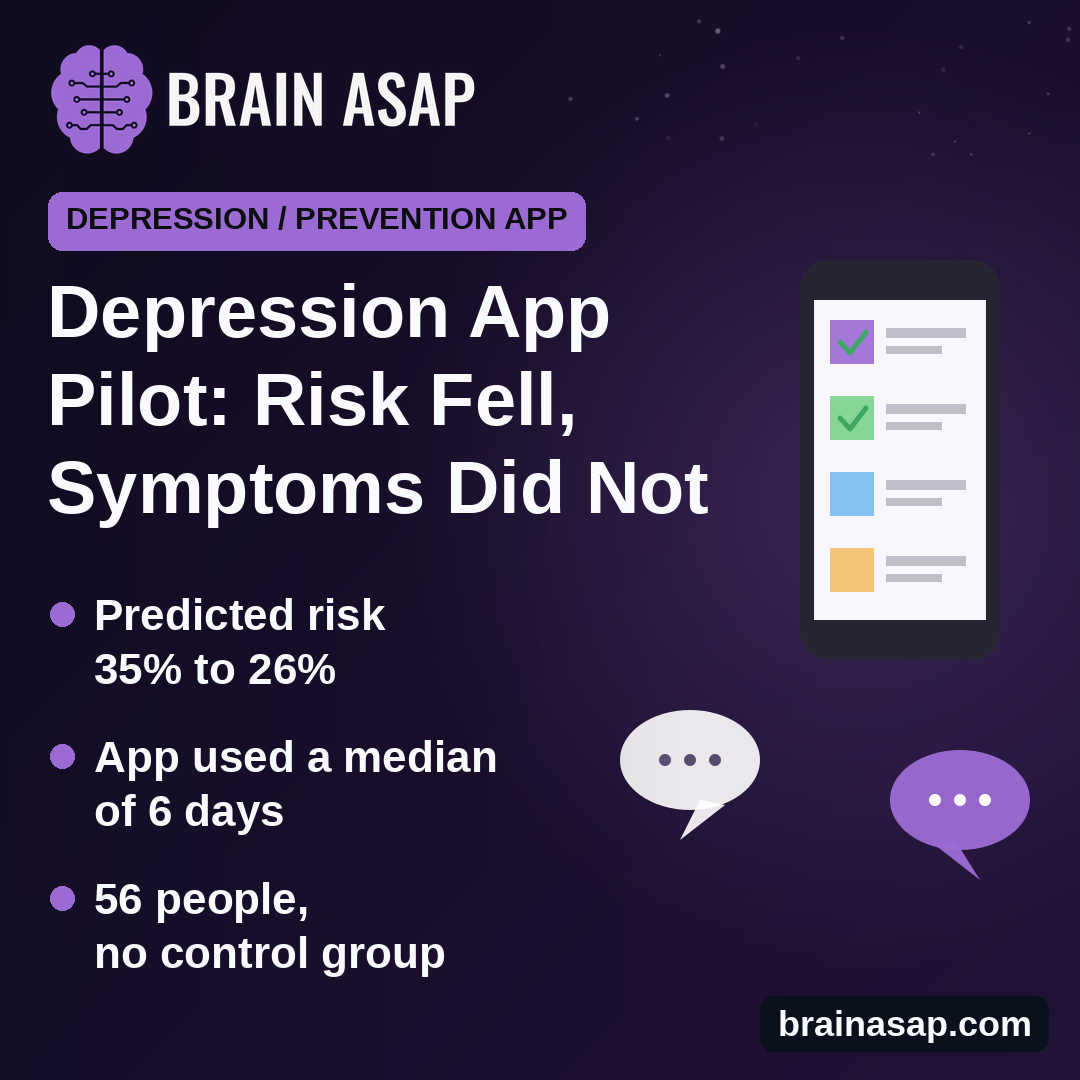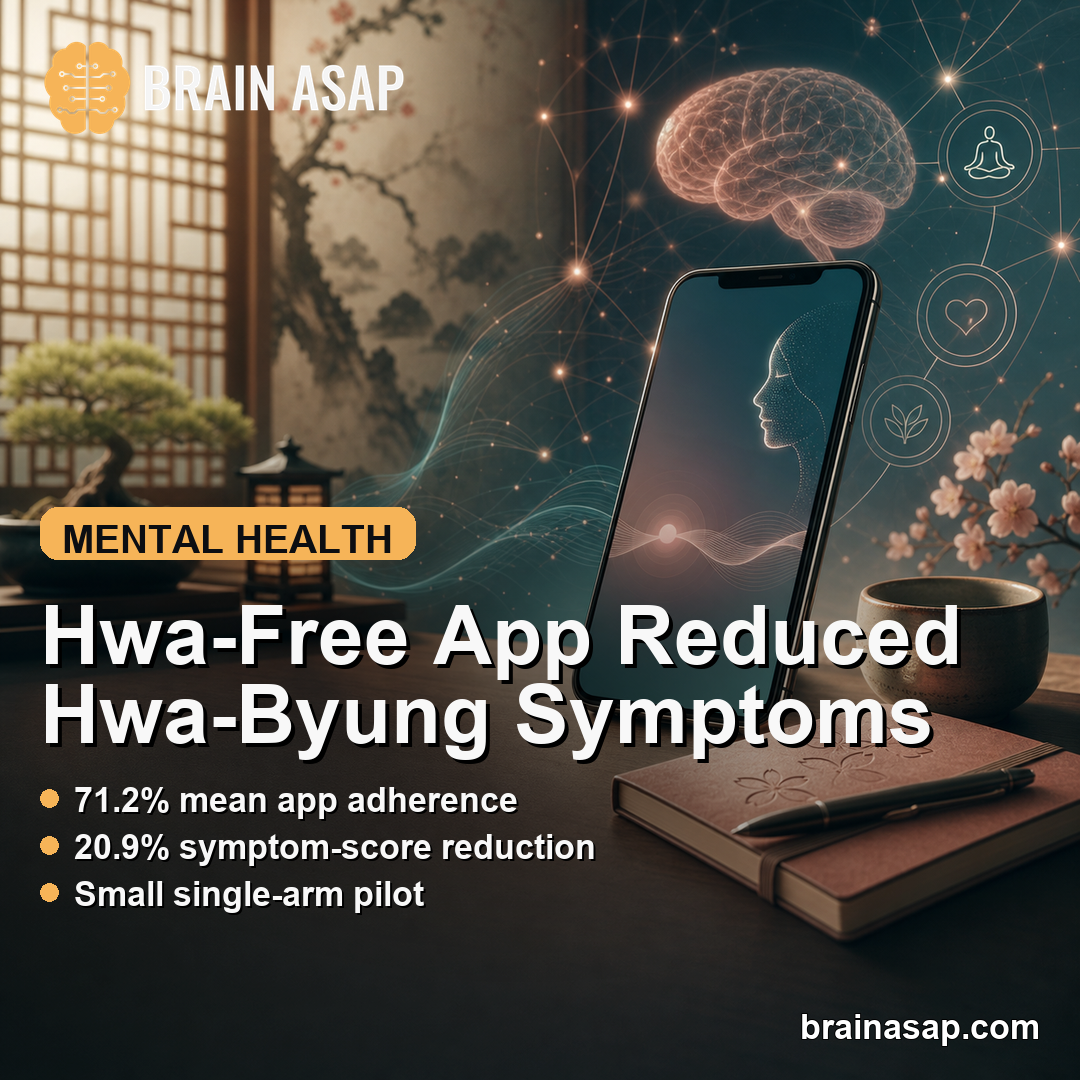
TL;DR: A 2026 medRxiv preprint reported that Hwa-free, a 4-week acceptance and commitment therapy app for Hwa-byung, was used on an average of 19.9 of 28 days and was followed by lower Hwa-byung symptoms, depression scores, and state anger in a small single-arm pilot trial.
Key Findings
- 28-person analysis: Researchers enrolled 30 adults with Hwa-byung, and 28 were included in the modified intention-to-treat analysis after two exclusions.
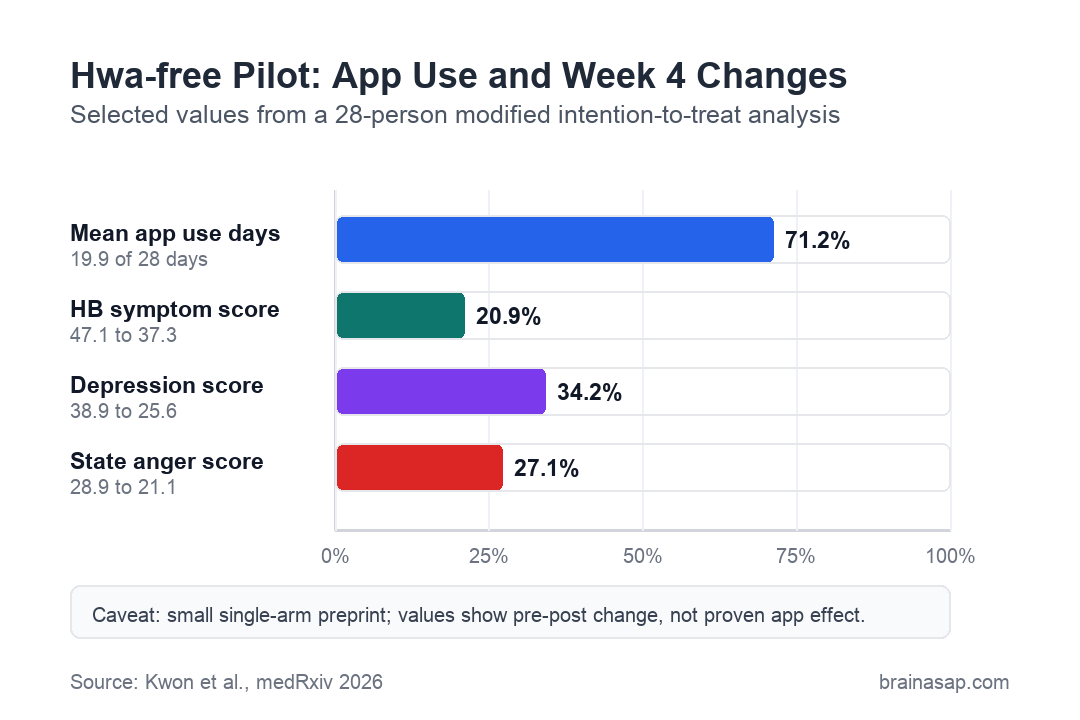
- 71.2% app adherence: Participants used Hwa-free on a mean of 19.9 out of 28 days during the 4-week intervention.
- 20.9% symptom reduction: Hwa-byung Symptom Scale scores fell from 47.1 to 37.3 by Week 4, with Cohen’s d of -0.92.
- 34.2% depression reduction: Beck Depression Inventory-II scores fell from 38.9 to 25.6, with Cohen’s d of -1.11.
- 55.6% still screen-positive: Hwa-byung screening positivity declined from 100% at baseline to 55.6% at Week 8, after the app-free follow-up period.
Source: medRxiv (2026) | Kwon et al.
Hwa-byung is a Korean cultural concept of distress linked to long-term suppressed anger, resentment, and body symptoms such as chest tightness, heat sensations, palpitations, and a lump-like feeling in the throat or upper abdomen.
The pilot trial tested whether a phone-based program could be acceptable enough for people to use and whether symptom changes were large enough to justify a later randomized trial.
Because the study had no control group, the results should be read as feasibility and early evidence, not proof that the app caused the improvements.
Hwa-Free Combined ACT Skills With Daily Self-Monitoring
The app, called Hwa-free, was built around acceptance and commitment therapy (ACT), a psychotherapy approach that trains people to notice difficult internal experiences while acting in line with chosen values.
That design matched the syndrome the researchers were studying. Hwa-byung is often described around anger suppression and emotional avoidance, so the app emphasized awareness, breathing, relaxation, meditation, and tracking rather than only trying to suppress anger harder.
- Psychoeducation: Video modules explained Hwa-byung and ACT-based coping concepts.
- Body regulation: Diaphragmatic breathing, relaxation, and meditation were included as structured practices.
- Daily monitoring: The app included self-assessment and a three-line diary so participants could track symptoms and emotional patterns.
The trial enrolled adults aged 19 to 80 years who met diagnostic criteria for Hwa-byung. Researchers assessed them at baseline, Week 2, Week 4, and Week 8, with Week 8 serving as a follow-up after access to the app had ended.
App Use Was Strong Enough for a Feasibility Signal
The first question was not whether Hwa-free should become a treatment. It was whether people with Hwa-byung would actually use it for a month and rate the experience as acceptable.
On that point, the pilot was mostly positive. Participants used the app on an average of 19.9 days out of 28, equal to 71.2% minimum use-day adherence.
Complete diaphragmatic breathing sessions were performed on an average of 14.4 days.
- Video content: Week 4 video content had an 89.7% positive response rate.
- Self-assessment: The Hwa-byung self-assessment feature had an 86.2% positive response rate.
- Meditation: Meditation therapy effectiveness was rated positively by 86.2% of respondents.
- In-app guidance: Guidance clarity had an 85.7% positive response rate.
The breathing feature was less polished. Only 41.4% rated breath-count accuracy positively, and 48.3% rated phone-on-abdomen breathing placement as easy to use.
A digital therapeutic can fail on ergonomics even when the underlying therapy model is reasonable.
Hwa-Byung Symptoms and Depression Scores Were Lower at Week 4
The clinical changes were broad. Of 18 clinical scales analyzed, 11 reached statistical significance after false discovery rate correction at Week 4.
The main Hwa-byung symptom measure fell from 47.1 to 37.3, a 20.9% reduction. Depression symptoms on the Beck Depression Inventory-II fell from 38.9 to 25.6, a 34.2% reduction.
State anger also moved in the expected direction. Scores on the State-Trait Anger Expression Inventory state anger subscale fell from 28.9 to 21.1, a 27.1% reduction.
- Hwa-byung symptoms: HBSS changed by -9.8 points, with Cohen’s d of -0.92.
- Depression symptoms: BDI-II changed by -13.3 points, with Cohen’s d of -1.11.
- State anger: STAXI-S changed by -7.8 points, with Cohen’s d of -0.96.
Not every outcome changed. State anxiety at Week 4 and anger control did not reach statistical significance, and heart-rate-variability measures did not show significant change after correction.
Week 8 Follow-Up Suggested Symptoms Did Not Immediately Rebound
The follow-up result is useful because app access was restricted after Week 4. Hwa-byung screening positivity declined from 100% at baseline to 82.1% at Week 4 and 55.6% at Week 8.
The exploratory responder rate also increased over time. A response was defined as at least a 30% reduction in Hwa-byung Symptom Scale score; the rate was 28.6% at Week 4 and 59.3% at Week 8.
Psychological flexibility may be part of the mechanism, but that analysis was exploratory. Improvement on the Acceptance and Action Questionnaire-II correlated with symptom improvement, and a mediation model was consistent with psychological flexibility carrying part of the change.
The Main Limitation Is the Missing Control Group
The cleanest reading is that Hwa-free was feasible and associated with symptom improvement in this specific pilot sample. The study cannot separate app effects from expectancy, regression to the mean, repeated assessment, clinician contact, or natural symptom change.
- Single-arm design: Everyone received the app, so there was no sham app, waitlist, or active comparison group.
- Small sample: The main analysis included 28 people, and the per-protocol analysis included 19.
- Preprint status: The report had not been peer reviewed, and the authors explicitly said it should not guide clinical practice.
- UX thresholds: The trial did not predefine clear success cutoffs for adherence and user experience.
Those limits define the next test: a randomized controlled trial with prespecified feasibility thresholds, a comparator condition, and enough participants to estimate whether Hwa-free improves symptoms beyond nonspecific study effects.
Citation: DOI: 10.64898/2026.04.19.26351203. Kwon et al. Digital Therapeutic for Hwa-byung Based on Acceptance and Commitment Therapy: A Pilot Feasibility Trial. medRxiv. 2026.
Study Design: Single-arm, single-center pilot feasibility trial of a 4-week app-based intervention with Week 8 follow-up.
Sample Size: 30 enrolled adults with Hwa-byung; 28 included in the modified intention-to-treat analysis.
Key Statistic: Mean app use was 19.9 of 28 days, and Hwa-byung Symptom Scale scores fell by 9.8 points by Week 4.
Caveat: No control group and no peer review yet, so the findings support a randomized trial rather than clinical use.