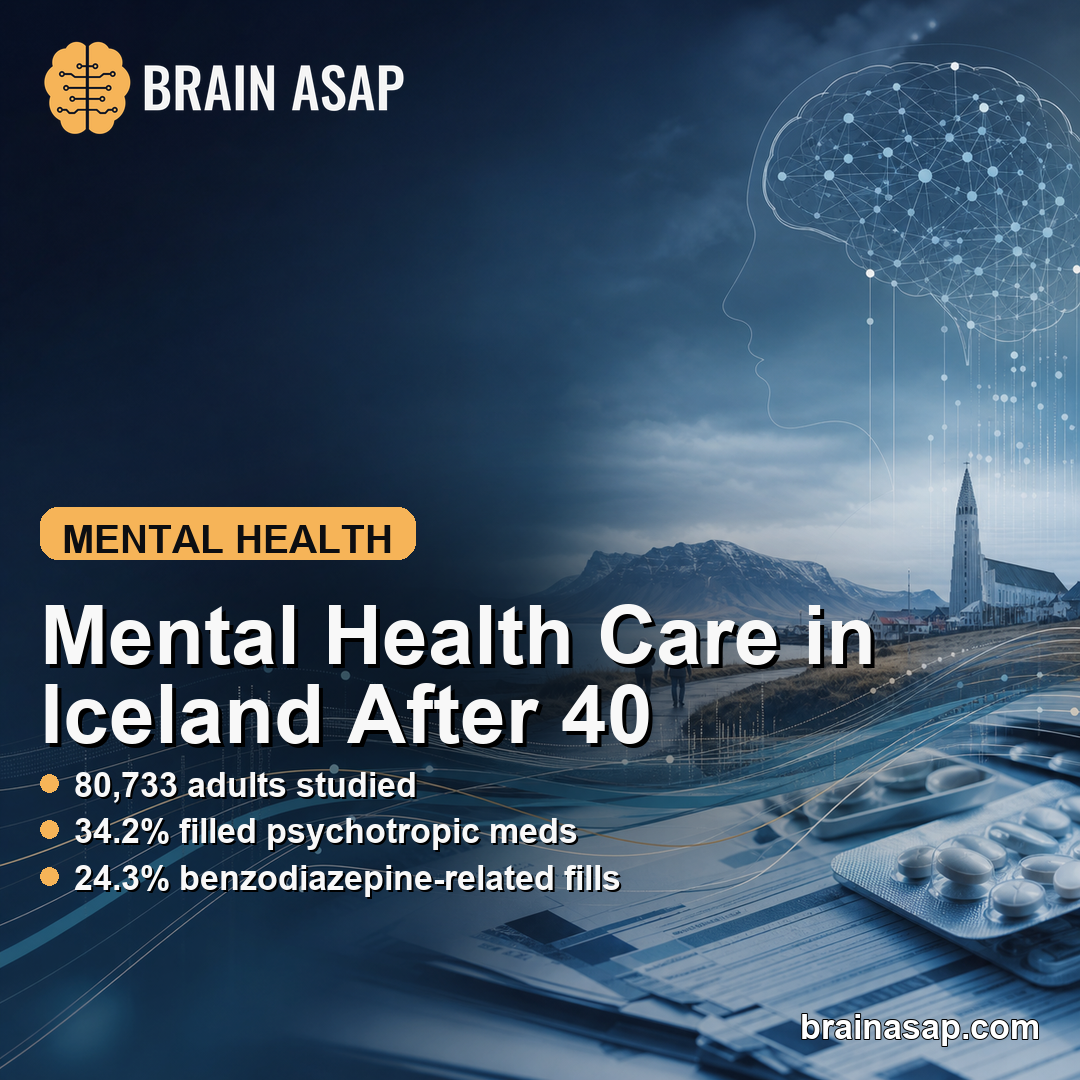
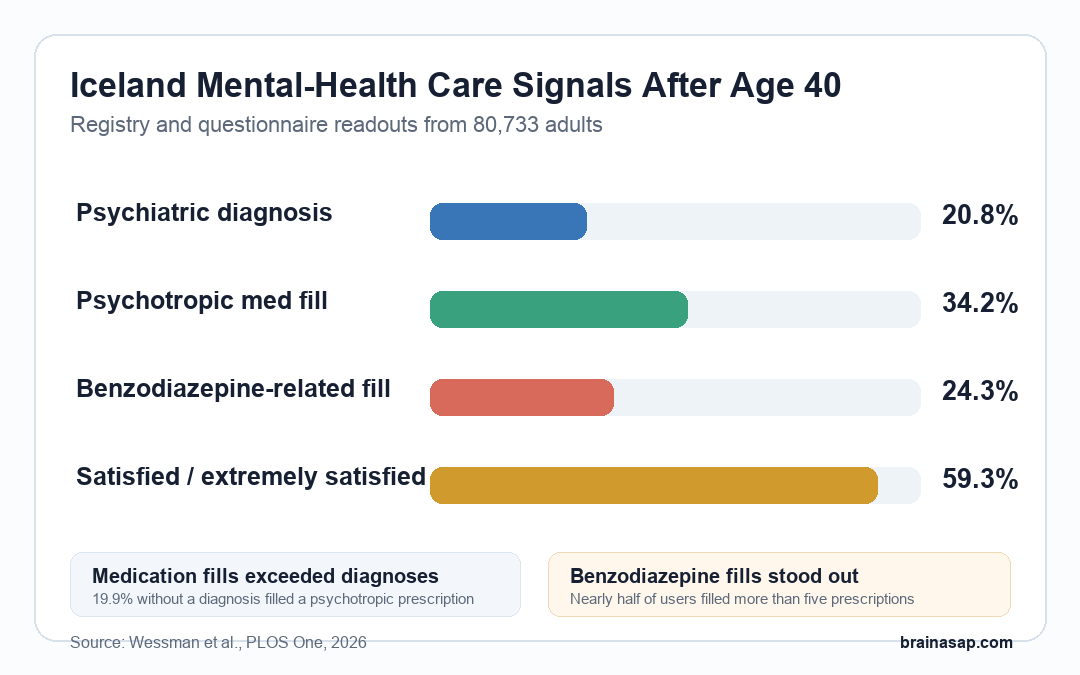
TL;DR: A 2026 nationwide study in PLOS One found that adults age 40 and older in Iceland often had psychiatric diagnoses and psychotropic medication fills, with 20.8% receiving a diagnosis in the prior year and 34.2% filling at least one psychotropic prescription.
Key Findings
- Nationwide cohort: Researchers analyzed registry data from 80,733 Icelanders age 40 and older, plus self-reported anxiety, depression, and life-satisfaction measures from roughly 36,000 to 37,000 respondents.
- Recent psychiatric diagnoses were common: 20.8% had at least one psychiatric diagnosis in the prior year, and 44.9% had one in the prior 20 years.
- Medication fills were more common than diagnoses: 34.2% filled at least one psychotropic prescription in the prior year, including 19.9% of people without a recorded psychiatric diagnosis.
- Benzodiazepine-related fills stood out: 24.3% filled at least one benzodiazepine-related or benzodiazepine-derivative prescription in the prior year.
- Symptoms and life satisfaction diverged: Most questionnaire respondents reported no/mild anxiety or depression, and 59.3% reported being satisfied or extremely satisfied with life.
Source: Wessman et al. PLOS One. 2026.
Psychiatric burden can look different depending on what is measured. A registry diagnosis, a filled prescription, a symptom questionnaire, and a life-satisfaction scale each capture a different part of mental health care.
The Wessman study used all four. Researchers combined Icelandic healthcare registries with self-report measures from a large nationwide cohort of adults age 40 and older.
That design makes the paper useful for health-system planning. It does not only ask how many people report symptoms in a survey; it asks how many people are diagnosed, medicated, symptomatic, and still satisfied with life.
Recent Psychiatric Diagnoses Were Common in Iceland
The study included 80,733 participants, with a mean age of 60.0 years. Registry diagnosis and prescription data were available for the whole registered sample.
In the year before study entry, 16,764 people received at least one psychiatric diagnosis. That equals 20.8% of the cohort.
Over the prior 20 years, the proportion was higher: 36,227 people, or 44.9%, had at least one recorded psychiatric diagnosis.
- Most common diagnosis: Nonorganic sleep disorders, a category that includes insomnia, hypersomnia, and sleep terrors, affected 11.4% in the prior year.
- Anxiety diagnoses: Other anxiety disorders accounted for 4.9%, while the broader anxiety-disorder grouping reached 6.5%.
- Depressive disorders: Depressive episode was recorded in 4.1%, and depressive episode or depressive disorder was recorded in 5.0%.
- Age gradient: The diagnosis rate was 16.7% at ages 40-44 and 32.3% at age 80 and older.
Female participants had more recorded diagnoses than male participants. In the prior year, 24.9% of females and 15.9% of males had at least one psychiatric diagnosis.
Psychotropic Medication Fills Exceeded Diagnosis Rates
The prescription data showed an even larger treated population. In the year before registration, 27,642 people, or 34.2%, filled at least one psychotropic medication prescription.
That medication category included antipsychotics, anxiolytics, hypnotics and sedatives, antidepressants, psychostimulants/nootropics, and one antihistamine category used in this analysis.
Prescription fills were also more common among women and older adults. In the prior year, 41.2% of females and 26.1% of males filled at least one psychotropic prescription.
- Hypnotics and sedatives: 19.3% of the full cohort filled a prescription in this class.
- Antidepressants: 17.5% filled at least one antidepressant prescription.
- Anxiolytics: 11.4% filled at least one anxiolytic prescription.
- Antipsychotics: 3.9% filled at least one antipsychotic prescription.
The most important mismatch was not only that prescriptions were common. It was that 19.9% of people without a formal psychiatric diagnosis still filled a psychotropic prescription in the prior year.
Benzodiazepine-Related Prescriptions Were a Central Concern
The authors highlighted benzodiazepine-related prescribing because clinical guidelines generally discourage these medications as first-line treatment for psychiatric disorders, especially for long-term use.
In the prior year, 24.3% of the cohort filled at least one prescription for benzodiazepine-related drugs or benzodiazepine derivatives. After excluding people diagnosed with nonorganic sleep disorders, the rate was still 16.3%.
The prescribing pattern also suggested recurrent use for many people. Among individuals filling benzodiazepine-related prescriptions, nearly half filled more than five prescriptions during the one-year period.
- Common drug class: Benzodiazepine-related drugs accounted for 115,348 prescriptions across 15,262 people.
- Repeated fills: 49.0% of people in this medication grouping filled more than five prescriptions during the year.
- Nonpsychiatric prescribing: Psychiatrists accounted for only 5.76% of all benzodiazepine-related prescriptions.
- Older-age rise: Benzodiazepine prescription filling increased across age groups, ranging from 12.4% to 48.3%.
The study cannot prove that every prescription was inappropriate. It does show why prescription monitoring and access to non-drug treatments matter for psychiatric care.
Questionnaires Showed Lower Symptom Rates Than Registries
The self-report measures added a different view of the same population. The Generalized Anxiety Disorder Scale (GAD-7), a seven-item anxiety-symptom questionnaire, was completed by 36,674 participants.
Most GAD-7 respondents reported no or mild anxiety symptoms. Still, 9.5% met the clinical cut-point for an anxiety disorder.
The Patient Health Questionnaire (PHQ-9), a nine-item depression-symptom questionnaire, was completed by 36,838 participants. Most reported minimal or mild depressive symptoms, while 7.1% met the clinical cut-point for major depressive disorder.
People with a psychiatric diagnosis or a psychotropic medication fill had higher symptom scores and lower life satisfaction than people without those markers. The average PHQ-9 score, for example, was 6.9 among people with a recent psychiatric diagnosis and 4.0 among people without one.
Life Satisfaction Stayed High for Many Participants
The Satisfaction with Life Scale (SWLS), a brief life-satisfaction questionnaire, was completed by 37,215 participants. Most respondents were at least slightly satisfied with life.
The clearest number was at the high end: 59.3% reported being satisfied or extremely satisfied with life.
This does not cancel the diagnosis or medication findings. It means the paper separates clinical burden from subjective well-being.
- Diagnosis marker: People with a recent psychiatric diagnosis had lower average life-satisfaction scores than people without one.
- Medication marker: People who filled psychotropic prescriptions also had lower average life-satisfaction scores.
- Symptom severity: Higher anxiety and depressive symptoms were associated with lower life satisfaction.
- Depression signal: Depressive symptoms had the strongest relationship with lower life satisfaction in the model.
For health systems, that distinction is important. A person can be coping well in daily life while still needing evidence-based assessment, safer prescribing, or better access to therapy.
The Main Boundary Is Healthcare Contact
This was a cross-sectional registry and questionnaire study. Registry diagnoses count people who touched healthcare systems and received diagnostic codes; they do not measure every undiagnosed person in the community.
Self-report data also had nonresponse. About 40% of invited questionnaire respondents did not complete the symptom and life-satisfaction measures, and nonresponders differed from responders in age, sex, education, retirement, and salary.
The paper still gives a strong population-level signal. In a nationwide cohort of older and middle-aged adults, psychiatric diagnoses and psychotropic medication fills were common, benzodiazepine-related fills were especially high, and symptom questionnaires told a more nuanced story than prescriptions alone.
Citation: DOI: 10.1371/journal.pone.0342075. Wessman et al. Psychiatric health of Icelandic adults 40 years or older: A nationwide study of diagnoses, medications, and symptoms. PLOS One. 2026;21(4):e0342075.
Study Design: Nationwide cross-sectional cohort study combining Icelandic healthcare registries with self-reported anxiety, depression, and life-satisfaction questionnaires.
Sample Size: 80,733 adults age 40 and older had registry diagnosis and prescription data; 36,674 to 37,215 completed the self-report measures.
Key Statistic: 20.8% had a psychiatric diagnosis in the prior year, while 34.2% filled at least one psychotropic medication prescription.
Caveat: Registry data reflect diagnosed help-seeking care, and questionnaire nonresponse may affect the self-reported symptom estimates.