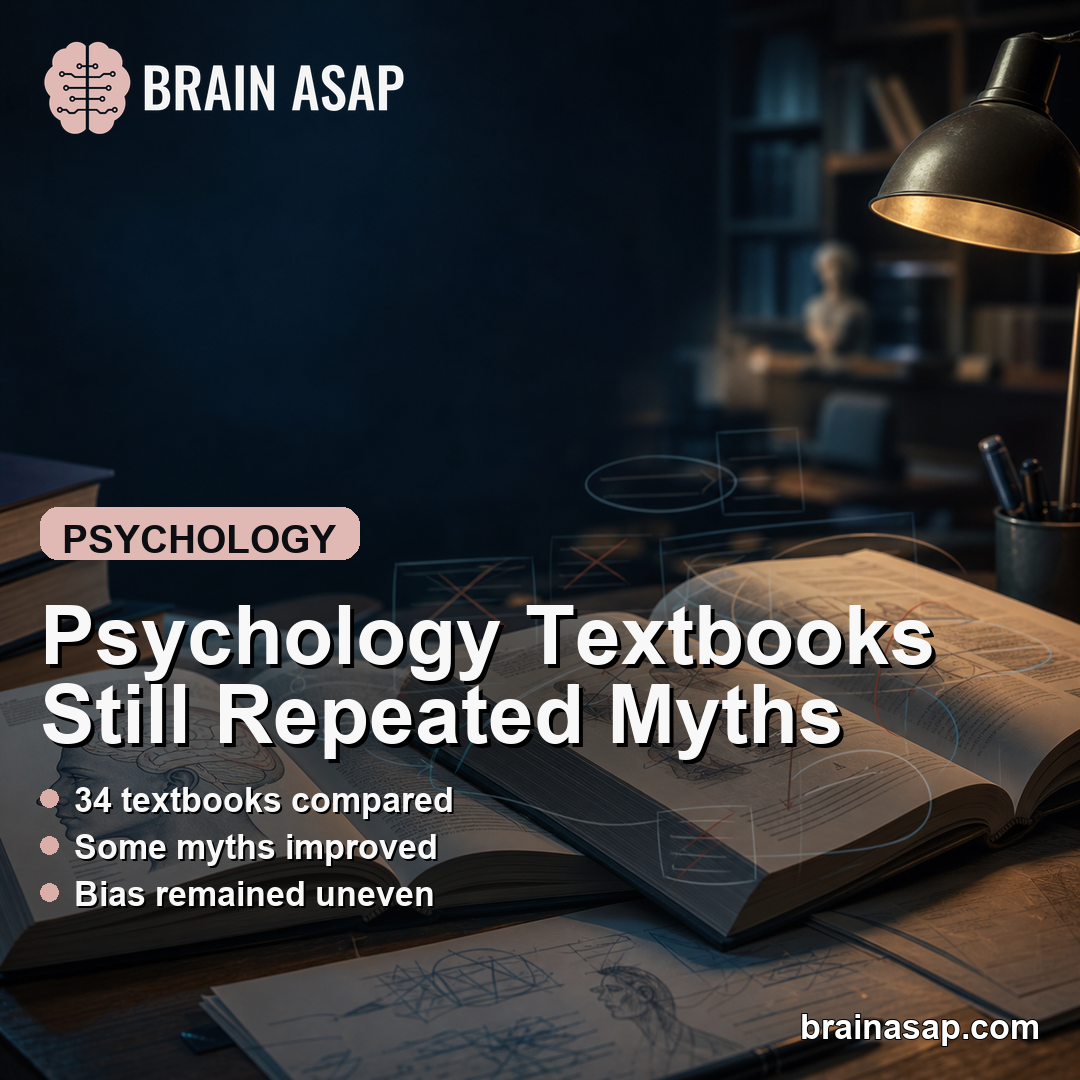
TL;DR: A 2025 study in The Journal of General Psychology found that introductory psychology textbooks showed modest improvement from 2018 to 2023, but several classic myths and contested topics were still presented in biased or oversimplified ways.
Key Findings
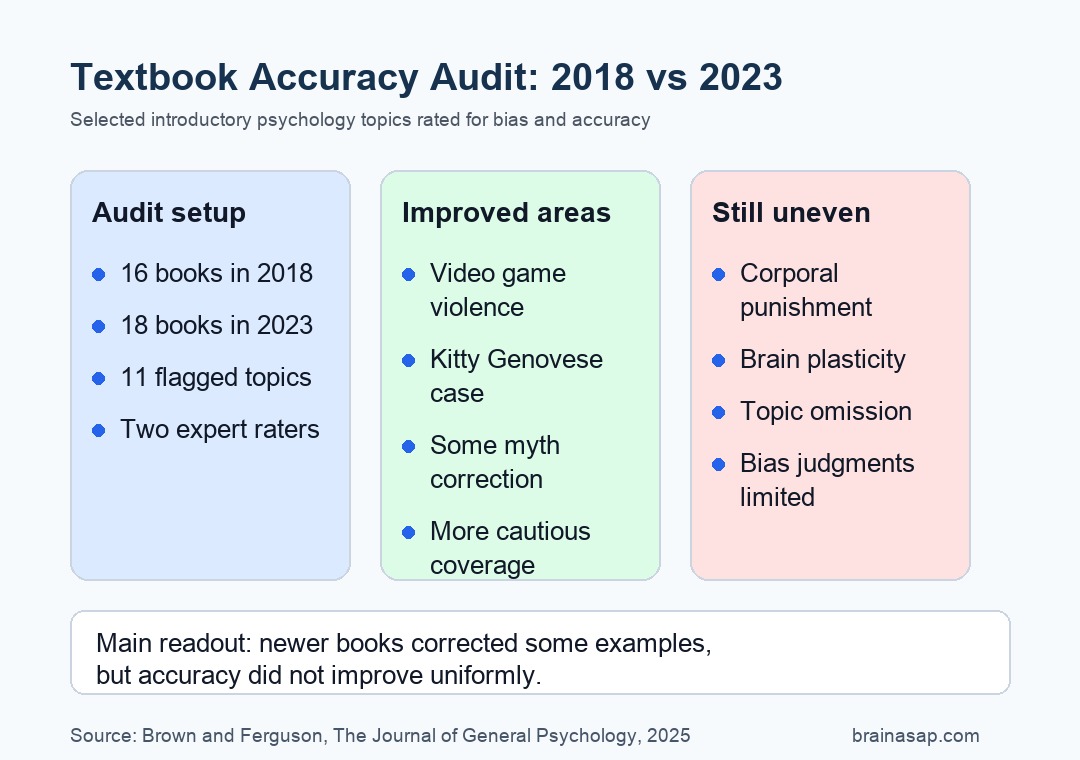
- Researchers rated coverage of 11 textbook topics that psychology professors had flagged as commonly distorted or incomplete.
- The 2023 textbook sample showed improvement for video game violence and the Kitty Genovese case, but not across all topics.
- Some newer textbooks handled problematic material by omitting topics instead of correcting myths or explaining scientific disagreement.
- Bias scores worsened for several areas, including corporal punishment and brain plasticity.
- The main limitation is that the ratings came from two expert raters, so the findings should be read as a focused audit rather than a complete map of textbook accuracy.
Source: Brown and Ferguson, The Journal of General Psychology, 2025.
Introductory psychology textbooks often shape the first version of psychological science that college students encounter. A textbook can make a messy evidence base look settled.
It can also turn a flawed historical account into a classroom fact, or leave out the controversy that would help students understand how the field changes over time.
Brown and Ferguson tested whether newer textbooks had moved in a cleaner direction. Their study compared 16 introductory psychology textbooks from 2018 with 18 textbooks from 2023.
Researchers used the same topic list and rating approach across both textbook samples.
Professors First Identified Commonly Misrepresented Psychology Topics
The researchers did not start by choosing only their own pet examples. First, they ran a pilot survey of psychology professors at four-year colleges in the United States.
The prompt asked professors to name topics they thought introductory textbooks handled poorly.
That survey produced a list of 11 topics for the textbook audit. The list mixed famous historical examples with current scientific debates:
- Historical cases: the Stanford Prison Experiment, the Kitty Genovese murder, Little Albert, and Phineas Gage.
- Contested research topics: video game violence, corporal punishment, stereotype threat, evolutionary psychology, and brain plasticity.
- Biological topics: areas where accuracy could improve either through better coverage or through avoiding unsupported claims.
Textbook bias is not only a political or cultural problem. A simplified account can also hide weak methods, contested interpretations, or later evidence that changed how psychologists understand a famous result.
Textbooks Were Rated for Omission, Bias, and Accuracy
Two independent raters examined how each textbook covered the 11 target topics. Each topic received a four-point rating: a low score meant the topic was absent or handled poorly, while a high score meant the coverage was balanced and accurate.
For historical cases, bias meant the textbook presented a questionable or false version as if it were settled fact. The Kitty Genovese case is a clear example.
Many textbook accounts use it to introduce the bystander effect, but the familiar claim that 38 witnesses watched and did nothing is historically overstated.
For controversial research areas, bias meant the textbook framed a debated question as if one side had already won. The researchers were especially interested in whether books acknowledged uncertainty when the evidence was mixed.
The scoring logic separated three problems that can look similar to students:
- False certainty: a textbook presents an unsettled claim as established science.
- Historical myth: a textbook repeats a famous classroom story after later scholarship has complicated it.
- Omission: a textbook avoids the topic entirely, which may reduce misinformation but also removes a chance to teach scientific correction.
Some Textbook Coverage Improved, but the Pattern Was Uneven
The 2023 textbooks were not simply worse or better than the 2018 textbooks. Brown and Ferguson reported a mixed pattern.
Coverage improved for some areas, including video game violence and the Kitty Genovese case, suggesting that publishers had corrected at least some older problems.
Other areas moved in the wrong direction. The study reported more biased coverage for corporal punishment and brain plasticity in the newer sample.
For brain plasticity, broad textbook language can overstate how general the lesson is. The actual science depends on age, context, measurement, and intervention.
The clearest newer pattern was omission. Some textbooks appeared to avoid contested or historically messy material instead of explaining it more carefully.
That can reduce exposure to bad claims, but it also makes the textbook less useful as a guide to how psychology self-corrects.
The study does not show that introductory psychology textbooks are useless. It shows a narrower problem: a student reading a textbook may still encounter simplified accounts of famous studies and incomplete descriptions of live scientific debates.
Classic Psychology Stories Need More Historical Context
Several target topics are familiar because they are easy to teach. Phineas Gage is often used to introduce brain-behavior relationships.
Little Albert is used to illustrate conditioned fear. The Stanford Prison Experiment is used to discuss social roles and situational pressure.
Those examples can still be useful, but the study argues that textbooks should not strip away the problems that later scholars identified. A better introductory account would tell students what the case originally seemed to show and what later evidence changed.
For a textbook writer, the practical standard is straightforward:
- Name the controversy: tell students when a famous result has been challenged.
- Separate story from evidence: distinguish a memorable classroom narrative from the strongest supported finding.
- Show correction: use disputed cases to explain how psychological science revises itself.
That approach would not make introductory books more confusing. It would make them more honest about the difference between a teaching example and a settled fact.
The Study Is a Focused Audit, Not a Final Textbook Verdict
The main caveat is the rating process. Bias judgments can be subjective, even when raters use a common scale.
This study relied on two psychology professors rating selected textbook sections, not a large committee of reviewers or a fieldwide audit.
The topic list is also selective. It captures areas professors flagged as commonly mishandled, not every topic in introductory psychology.
A textbook could perform well in cognition, neuroscience, development, or methods while still doing poorly on the 11 audited items.
Still, the study points to a concrete editorial problem. Introductory textbooks do not only summarize psychology for beginners.
They decide which uncertainties are visible, which historical myths survive, and whether students learn science as a fixed list of facts or a process that can revise itself.
Citation: DOI: 10.1080/00221309.2025.2587151. Brown and Ferguson. Have Introductory Psychology Textbooks Gotten Better at Representing Psychological Science? The Journal of General Psychology. 2025.
Study Design: Comparative textbook content audit of introductory psychology textbooks from 2018 and 2023.
Sample Size: 16 textbooks from 2018 and 18 textbooks from 2023, rated across 11 selected topics.
Key Statistic: Coverage improved for some topics, including video game violence and the Kitty Genovese case, while bias worsened for topics such as corporal punishment and brain plasticity.
Caveat: Bias ratings came from two expert raters and focused on selected topics, so the results do not measure every strength or weakness of each textbook.