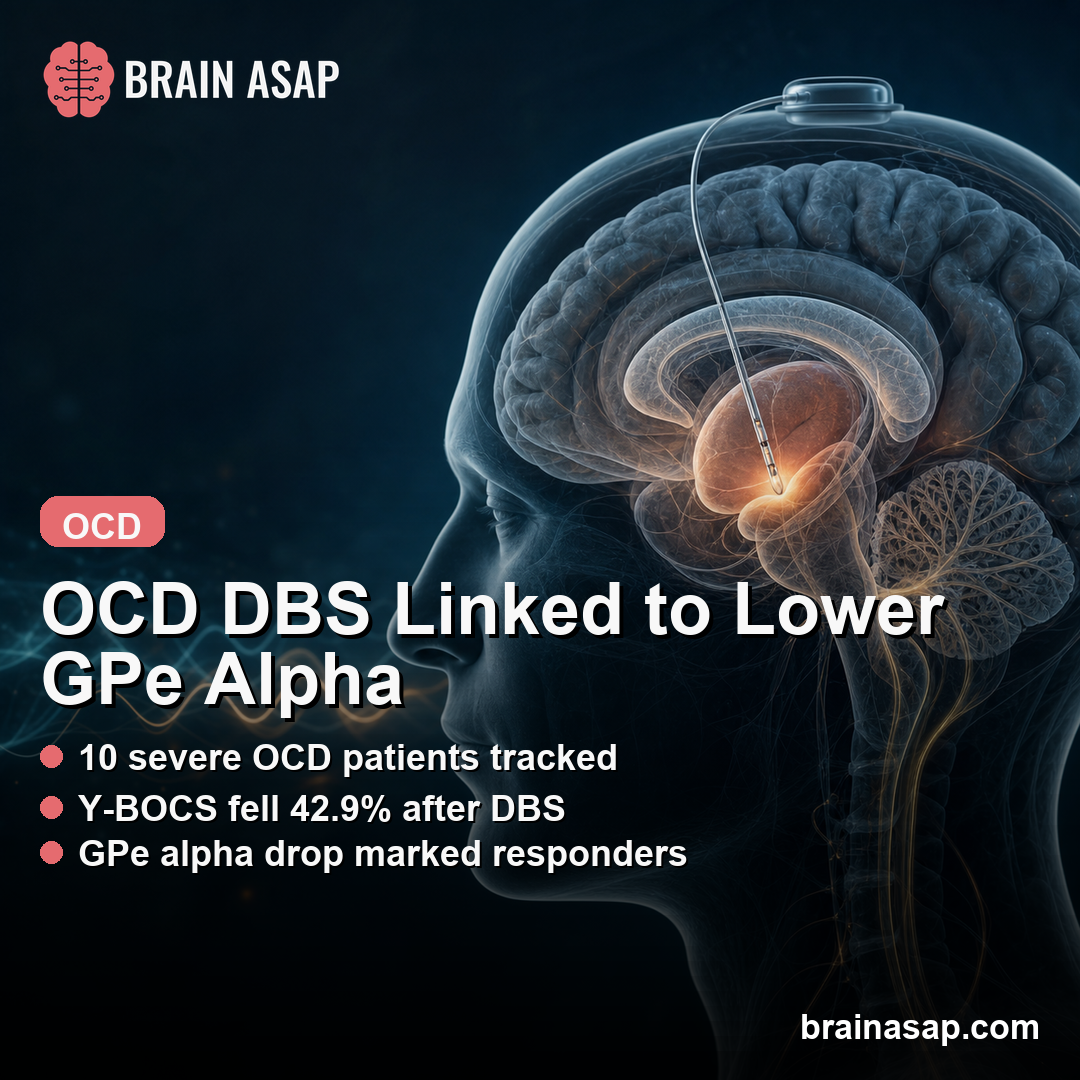
TL;DR: A 2026 preprint in medRxiv found that deep brain stimulation for severe obsessive-compulsive disorder was followed by lower globus pallidus externus alpha-band activity in clinically responsive patients, suggesting a possible brain readout of sustained DBS response.
Key Findings
- 10 severe OCD patients: Researchers recorded local field potentials from the anterior globus pallidus externus (GPe) before stimulation started and again after 6 months of active anterior limb of the internal capsule DBS.
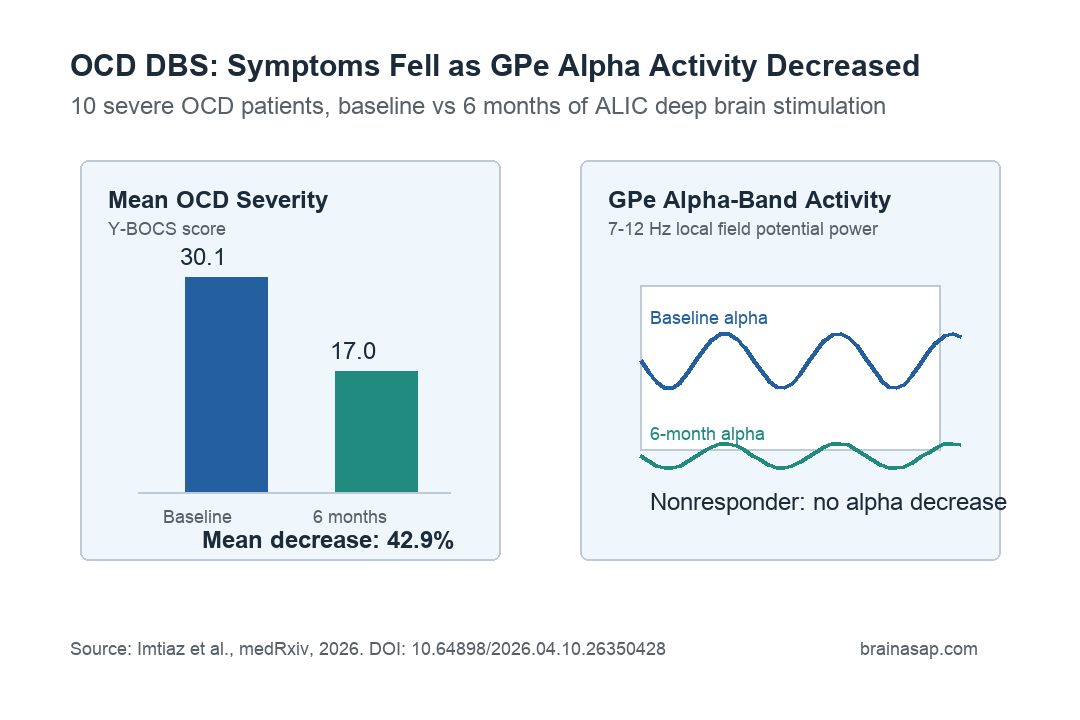
- 42.9% mean Y-BOCS decrease: Yale-Brown Obsessive Compulsive Scale scores fell from 30.1 to 17.0 on average, while depression and anxiety scores did not show the same clear change.
- Alpha power decreased: The only frequency band that survived correction across pooled hemispheres was alpha activity, measured at 7-12 Hz in the GPe local field potential recordings.
- One nonresponder stood out: The only patient without symptom improvement was also the only patient whose GPe alpha power never decreased in either hemisphere across the 6-month follow-up.
- Biomarker status remains early: The authors framed GPe alpha decrease as a candidate response marker, not a ready DBS-programming rule, because the cohort was small and the work was a preprint.
Source: medRxiv (2026) | Imtiaz et al.
Deep brain stimulation (DBS) is already used for some people with severe treatment-resistant obsessive-compulsive disorder (OCD), but clinicians still need better ways to tell whether stimulation is engaging the right circuit.
This preprint focused on a narrow electrophysiology question: after anterior limb of the internal capsule DBS, did a measurable brain rhythm change in the globus pallidus externus (GPe), a basal ganglia node tied to indirect-pathway control?
ALIC DBS Targeted White-Matter Fibers While Recording From GPe
The study included 10 patients with severe OCD who received DBS leads placed with a tractography-guided strategy. Dorsal contacts stimulated white-matter fibers in the anterior limb of the internal capsule (ALIC), while ventral contacts sat in the anterior GPe and recorded local field potentials.
That lead placement mattered because it gave researchers two functions in the same implanted system:
- Therapeutic stimulation: Dorsal contacts delivered stimulation to ALIC white-matter pathways connected with frontal and midbrain circuitry implicated in prior OCD DBS response.
- Physiology readout: Ventral contacts recorded resting local field potential activity from the anterior GPe, a grey-matter node in the non-motor indirect pathway.
- Longitudinal comparison: Patients completed baseline recordings before DBS activation and repeat recordings after 6 months of active treatment.
Researchers measured resting-state activity with patients sitting quietly, eyes open, for 5 minutes. The recordings were then analyzed across theta, alpha, beta, and low-gamma frequency bands.
OCD Symptoms Improved While Depression and Anxiety Did Not Clearly Shift
The clinical result was strongest for OCD symptoms. Mean Y-BOCS score fell from 30.1 at baseline to 17.0 after 6 months, a mean decrease of 42.9%.
Y-BOCS stands for Yale-Brown Obsessive Compulsive Scale, a clinician-rated measure of OCD symptom severity. In this cohort, the change was large enough to make the electrophysiology result worth interpreting, but the sample was still small.
Depression and anxiety scores did not show the same clear treatment-linked shift. Beck Depression Inventory scores moved from 31.5 to 22.7 on average, but the reported comparison did not meet conventional significance.
Beck Anxiety Inventory scores moved from 15.5 to 17.7, so the main clinical change was not a broad drop across every symptom scale.
The scale pattern supports a specific interpretation: the DBS course was mainly tracking OCD symptom response rather than a broad improvement across every psychiatric symptom rating.
GPe Alpha Activity Decreased After 6 Months of DBS
Alpha-band power, defined here as activity in the 7-12 Hz range, decreased after DBS in the pooled left-plus-right hemisphere analysis. Other canonical bands did not show the same corrected result, making alpha the candidate readout in this dataset rather than a general drop across every measured frequency range.
- Pooled hemispheres: Alpha activity decreased from baseline to 6 months, with a paired t-test result reported as t(19) = 3.4 and p = 2.8 x 10^-3.
- Left hemisphere: The separate left GPe comparison was significant, with p = 0.01.
- Right hemisphere: The separate right GPe comparison showed a decrease but did not reach significance, with p = 0.1.
The researchers also used intermediate visits when data were available. Across those timepoints, alpha power changed over time, and alpha change tracked the time course of Y-BOCS change in the mixed-effects model.
The Nonresponder Had the Opposite Alpha Pattern
The clearest single-patient clue came from the one person who did not improve clinically. That patient had no 6-month Y-BOCS decrease and also showed an increase in bilateral GPe alpha rather than a decrease.
Across intermediate visits, the same patient was the only one whose alpha power never decreased in either hemisphere. Removing that nonresponder made the baseline-to-6-month alpha decrease larger in the remaining patients.
This does not prove that alpha decrease causes symptom improvement. It does show that the physiology and symptom trajectories separated the nonresponder from the responders in the same direction.
Why a GPe Signal Could Matter for OCD DBS
The GPe is part of basal ganglia circuitry that helps regulate action selection, inhibition, and repetitive behavior. OCD DBS has often been discussed through cortico-striatal circuits, but this study points toward the limbic-cognitive indirect pathway as a measurable treatment-related node.
A response marker would matter because DBS programming is still partly clinical and iterative. If a reliable GPe alpha measure were validated, future clinicians might have a physiological readout to help guide stimulation adjustments.
- Clinical tracking: Alpha change might help identify whether stimulation is engaging a response-linked circuit before months of symptom ratings accumulate.
- DBS optimization: A reproducible readout could help compare contacts, amplitudes, or programming strategies in treatment-resistant OCD.
- Mechanism research: GPe recordings could test whether indirect-pathway modulation is central to the anti-compulsive effect of ALIC DBS.
Clinical value depends on replication. A 10-patient electrophysiology pattern can guide the next study, but it should not be treated as a clinical cutoff.
Small Preprint Cohort Keeps the Result Preliminary
The strongest limitation is scale. The cohort had 10 patients, and only one person was a complete clinical nonresponder.
The nonresponder pattern is important but not enough to define sensitivity, specificity, or a programming threshold.
The paper is also a medRxiv preprint, so the findings had not been peer reviewed at the time of posting. The device platform also has recording limitations, especially for very low and high-frequency ranges, which matters when interpreting what bands were or were not detected.
- Small sample: Larger OCD DBS cohorts are needed to test whether alpha decrease reliably separates responders from nonresponders.
- Limited nonresponse data: One nonresponder cannot establish a predictive rule by itself.
- Device constraints: Commercial sensing devices are useful clinically, but they are not optimized for every electrophysiological frequency range.
- Preprint status: The result should be read as early mechanistic evidence, not as a settled DBS biomarker.
The study’s useful contribution is specific: in a uniformly targeted OCD DBS cohort, symptom improvement coincided with lower anterior GPe alpha activity, and the one nonresponder lacked that decrease.
That gives future DBS research a concrete measure to test: whether GPe alpha-band reduction can become a stable response marker for severe OCD treatment.
Citation: DOI: 10.64898/2026.04.10.26350428. Study authors et al. Imtiaz et al. Globus pallidus externus (GPe) alpha band activity decreases after deep brain stimulation in clinically responsive obsessive-compulsive disorder patients. medRxiv . 2026.
Study Design: Longitudinal electrophysiology study of OCD patients receiving tractography-guided ALIC deep brain stimulation.
Sample Size: 10 patients with severe obsessive-compulsive disorder, each recorded at baseline and after 6 months of active DBS.
Key Statistic: Mean Y-BOCS score decreased by 42.9%, and GPe alpha-band activity was the only canonical frequency-band change that survived correction in the pooled hemisphere analysis.
Caveat: Small preprint cohort with only one complete clinical nonresponder; GPe alpha decrease remains a candidate biomarker, not a clinical rule.