TL;DR: A 2026 review in Journal of Pain Research argued that G protein-coupled receptor 30 (GPR30/GPER), a membrane estrogen receptor, could help connect estrogen fluctuations with migraine biology.
Key Findings
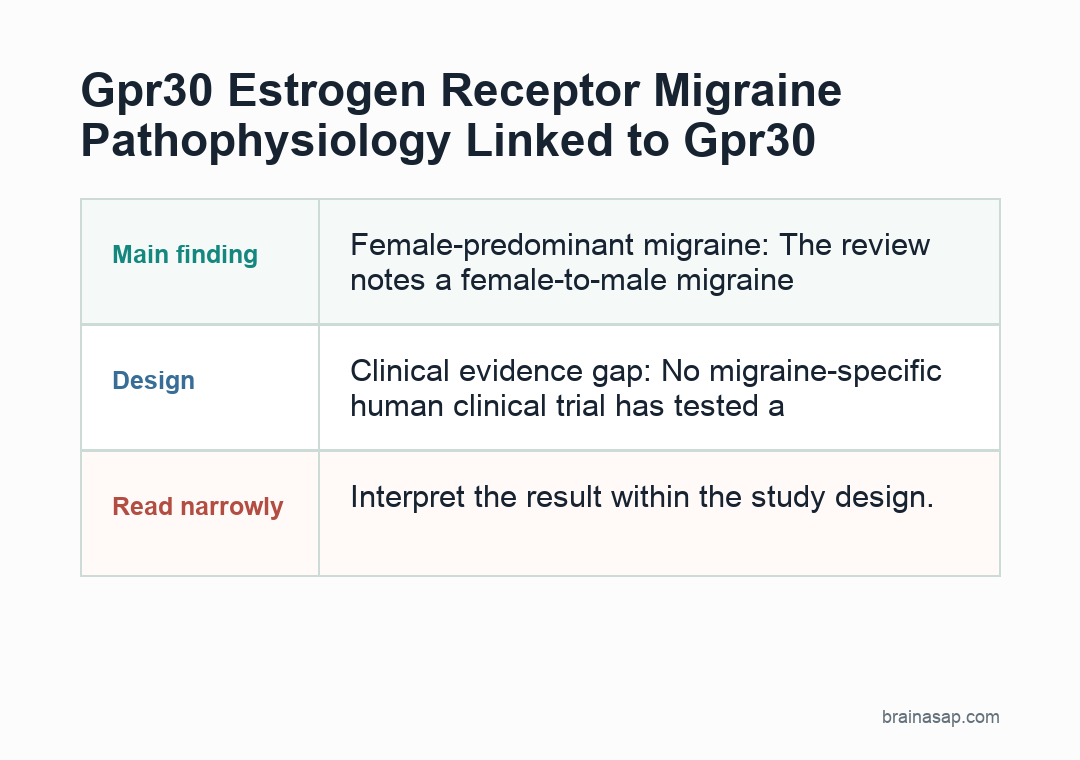
- Female-predominant migraine: The review notes a female-to-male migraine prevalence ratio of about 2:1 to 3:1.
- Menstrual migraine link: About 50% to 60% of female migraineurs have menstrually related migraine.
- GPR30 tissue focus: GPR30 is described as highly expressed in migraine-relevant tissues such as the trigeminal ganglion.
- Mechanism cluster: The review connects GPR30 signaling to trigeminovascular activation, neuroinflammation, oxidative stress, and nociceptive sensitization.
- Clinical evidence gap: No migraine-specific human clinical trial has tested a GPR30-specific ligand such as G-1.
Source: Journal of Pain Research (2026) | Yao et al.
Migraine pain is often explained through trigeminal sensory signaling, blood-vessel-associated inflammation, and sensitized pain pathways. The review adds a receptor-level question: which hormone-sensitive switches could alter those pathways quickly enough to affect attacks?
The review is not a treatment trial. It is a mechanism-focused synthesis that asks whether GPR30 helps explain why estrogen-linked migraine patterns are so common and why trigeminal pain circuits may be hormonally sensitive.
GPR30 Could Link Estrogen Fluctuation to Migraine Pathways
Migraine has a strong sex difference. The review cites a female-to-male prevalence ratio of about 2:1 to 3:1, and it notes that 50% to 60% of female migraineurs experience menstrually related migraine.
Those patterns do not prove that estrogen causes every migraine attack. They do make estrogen signaling a reasonable biological focus, especially for pathways that respond quickly to hormone changes.
Classic estrogen receptors act partly through gene transcription, which is too slow to explain every short-term migraine fluctuation. GPR30 is different because it can activate faster intracellular signaling cascades, making it a candidate for rapid hormone-sensitive pain modulation during vulnerable cycle windows.
- Sex difference: Migraine is more common in women than in men.
- Menstrual timing: Many female migraineurs report attacks related to menstrual-cycle timing.
- Receptor hypothesis: GPR30 may mediate some rapid, non-genomic estrogen effects relevant to pain circuits.
The review’s central claim is mechanistic: GPR30 may be one molecular route through which estrogen fluctuations influence migraine-relevant neural tissue.
Trigeminal Ganglion Expression Makes GPR30 Biologically Plausible
The trigeminal ganglion contains sensory neurons that relay head and facial pain signals. It is central to trigeminovascular models of migraine, which link trigeminal activation with meningeal blood vessels, inflammatory mediators, and pain sensitization.
Yao et al. describe GPR30 as highly expressed in migraine-associated tissues, including the trigeminal ganglion. The location fits a receptor-level migraine hypothesis because trigeminal neurons are directly involved in head-pain transmission.
- Location: GPR30 appears in neural tissues relevant to migraine mechanisms.
- Timing: Membrane estrogen receptors can support faster signaling than classic genomic hormone pathways.
- Pathway fit: Trigeminal neurons, inflammatory mediators, and pain-sensitization pathways are all relevant to migraine attacks.
The review also emphasizes uncertainty. Rodent and reporter-model evidence cannot replace direct human evidence from migraine patients.
Subcellular location also matters. The review describes GPR30 at the plasma membrane and presynaptic membrane, with smaller pools in the endoplasmic reticulum and Golgi apparatus, locations that could affect extracellular signaling and intracellular calcium regulation.
GPR30 Signaling May Affect Neuroinflammation and Sensitization
Mechanistically, the review links GPR30 to G protein-dependent and beta-arrestin-dependent signaling pathways. Those pathways can influence intracellular calcium, kinase signaling, inflammatory activity, and neuronal excitability.
For migraine, the relevant downstream processes are not one single pathway. The review highlights trigeminovascular activation, neuroinflammation, oxidative stress, and nociceptive sensitization, which means increased responsiveness in pain-processing systems.
- Trigeminovascular activation: A core migraine mechanism involving trigeminal sensory signaling and cranial vascular/inflammatory responses.
- Neuroinflammation: Immune and inflammatory signaling in nervous-system tissue that can amplify pain pathways.
- Oxidative stress: A redox imbalance that can alter neuronal and vascular function.
- Nociceptive sensitization: Increased pain-system responsiveness that can turn ordinary input into pain or intensify headache pain.
This mechanism cluster is plausible, but it remains a synthesis of preclinical and indirect evidence rather than a direct human migraine intervention result. That distinction should stay visible in any treatment discussion.
Raloxifene Evidence Is Indirect, Not GPR30-Specific
The review discusses raloxifene, a selective estrogen receptor modulator, as part of the clinical background. Some studies have suggested migraine-related benefit, but raloxifene can act on ER-alpha, ER-beta, and GPR30.
Any observed clinical effect therefore cannot be assigned specifically to GPR30. A drug that touches multiple estrogen receptors cannot isolate the role of one receptor in migraine.
- Indirect clinical clue: Raloxifene-related findings support interest in estrogen-receptor biology.
- Specificity problem: Raloxifene is not a selective GPR30 test.
- Trial gap: GPR30-specific ligands such as G-1 have not been tested in migraine-specific human clinical trials.
This is the main clinical boundary. GPR30 is a candidate target, not an established migraine-treatment target.
The GPR30 Migraine Hypothesis Needs Human Validation
The review ends with a cautious target-development message. GPR30 may be a promising molecular mediator of estrogen-regulated migraine biology, but several evidence gaps remain.
Human tissue verification, migraine-specific receptor studies, imaging or biomarker work, and selective ligand trials would be needed before GPR30 could move from pathway hypothesis to treatment strategy.
- Human tissue gap: Much receptor-distribution evidence comes from rodent or reporter models.
- Mechanism gap: GPR30’s effects can vary by cell type, tissue, ligand, and migraine subtype.
- Clinical gap: No selective GPR30 migraine therapy has been validated in patients.
The review narrows a broad hormonal migraine question into a testable receptor pathway. The next step is direct human evidence.
Citation: DOI: 10.2147/JPR.S594943. Yao et al. Potential Roles of G Protein-Coupled Receptor 30 (GPR30) in Migraine Pathophysiology. Journal of Pain Research. 2026;19.
Study Design: Narrative review of GPR30/GPER signaling and migraine pathophysiology.
Sample/Model: Review of receptor biology, preclinical evidence, and indirect clinical estrogen-receptor findings.
Key Statistic: The review cites a 2:1 to 3:1 female-to-male migraine prevalence ratio and 50% to 60% menstrually related migraine among female migraineurs.
Caveat: GPR30-specific migraine treatment evidence in humans is not yet available.