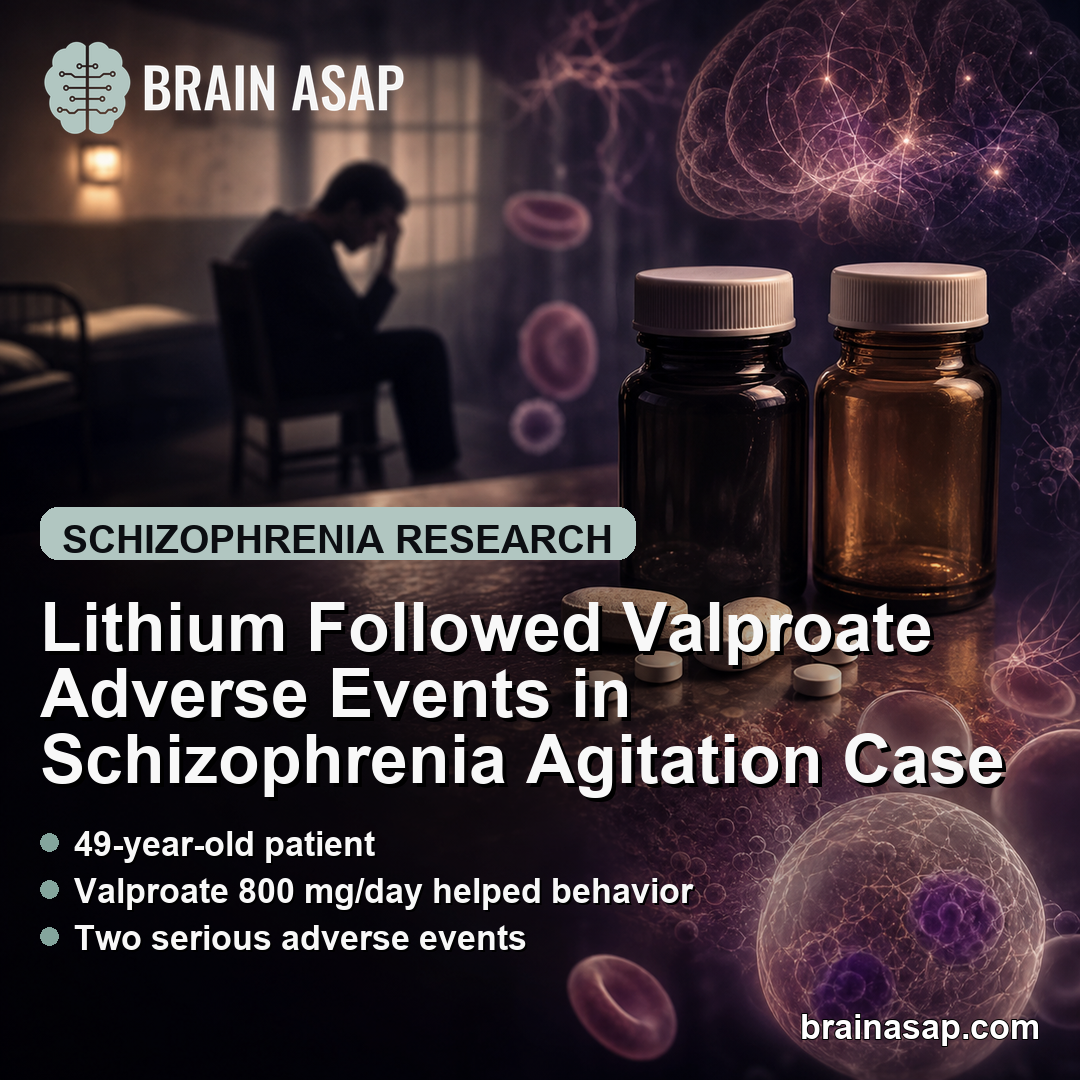
TL;DR: A 2026 study in Psychiatry and Clinical Neurosciences Reports described a treatment-resistant residual-phase schizophrenia case in which valproate helped agitation but caused hypoglycemia and pancytopenia, while lithium augmentation was followed by lower hostility and excitement scores.
Key Findings
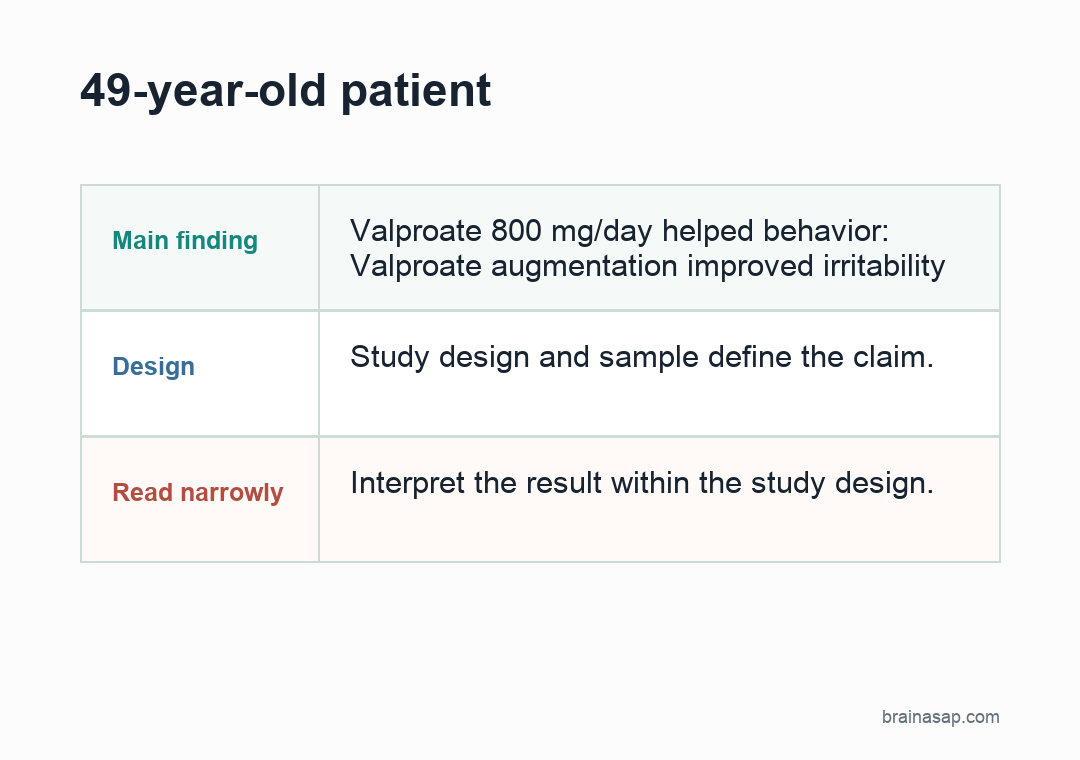
- 49-year-old patient: The case involved a Japanese woman with chronic treatment-resistant schizophrenia and persistent agitation, aggression, and residual psychotic symptoms.
- Valproate 800 mg/day helped behavior: Valproate augmentation improved irritability and agitation but hallucinations and delusions persisted.
- Two serious adverse events: Long-term valproate was linked to hypoglycemia with suspected relative carnitine deficiency, then pancytopenia after re-administration.
- Lithium 600 mg/day was added: At a serum lithium level of 0.8 mEq/L, dangerous behaviors and shouting resolved and bizarre behaviors decreased.
- BPRS total improved: Brief Psychiatric Rating Scale (BPRS) score fell from 80 to 64, with hostility improving from 6 to 2 and excitement from 6 to 4.
Source: Psychiatry and Clinical Neurosciences Reports (2026) | Kasagi et al.
Mood Stabilizer Augmentation Was Used for Residual Schizophrenia Agitation
Treatment-resistant schizophrenia can leave patients with severe residual symptoms despite antipsychotic therapy. In this case, the main practical problem was not only hallucinations or delusions but dangerous agitation and aggression.
The patient had longstanding psychotic illness, social withdrawal, disorganized behavior, poor hygiene, irritability, and aggression. Clozapine and electroconvulsive therapy were proposed more than once but were declined by her family.
That left clinicians with a common but imperfect option: adding a mood stabilizer to antipsychotic treatment. Guidelines do not strongly recommend this strategy, but real-world prescribing often uses valproate or lithium when agitation remains difficult to manage.
- Primary diagnosis: schizophrenia, with schizoaffective disorder and lifetime manic/hypomanic episodes not supported by the longitudinal history.
- Residual target symptoms: irritability, aggression, psychomotor agitation, shouting, and dangerous behaviors.
- Antipsychotic background: prior quetiapine up to 800 mg/day, olanzapine up to 20 mg/day, and later zotepine.
Valproate Improved Agitation but Raised Safety Problems
Valproate 800 mg/day was added to olanzapine after persistent irritability and aggression. The behavioral response was clinically useful: agitation and irritability improved, although hallucinations and delusions continued.
The safety problem emerged later. At age 47, the patient developed hypoglycemia after long-term valproate exposure. Workup excluded several alternative causes, including liver dysfunction, sepsis, adrenal insufficiency, thyroid dysfunction, and insulin autoimmune syndrome.
Serum carnitine testing did not meet formal deficiency criteria, but the values were low-normal and clinically suspicious. After valproate was stopped and L-carnitine supplementation was started, free carnitine rose and hypoglycemic symptoms resolved.
Behavior then worsened, including wall-kicking, biting staff, and marked psychomotor agitation. Valproate was restarted and symptoms temporarily improved, but pancytopenia followed.
- White blood cells: 2870/uL after valproate re-administration.
- Hemoglobin: 8.8 g/dL during the cytopenia episode.
- Platelets: 2.4 x 10³/uL, prompting discontinuation.
After valproate discontinuation, hematologic abnormalities improved. Psychiatric symptoms worsened again, which created the treatment dilemma: the medication seemed behaviorally helpful but no longer looked safe enough to continue.
Lithium Followed Valproate Discontinuation and Lower BPRS Scores
On admission, the patient’s Brief Psychiatric Rating Scale (BPRS) total score was 80. The BPRS is a clinician-rated symptom scale used to track psychiatric severity across domains such as hostility, suspiciousness, hallucinations, and excitement.
Zotepine was increased from 300 to 450 mg/day, but shouting and dangerous agitation persisted. Lithium carbonate was then started at 400 mg/day and increased to 600 mg/day.
When serum lithium reached 0.8 mEq/L, dangerous behaviors and shouting resolved, and bizarre behaviors decreased. At discharge, the BPRS total score had fallen to 64.
The largest item-level changes matched the target symptoms. Hostility improved from 6 to 2, suspiciousness from 5 to 2, and excitement from 6 to 4.
Hallucinatory behavior improved only from 6 to 5, so the response was more behavioral than fully antipsychotic.
- Behavioral improvement: dangerous behavior and shouting resolved after lithium titration.
- Residual psychosis: hallucinations and delusions persisted at follow-up.
- Short follow-up: no agitation or violent behavior was observed during 3 months after discharge.
Valproate and Lithium Have Different Risk Profiles
The case is clinically useful because it does not frame mood stabilizers as interchangeable add-ons. Valproate and lithium can both be used for behavioral dysregulation, but the adverse-event profile can decide which option is realistic.
For valproate, the report emphasized two possible mechanisms. Valproate can reduce systemic carnitine stores and impair mitochondrial beta-oxidation, which can contribute to hypoglycemia during fasting states.
Valproate has also been associated with hematologic abnormalities, including thrombocytopenia, leukopenia, and anemia. In this patient, the combination of timing, exclusion of alternatives, and improvement after withdrawal made valproate a probable cause.
Lithium’s mechanism in schizophrenia augmentation is less settled. The report discussed possible effects on dopamine signaling, glutamate, inhibitory neurotransmission, glycogen synthase kinase-3, and neurotrophic pathways.
A Single Schizophrenia Case Cannot Prove Lithium Efficacy
This was a case report, not a randomized trial. The lithium response could have been influenced by the inpatient structure, zotepine dose escalation, symptom fluctuation over time, or other unmeasured factors.
The broader evidence is mixed. A cited Cochrane review found better clinical response with lithium augmentation across some trials, but the advantage weakened when studies with schizoaffective disorder, non-double-blind designs, or high attrition were excluded.
For chronic schizophrenia with persistent aggression and agitation, mood stabilizer augmentation fits best when it is tied to specific target symptoms and active safety monitoring rather than used as a generic add-on.
- Best-supported reading: lithium may be a reasonable alternative when valproate helped behavior but became unsafe.
- Clinical boundary: persistent hallucinations and delusions did not fully resolve.
- Monitoring need: glucose, blood counts, carnitine status, renal function, thyroid function, and serum lithium levels all matter in this medication space.
Citation: DOI: 10.1002/pcn5.70334. Kasagi et al. Clinical dilemma of mood stabilizer augmentation in treatment-resistant schizophrenia with residual phase: A case report of valproate-associated hypoglycemia and cytopenia, and subsequent lithium response. Psychiatry and Clinical Neurosciences Reports. 2026;5:e70334.
Study Design: Single-patient psychiatric case report.
Sample Size: One 49-year-old Japanese woman with treatment-resistant residual-phase schizophrenia.
Key Statistic: BPRS total score improved from 80 to 64 after lithium augmentation; hostility improved from 6 to 2 and excitement from 6 to 4.
Caveat: Case report with possible confounding from zotepine dose escalation, inpatient structure, and natural symptom fluctuation.