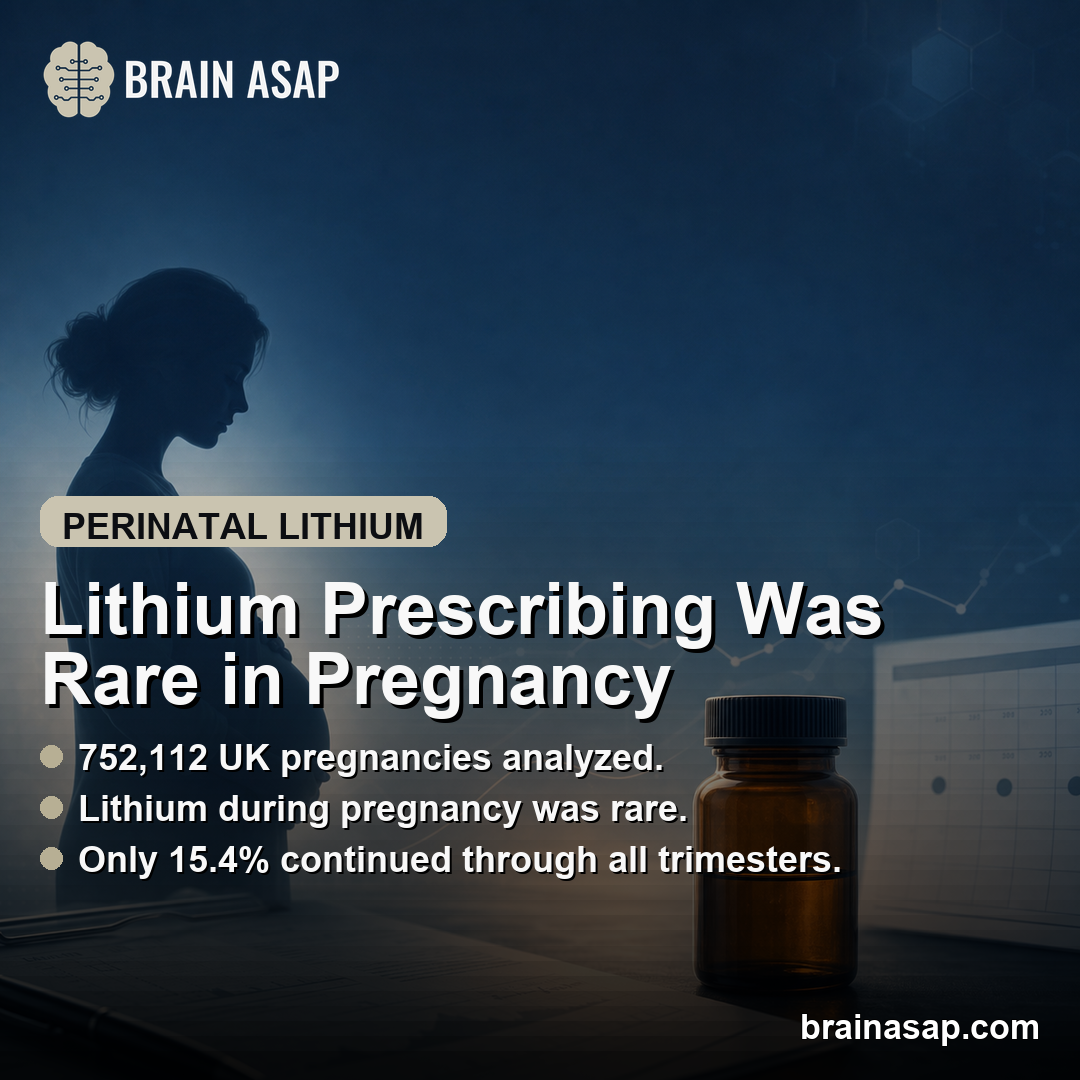
TL;DR: A 2026 cohort study in The British Journal of Psychiatry found that lithium prescribing around pregnancy was rare in UK primary care records, and most pre-pregnancy lithium users did not stay on treatment through all three trimesters.
Key Findings
- 752,112 pregnancies analyzed: Researchers used UK Clinical Practice Research Datalink GOLD records from 1995 to 2018 to describe lithium prescribing before, during, and after pregnancy.
- Pregnancy prescribing was uncommon: Lithium appeared in 1.89 per 10,000 pregnancies during pregnancy, compared with 3.02 before pregnancy and 2.81 postpartum.
- 337 pregnancies had perinatal lithium exposure: About 48.4% of those lithium-exposed pregnancies had a recorded bipolar disorder diagnosis.
- Continuation was rare: Among 227 pregnancies with lithium prescribed before conception, only 15.4% continued treatment throughout all three trimesters.
- Discontinuation often happened after pregnancy began: 20.7% discontinued before pregnancy, while 30.8% discontinued during the second or third trimester.
Source: The British Journal of Psychiatry (2026) | Chauhan et al.
Pregnancy Made Lithium Treatment a Narrow Clinical Tradeoff
Lithium is a long-standing mood stabilizer used in bipolar disorder and sometimes major depressive disorder. Pregnancy changes the treatment calculation because untreated severe mood illness can harm the mother and infant, while lithium exposure can carry dose-related fetal and neonatal risks.
The 2026 cohort study did not test whether lithium should be stopped or continued for any individual patient. Researchers asked a simpler population question: how often did lithium prescribing actually happen before, during, and after pregnancy in UK primary care records?
Perinatal psychiatry often has to balance two real risks at once: relapse risk if treatment is stopped, and exposure risk if treatment continues. This study describes how that balance appeared in routine prescribing data rather than in a trial protocol.
UK Primary Care Records Covered More Than 752,000 Pregnancies
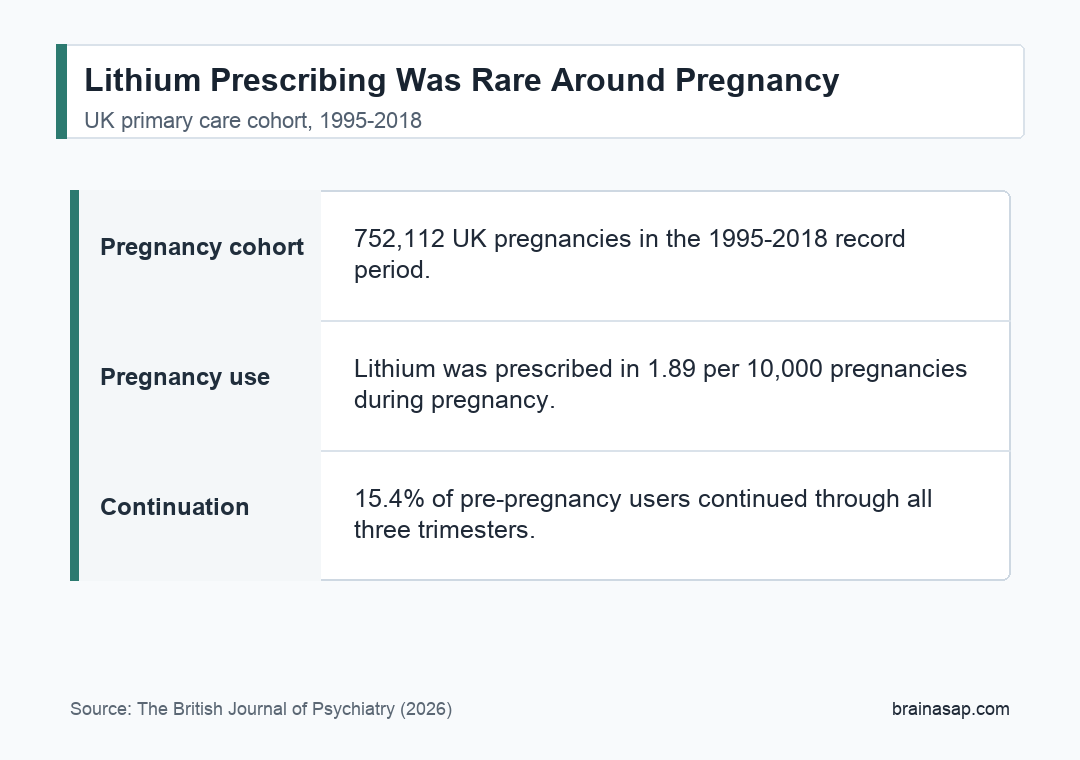
Researchers used Clinical Practice Research Datalink GOLD, a UK primary care database, and linked it to the CPRD Pregnancy Register. The analysis included 752,112 eligible pregnancies from 1995 through 2018 that resulted in live birth or stillbirth.
The team counted lithium prescriptions across several windows:
- Before pregnancy: prescriptions in the preconception period, including a definition for established pre-pregnancy use.
- During pregnancy: prescriptions spanning the first, second, or third trimester.
- After delivery: prescriptions in the postpartum period.
The database captures primary care prescribing well. It does not fully capture prescriptions issued only in specialist or secondary care.
The limit is important because lithium may be initiated or adjusted by specialists even when long-term prescribing later runs through primary care.
Lithium Use During Pregnancy Stayed Very Low
The headline rate was small. Across the study period, lithium was prescribed in 3.02 per 10,000 pregnancies before pregnancy, 1.89 per 10,000 during pregnancy, and 2.81 per 10,000 after delivery.
Only 337 pregnancies had lithium exposure at any point in the broader perinatal window. Of those, 163 pregnancies, or 48.4%, involved a recorded bipolar disorder diagnosis.
The most recent annual pregnancy-period estimate in 2018 was 1.03 per 10,000 pregnancies, with a wide confidence interval because the exposed group was small.
The broad pattern was still clear: lithium prescribing during pregnancy was uncommon and remained uncommon over time.
Most Pre-Pregnancy Users Did Not Continue Through All Trimesters
The clearest treatment-continuity finding came from the 227 pregnancies with lithium prescribed before conception. Only 15.4%, or 35 pregnancies, continued lithium throughout all three trimesters.
Discontinuation was more common, but it did not happen at one uniform point:
- Before pregnancy: 20.7% discontinued before pregnancy began.
- Later in pregnancy: 30.8% discontinued during the second or third trimester.
- Other patterns: 33.0% followed more varied prescribing patterns, including starts and stops that did not fit a simple continuation/discontinuation category.
The middle category is clinically important. Stopping before pregnancy may reflect planning.
Stopping during the second or third trimester may reflect changing clinical advice, emerging concerns, patient preference, or fragmented coordination after pregnancy is already underway.
Bipolar Diagnosis and Guideline Eras Pointed to Low Continuity
Among the 137 pre-pregnancy users with bipolar disorder, 14.6% continued lithium through pregnancy. Late discontinuation was more common in that subgroup, affecting 37.9%.
Among 90 pre-pregnancy users without a recorded bipolar disorder diagnosis, continuation was 16.7%. A larger share, 41.1%, fell into the more variable prescribing-pattern category.
Those subgroup differences matter, but they do not change the pregnancy-prescribing pattern. In routine UK records, sustained lithium treatment through pregnancy was unusual even among pregnancies where lithium had been used before conception.
Researchers compared three periods around UK NICE guidance: 1995-2006, 2007-2014, and 2015-2018. The prescribing pattern looked stable across those windows.
Across all three eras, lithium use was more common before pregnancy, declined starting in the first trimester, and stayed low in the second and third trimesters. The 2006 and 2014 guideline publications did not correspond to a major visible shift in prescribing rates.
Guidance may still shape individual care. At the population level in this database, the pattern remained steady: low pregnancy prescribing, frequent discontinuation, and renewed postpartum prescribing.
The Practical Risk Is Unplanned Treatment Disruption
The study is not a simple warning against stopping lithium. For some patients, discontinuation may be the right decision.
The practical concern is whether discontinuation is planned, monitored, and paired with another mental health strategy.
Three details make that point concrete:
- Pregnancy exposure risk: lithium can raise fetal and neonatal safety concerns, so automatic continuation is not a neutral choice.
- Relapse risk: bipolar disorder can worsen during pregnancy or after delivery, so automatic discontinuation is not a neutral choice either.
- Care coordination: late discontinuation may signal that treatment decisions are happening after pregnancy is already underway rather than during preconception planning.
The care-system conclusion is direct. Patients using lithium before pregnancy need proactive perinatal medication planning, not a last-minute handoff between primary care, psychiatry, obstetrics, and the patient.
Study boundary: This was a prescribing-pattern study, not an outcome trial. It did not estimate how stopping lithium changed relapse, hospitalization, congenital outcomes, or postpartum symptoms.
The unit of analysis was the pregnancy, and about half of the broader pregnancy register involved women contributing two or more pregnancies.
The source database also emphasizes primary care prescribing. If some lithium treatment was supplied only through specialist services, the study could miss part of the exposure picture.
Even with those limits, the cohort gives a useful baseline. In UK primary care records, lithium use during pregnancy was rare, continuation through all three trimesters was rarer, and the main clinical question is how to make those medication transitions deliberate instead of accidental.
Citation: DOI: 10.1192/bjp.2026.10632. Chauhan et al. Lithium prescribing in the perinatal period: UK primary care cohort study. The British Journal of Psychiatry. 2026;1-7.
Study Design: Population-based cohort study using UK primary care records and the CPRD Pregnancy Register.
Sample Size: 752,112 pregnancies from 1995 to 2018, including 337 pregnancies with lithium exposure at any point before, during, or after pregnancy.
Key Statistic: Among 227 pregnancies with lithium prescribed before conception, 15.4% continued treatment through all three trimesters.
Caveat: The database captures primary care prescribing and does not directly test maternal or infant outcomes after continuation versus discontinuation.