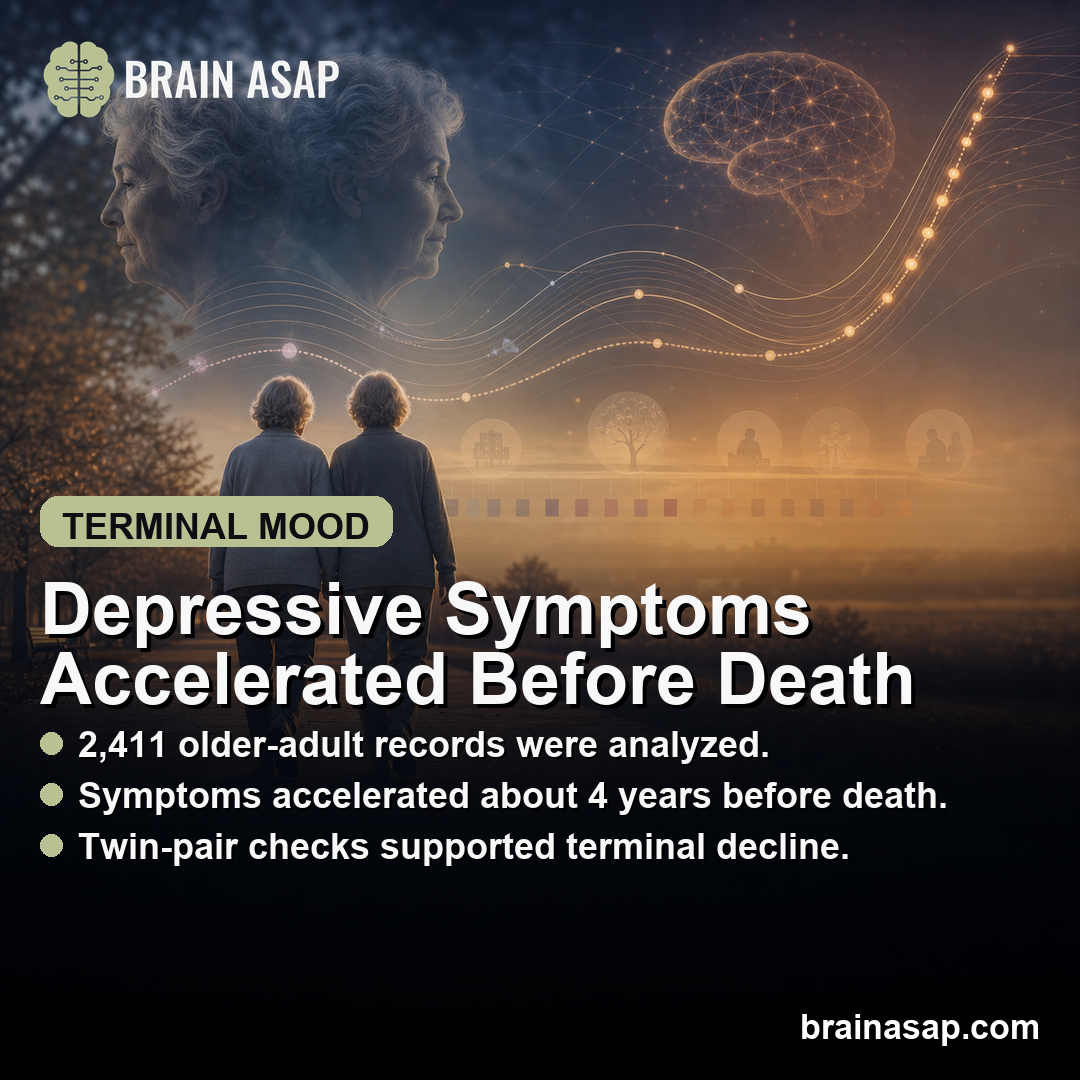
TL;DR: A 2025 study in Psychological Science found that depressive symptoms accelerated about 4 years before death in a multinational twin consortium, suggesting that late-life mood worsening can partly reflect terminal decline rather than chronological age alone.
Key Findings
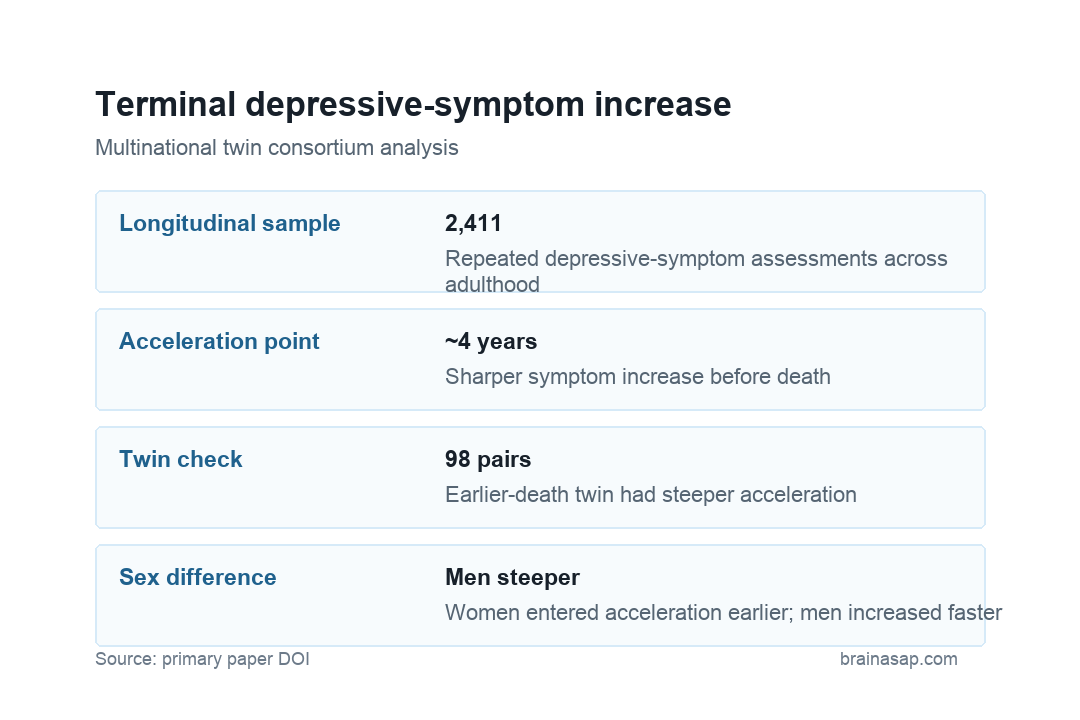
- 2,411 older-adult records: Researchers analyzed longitudinal depressive-symptom data from the Interplay of Genes and Environments across Multiple Studies consortium.
- 4-year acceleration: Random changepoint models identified a sharper increase in depressive symptoms approximately 4 years before death.
- Mortality link: Larger annual increases in depressive symptoms after age 70 were associated with higher risk of death.
- 98 twin-pair check: Co-twin control analyses found steeper symptom acceleration in the twin who died earlier than in the surviving twin.
- Sex difference: Men had more severe mortality-related increases, while women tended to enter the acceleration phase earlier.
Source: Psychological Science (2025) | Petkus et al.
Depressive symptoms often change across the lifespan. Many datasets show lower average symptoms from middle age into early older adulthood, followed by increases after about age 70.
The hard question is whether that later increase reflects aging itself or proximity to death.
Terminal decline means accelerated worsening near the end of life. It has been studied for cognition, well-being, and daily function; this study tested whether depressive symptoms follow a similar mortality-linked course.
Depressive Symptoms Accelerated About 4 Years Before Death
Researchers used data from Sweden, Denmark, and Australia in the IGEMS twin consortium. The sample included 2,411 participants with repeated mental health assessments across adulthood and older age.
Joint models connected symptom trajectories with mortality risk. Random changepoint models then worked backward from death to estimate when the rate of depressive-symptom increase changed most clearly.
The acceleration point was approximately 4 years before death.
- Chronological age model: Symptoms rose more after age 70.
- Time-to-death model: The late-life increase was concentrated near the final years of life.
- Exclusion check: Removing data from the 3 years before death greatly weakened the post-70 increase.
Higher Late-Life Depression Increases Were Linked to Mortality Risk
The mortality association was not simply that older people had more symptoms. Individuals with larger annual increases in depressive symptoms after age 70 had higher risk of death than those with more stable mood trajectories.
The study also reported that people with pronounced late-life depressive-symptom increases had shorter median survival than people with stable moods. That finding supports clinical attention to worsening depression in older adulthood, especially when change is rapid rather than gradual.
Twin Comparisons Reduced Familial Confounding
Observational aging studies can be confounded by genetics, childhood environment, socioeconomic background, and long-running health differences. The twin design helped address that problem.
Researchers compared 98 twin pairs in which 1 twin died and the other survived at least 4 more years. The twin who died earlier had a steeper acceleration in depressive symptoms, supporting a mortality-proximity interpretation rather than only shared family risk.
This comparison is stronger than a standard unrelated-person contrast. Identical and fraternal twins share different amounts of genetic risk, but both types tend to share many early-life conditions, making the surviving co-twin a more informative comparison than a random person of similar age.
- Shared background: Twins partly control for genetic and early-life environmental influences.
- Within-family comparison: The earlier-death twin showed sharper symptom acceleration.
- Remaining limits: Adult illness, caregiving, disability, medication, and social losses can still differ within a twin pair.
Men Had Steeper Terminal Mood Worsening
Women usually report more depressive symptoms than men across much of adulthood. In very late life, that sex gap often narrows.
The study suggests one reason: men experienced more severe mortality-related increases in depressive symptoms after the acceleration began.
Women tended to enter the acceleration phase earlier, but men’s increase was steeper. The analysis did not identify the cause.
Functional impairment, loss of independence, medical burden, social isolation, and treatment differences could all contribute.
The sex difference is clinically relevant because it warns against assuming that lower lifetime average depression reports in men mean lower vulnerability near death. Late-life assessment may need to attend to rapid change, not only to absolute symptom level.
The study also helps explain why the usual female-higher depression gap can narrow in the oldest ages. If men have a steeper terminal increase, average sex differences can shrink as more people approach the end of life.
Terminal Depression Is Not a Reason to Dismiss Treatment
The findings should not be read as saying late-life depression is inevitable or untreatable. They show that rapid mood worsening in older adulthood may be a marker of changing health, functional reserve, or proximity to death.
Clinical assessment should follow the symptom change. A sharp increase in depressive symptoms deserves attention to pain, sleep, mobility, sensory loss, medication effects, grief, social support, cognitive change, and treatable psychiatric illness.
The analysis also argues for repeated measurement. A single depression score can miss the trajectory, while a series of scores can show whether an older adult is stable, slowly changing, or entering a faster decline that deserves broader medical review.
Families may notice this before a clinic does. Withdrawal, loss of pleasure, sleep disruption, appetite change, or new hopelessness near the end of life should prompt care rather than resignation.
The study does not identify the biological or social driver of the terminal increase. Possible contributors include physical disability, inflammatory illness, bereavement, reduced sensory input, shrinking independence, and the burden of multiple medical conditions.
Medication data were also limited, so antidepressant treatment could not be fully modeled. Future studies that track treatment, pain, cognition, and functional decline together could separate mood changes that respond to care from mood changes that mainly mark advanced illness.
Citation: DOI: 10.1177/09567976251351022; Petkus et al; Terminal Increases in Depressive Symptoms in a Multinational Twin Consortium; Psychological Science; 2025;36(8):637-655.
Study Design: Longitudinal cohort analysis with joint models, random changepoint models, and co-twin control analyses.
Sample Size: 2,411 participants from multinational twin studies; 98 twin pairs in the co-twin control analysis.
Key Statistic: Depressive symptoms accelerated approximately 4 years before death.
Caveat: Primarily European-ancestry cohorts and limited medication tracking constrain generalizability and mechanism inference.