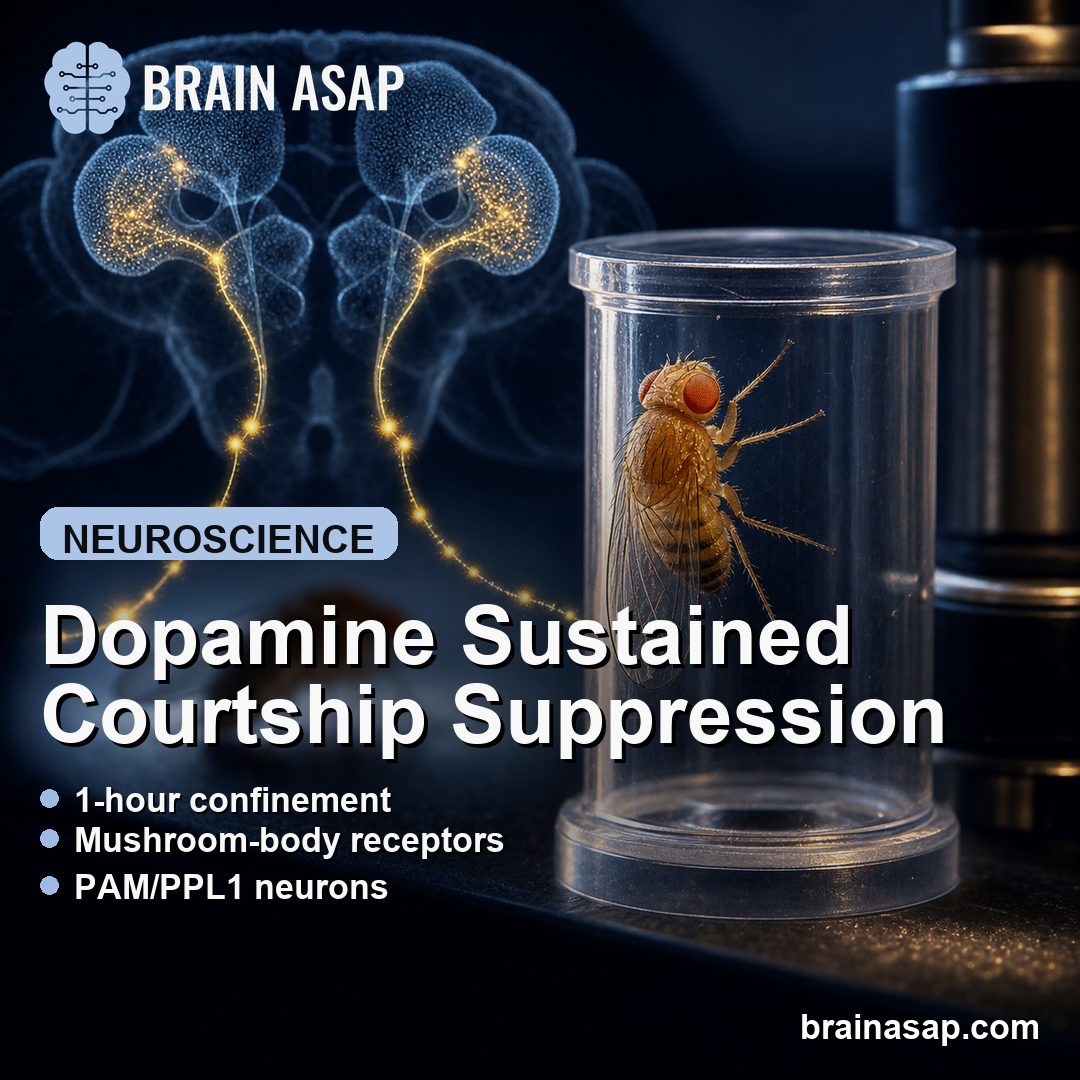
TL;DR: A 2026 study in iScience found that 1 hour of small-space confinement suppressed male courtship in Drosophila, and dopamine signaling into the mushroom body was needed to keep that suppression going after the stress ended.
Key Findings
- 1-hour stress model: Male flies confined in a 3 mm by 2 mm small-space chamber showed reduced courtship toward immobilized females after stress exposure.
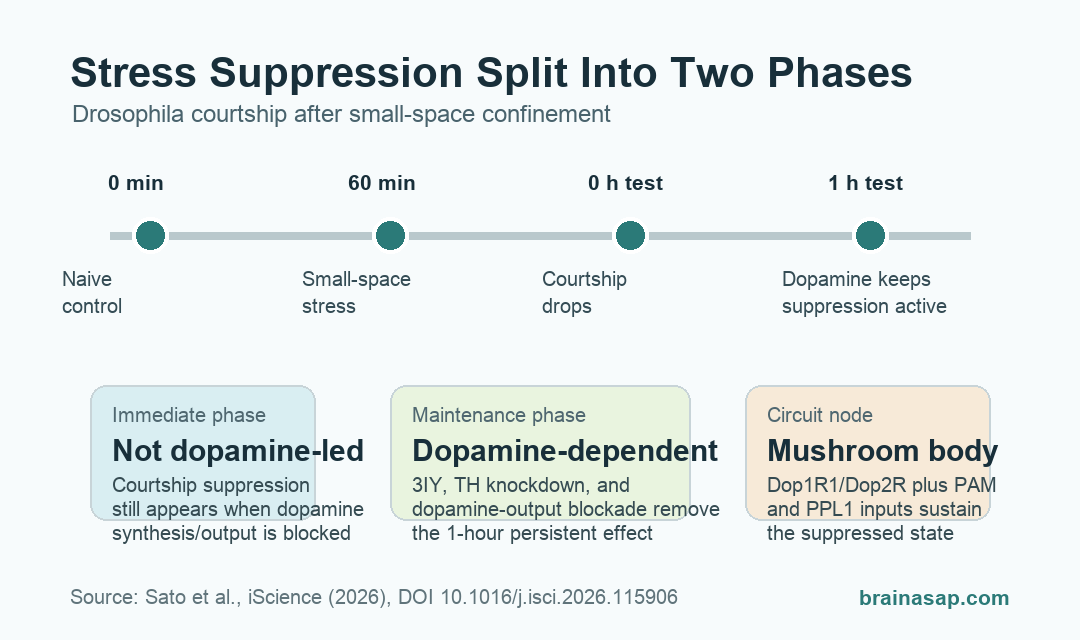
- Duration mattered: Courtship suppression appeared after 30- and 60-minute confinement immediately after stress, but only 60-minute confinement still reduced courtship 1 hour later.
- Transient effect: After 1 hour of confinement, courtship was lower immediately and 1 hour later, but the difference was no longer significant at 2 or 4 hours.
- Dopamine timing: Blocking dopamine synthesis with 3-iodo-L-tyrosine or knocking down tyrosine hydroxylase preserved the immediate effect but removed the 1-hour persistence.
- Mushroom-body circuit: Dop1R1 and Dop2R receptor knockdown in mushroom-body neurons, plus PAM or PPL1 dopamine-neuron transmission blockade, disrupted sustained courtship suppression.
Source: iScience (2026) | Sato et al.
Small-space stress gave the researchers a controllable way to ask why a stressful experience can reduce sexual behavior after the stressor is gone.
The model used male fruit flies, so the finding is not a human sexual-function study. It does isolate a neural timing problem that is hard to study cleanly in mammals.
The main question was whether dopamine starts the stress response or helps maintain it. The experiments separated those two phases by testing courtship immediately after confinement and again after a delay.
Small-Space Confinement Reduced Drosophila Courtship
The behavioral setup placed sexually mature virgin male flies into either a standard chamber or a much smaller chamber. The small-space chamber restricted movement without fully immobilizing the animal.
After confinement, each male was placed with an immobilized female. Researchers measured a courtship index, defined as the percentage of a 10-minute observation period spent performing courtship behaviors.
- Stress chamber: The small-space chamber measured 3 mm in diameter and 2 mm in depth, creating movement restriction without complete restraint.
- Comparison chamber: Control males were placed in a larger chamber where they could walk freely before the same courtship test.
- Behavioral readout: Courtship was scored as time spent orienting, following, singing, licking, attempting copulation, or related male courtship actions.
A clear timing pattern emerged. 10 minutes of small-space exposure did not significantly change courtship, but 30 and 60 minutes did when behavior was tested immediately afterward.
The stronger 60-minute protocol became the main stress condition because it was robust enough to test persistence. After 1 hour of small-space stress, courtship remained suppressed 1 hour later, while the 2- and 4-hour tests no longer showed a significant difference.
Dopamine Was Needed for Persistence, Not the First Drop
Dopamine often changes during stress, but the study did not simply ask whether dopamine was involved. It asked when dopamine mattered.
Blocking dopamine synthesis with 3-iodo-L-tyrosine (3IY), an inhibitor of tyrosine hydroxylase, did not stop the immediate courtship drop after small-space stress. The same manipulation did stop the delayed effect: 1 hour after stress, 3IY-fed males no longer showed courtship suppression.
- Drug test: Males were fed 0.1 or 1 mg/mL 3IY for 2 days before testing.
- Genetic test: Pan-neuronal tyrosine hydroxylase knockdown used two independent RNAi lines to reduce dopamine-synthesis machinery.
- Timing result: Both approaches preserved immediate suppression but disrupted the persistent 1-hour effect.
That timing split drives the interpretation. The initial stress response likely involves other pathways, while dopamine helps keep the behavioral state active after the stress exposure has ended.
Dopamine-Neuron Transmission Maintained the Suppressed State
The researchers then used temperature-sensitive shibire tools to block neurotransmission from dopamine neurons during specific windows. This gave them a way to test whether dopamine release during or after the stress period was necessary.
When dopamine-neuron transmission was blocked during small-space stress, males still showed immediate courtship suppression. But they failed to maintain suppression 1 hour later.
- During stress: Blocking dopamine-neuron output during the 1-hour confinement did not erase the immediate behavioral effect.
- After stress: Blocking dopamine-neuron output during the 1-hour post-stress interval also prevented the delayed suppression.
- Control logic: At permissive temperatures, the transgenic flies still showed stress-related courtship suppression, supporting a dopamine-output-specific interpretation.
The pattern supports a maintenance model. Dopamine-neuron activity was not the whole stress response, but it was required for the stress response to persist as a courtship-specific behavioral state.
Mushroom-Body Dop1R1 and Dop2R Carried the Delayed Effect
The next step was receptor mapping. Flies have multiple dopamine receptors, including D1-like and D2-like receptor types, so a general dopamine result was not enough.
Dopamine-receptor knockout tests showed that several receptors were dispensable for the immediate response. For the delayed 1-hour effect, however, Dop1R1, Dop1R2, and Dop2R knockout males failed to maintain courtship suppression, while DopEcR mutants still showed it.
The more specific mushroom-body test narrowed the result further. Knocking down Dop1R1 or Dop2R in mushroom-body neurons prevented the persistent suppression, while Dop1R2 knockdown in the mushroom body did not.
- Mushroom body: This fly brain region supports higher-order sensory processing, learning, and behavior-state regulation.
- Dop1R1 result: Mushroom-body Dop1R1 knockdown removed the delayed suppression without broadly lowering naive courtship.
- Dop2R result: Mushroom-body Dop2R knockdown produced the same loss of persistent suppression.
- Dop1R2 contrast: Dop1R2 mattered in whole-animal knockout tests but was not the key mushroom-body receptor in the RNAi experiment.
The receptor pattern points away from a global dopamine explanation. The sustained courtship change depended on particular dopamine receptors in a particular circuit node.
PAM and PPL1 Dopamine Inputs Sustained Courtship Suppression
Dopamine neurons in the adult fly brain are organized into clusters. The researchers focused on clusters that innervate the mushroom body, including PAM, PPL1, and PPL2ab.
Blocking neurotransmission from PAM or PPL1 dopamine neurons during the stress exposure disrupted courtship suppression 1 hour later. Blocking PPL2ab output did not have the same effect.
The proposed model is specific: small-space stress initiates courtship suppression through non-dopamine pathways, while dopamine release from PAM and PPL1 neurons helps maintain the suppressed state through mushroom-body signaling.
The main limitation is translation. Fruit-fly courtship is not human sexual function, and confinement stress is a simplified laboratory stressor.
The useful finding is the circuit timing: a stressor can trigger an immediate behavioral change through one pathway and preserve that change through a dopamine-dependent maintenance circuit.
Citation: DOI: 10.1016/j.isci.2026.115906. Sato et al. Role of dopamine signaling in male courtship suppression induced by confinement stress in Drosophila. iScience. 2026;29:115906.
Study Design: Behavioral and neurogenetic fruit-fly study using small-space confinement, courtship assays, dopamine-synthesis inhibition, RNAi knockdown, receptor mutants, and temperature-sensitive neurotransmission blockade.
Sample/Model: Sexually mature virgin male Drosophila melanogaster tested across wild-type strains and transgenic dopamine-signaling manipulations.
Key Statistic: 1 hour of small-space stress suppressed courtship immediately and 1 hour later; dopamine-synthesis and dopamine-neuron-output manipulations selectively removed the delayed 1-hour suppression.
Caveat: The study identifies a fly circuit mechanism for stress-related courtship suppression and should not be treated as direct evidence for human sexual dysfunction.