TL;DR: A 2026 mouse study in iScience found that blocking Itch, an E3 ubiquitin ligase involved in protein tagging, improved several memory-test readouts in an Alzheimer’s disease mouse model and reduced neuronal apoptosis, including when researchers used the existing drug clomipramine.
Key Findings
- Two Itch strategies: Researchers tested AAV-delivered loss-of-function Itch mutants and clomipramine, a tricyclic antidepressant previously identified as an Itch inhibitor.
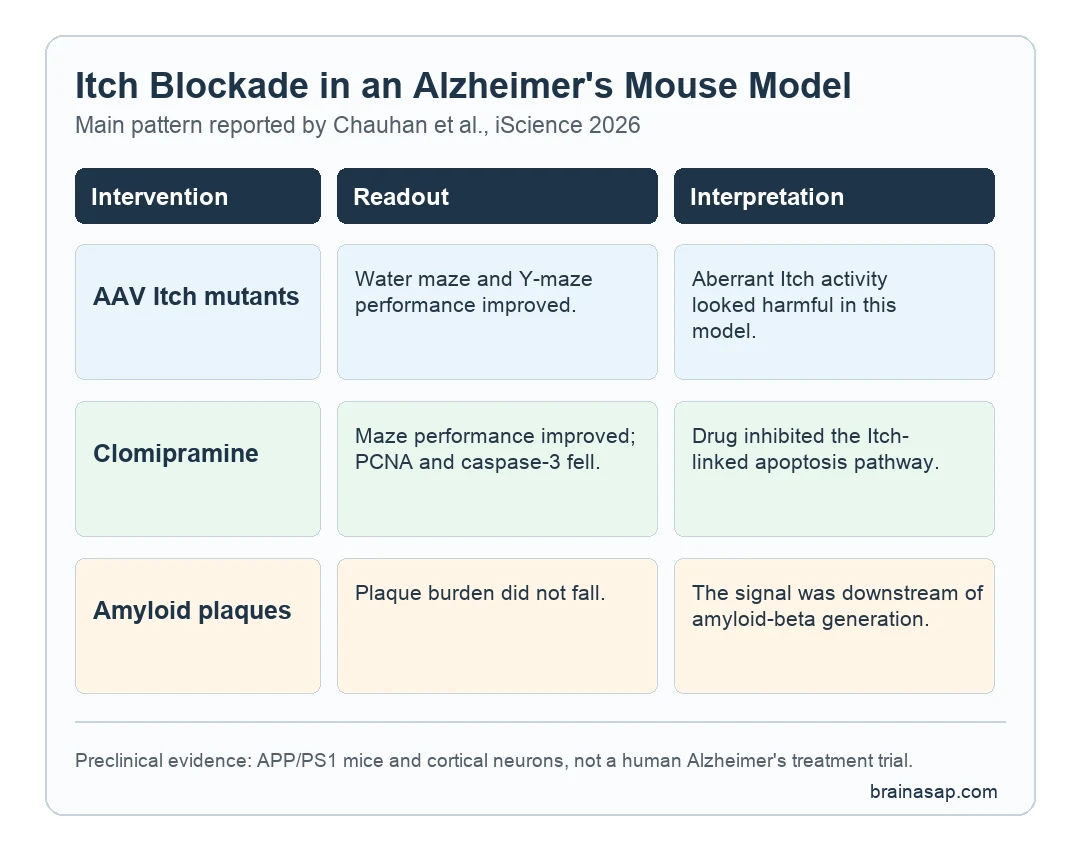
- Memory rescue in mice: In APP/PS1 transgenic Alzheimer’s mice, clomipramine improved Morris water maze, Y-maze, and radial-arm maze performance after 45 days of treatment.
- 25 mg/kg regimen: Six-month-old mice received intraperitoneal clomipramine every other day at 25 mg/kg for 45 days before behavioral testing.
- Cell-death markers fell: Clomipramine reduced cleaved caspase-3, PCNA, and TUNEL-positive neuronal markers tied to apoptosis and abnormal cell-cycle re-entry.
- Plaques did not change: The drug did not reduce amyloid plaque formation in this mouse model, suggesting the tested mechanism acted downstream of amyloid-beta generation.
Source: iScience (2026) | Chauhan et al.
Itch Was Tested as a Downstream Alzheimer’s Target
Itch, also called AIP4, is an E3 ubiquitin ligase, meaning it helps tag proteins for cellular handling or degradation. In this study, researchers focused on a proposed Alzheimer’s disease pathway in which amyloid-beta 42 (Abeta42) activates JNK signaling, which then hyperactivates Itch in neurons.
The proposed chain matters because Itch can promote degradation of TAp73, a protein linked here to neuronal survival. The researchers describe this as part of cell cycle-related neuronal apoptosis, where mature neurons show abnormal cell-cycle markers before dying.
This study did not test whether clomipramine slows dementia in people. It tested whether interrupting a specific Itch-related pathway could protect neurons and improve memory behavior in a transgenic mouse model.
AAV Itch Mutants Improved Mouse Memory Tests
The first intervention used AAV9 gene delivery to express loss-of-function Itch mutants in the prefrontal cortex of 6-month-old APP/PS1 Alzheimer’s-model mice. The two mutant forms targeted sites called T222A/S232A and K393R, which are involved in the paper’s proposed Itch activation mechanism.
After 45 days, researchers measured cognition with the Morris water maze and Y-maze. These tests are mouse behavioral assays, not clinical memory scales, but they are commonly used to probe spatial learning, working memory, and reference memory in Alzheimer’s models.
- Morris water maze: TgAD mice took longer to reach the hidden platform, while mice receiving either loss-of-function Itch mutant showed shorter escape latency.
- Probe trial: The same Itch mutant groups showed more platform-area crossings, a readout of stored spatial memory.
- Y-maze: Spontaneous alternation improved with the Itch mutants, while total arm entries did not change, making a movement-only explanation less likely.
Wild-type Itch did not produce the same memory improvement. The contrast points toward blocking aberrant Itch activity, not simply increasing Itch expression.
Clomipramine Reduced Itch-Linked Apoptosis Markers
The second intervention was clomipramine, a tricyclic antidepressant used clinically for psychiatric disorders and previously reported to inhibit Itch catalytic activity. In cultured neurons, researchers used 75 nM clomipramine because that concentration restored TAp73-related signaling without the toxicity pattern seen at higher concentrations.
In Abeta42-treated cortical neurons and TgAD mouse neurons, clomipramine reduced markers tied to cell death and abnormal cell-cycle activity. The main readouts were:
- TAp73 restoration: Clomipramine reversed the loss of TAp73 associated with Itch-mediated ubiquitination.
- Lower cleaved caspase-3: This apoptosis marker decreased in treated neurons and in the cortex of treated TgAD mice.
- Lower PCNA: PCNA, a cell-cycle marker that is abnormal in mature neurons when tied to apoptosis, was reduced by treatment.
- Fewer TUNEL-positive neurons: TUNEL staining, another cell-death readout, fell in cortex and hippocampus sections after clomipramine treatment.
The paper reports that Itch expression itself was not substantially changed. The interpretation is that clomipramine inhibited Itch activity rather than simply lowering the amount of Itch protein.
Clomipramine Improved Spatial and Working Memory in TgAD Mice
For the in vivo drug experiment, researchers injected 6-month-old female WT and TgAD mice with saline or clomipramine every other day for 45 days. The treatment dose was 25 mg/kg body weight by intraperitoneal injection.
Clomipramine-treated TgAD mice improved across several behavioral tasks. In the Morris water maze, treated TgAD mice reached the platform faster by the final training day and crossed the target area more often in the probe test.
Working memory also improved in the Y-maze, where spontaneous alternation increased in treated TgAD mice. In the radial-arm maze, clomipramine reduced both short-term and long-term memory errors.
- Spatial learning: Morris water maze latency moved closer to wild-type performance.
- Stored spatial memory: Probe-trial platform crossings increased after treatment.
- Working/reference memory: Y-maze and radial-arm maze errors improved without major locomotor differences.
The researchers also checked movement-related explanations. Average distance traveled, average speed, swimming speed, food or water intake, and body weight were reported as largely similar across relevant groups, which supports a memory-related interpretation.
Memory Improvement Did Not Depend on Plaque Removal
A central detail is that clomipramine did not reduce amyloid plaque formation in the TgAD mouse brain. The claim is therefore different from anti-amyloid antibody logic.
The proposed mechanism is downstream of Abeta42 generation: amyloid-related signaling may activate Itch, Itch may destabilize TAp73, and neurons may enter an apoptosis-linked cell-cycle state. In this model, blocking Itch helped even though plaques remained.
Plaque burden may still matter in human Alzheimer’s disease. This mouse study instead identified a possible downstream cell-survival target that could be tested alongside, or apart from, plaque-clearing strategies.
Mouse Data Keep the Clinical Claim Limited
The clinical angle is tempting because clomipramine is already a human drug. Repurposing a known drug can shorten some development questions, but it does not remove the need for Alzheimer’s-specific dosing, safety, target-engagement, and efficacy studies.
Several limits keep the result preclinical:
- Mouse model: APP/PS1 mice reproduce selected Alzheimer’s-like pathology but do not capture the full human disease.
- Behavioral assays: Maze performance is useful for mouse cognition, but it is not the same as human memory preservation.
- Mechanism scope: The study focused on neuronal apoptosis and did not fully test microglial activation or broader neuroinflammation.
- Drug caveat: Clomipramine has known psychiatric uses and side effects, so any Alzheimer’s program would need disease-specific safety work.
The supported claim is narrow: in this Alzheimer’s mouse model, Itch inhibition improved memory-test performance and reduced neuronal death markers without clearing plaques. Human relevance remains a next-step question.
Citation: DOI: 10.1016/j.isci.2026.115181. Chauhan et al. Targeting of Itch by clomipramine or gene therapy improves cognitive defects related to Alzheimer’s disease. iScience. 2026;29:115181.
Study Design: Preclinical mouse and neuron study testing AAV-delivered loss-of-function Itch mutants and clomipramine in an APP/PS1 Alzheimer’s disease model.
Sample/Model: APP(Swe)/PS1(dE9) transgenic Alzheimer’s-model mice, wild-type controls, and cultured cortical neurons.
Key Statistic: Clomipramine was given every other day at 25 mg/kg for 45 days and improved Morris water maze, Y-maze, and radial-arm maze readouts in TgAD mice.
Caveat: The findings are preclinical and do not show that clomipramine treats Alzheimer’s disease in humans.