TL;DR: A 2026 preprint in medRxiv linked higher neighborhood deprivation to faster DNA-methylation aging in 370 healthy adults, with lifetime adversity explaining part of the association and stronger direct effects among Black participants.
Key Findings
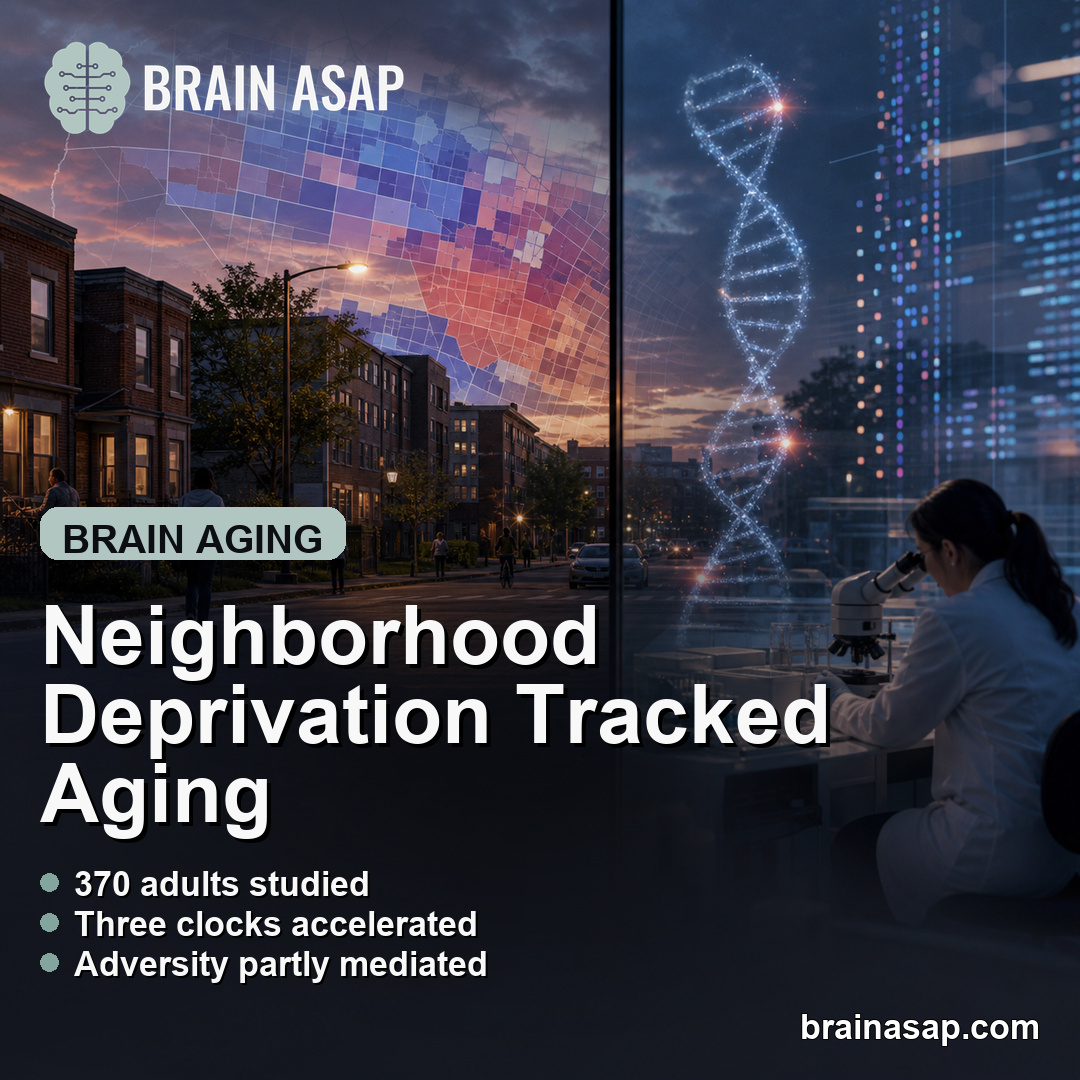
- Yale sample anchored the test: The cross-sectional Yale Stress Center sample included 370 adults aged 18 to 50 years without major psychiatric, medical, or cognitive disorders.
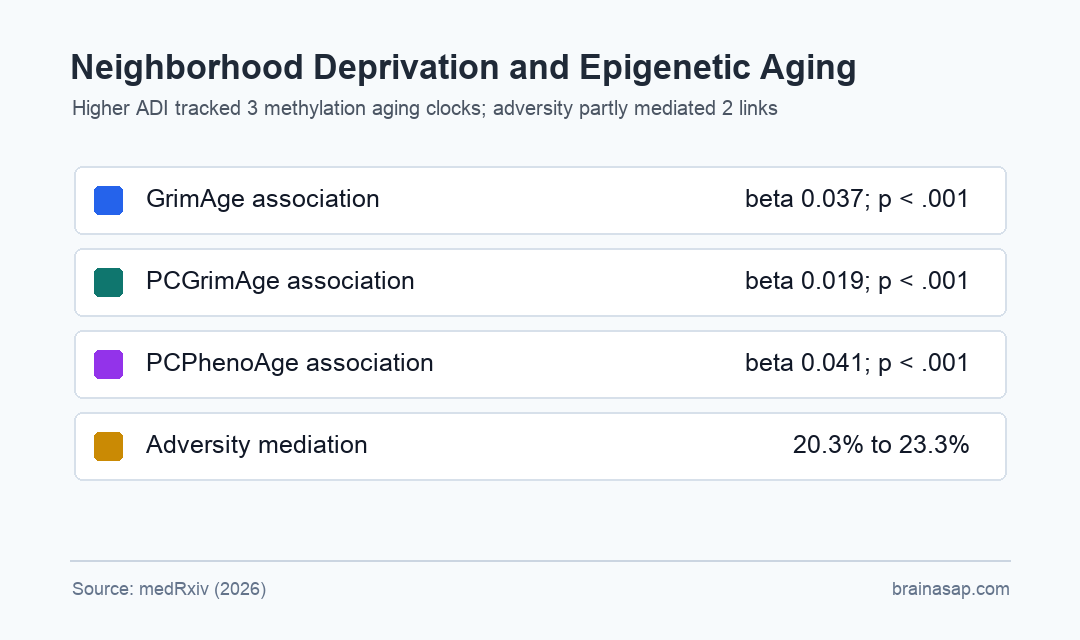
- Three clocks accelerated: Higher Area Deprivation Index was associated with faster GrimAge (beta = 0.037), PCGrimAge (beta = 0.019), and PCPhenoAge (beta = 0.041), all with p values below .001.
- One clock did not track: PhenoAge was not significantly associated with neighborhood deprivation in the main model.
- Adversity partly mediated the link: Lifetime adversity explained 20.3% of the ADI-GrimAge association and 23.3% of the ADI-PCGrimAge association.
- Race modified some associations: The direct ADI association was stronger among Black participants for GrimAge (beta = 0.061, p = .004) and PCPhenoAge (beta = 0.057, p = .02) than among White participants.
Source: medRxiv (2026) | Koirala et al.
Neighborhood deprivation is not just a label for where someone lives. In this study, it was measured with the Area Deprivation Index, a census-based score that summarizes local socioeconomic conditions such as income, education, employment, housing, and household resources.
The biological outcome was epigenetic age acceleration, meaning DNA-methylation patterns suggested a person’s body was aging faster or slower than expected for chronological age. Researchers tested four second-generation clocks rather than relying on one aging readout.
Area Deprivation Index Tracked Faster GrimAge and PCPhenoAge
The analysis used data from 370 healthy adults in the greater New Haven, Connecticut area. Participants were 18 to 50 years old, and the mean age was 29.3 years.
Higher neighborhood deprivation was associated with faster aging on three DNA-methylation clocks. The strongest result in the abstract was for PCPhenoAge beta = 0.041, followed by GrimAge beta = 0.037 and PCGrimAge beta = 0.019.
- GrimAge: Higher deprivation tracked faster methylation aging related to mortality and healthspan risk.
- PCGrimAge: A principal-component version of GrimAge showed the same direction with a smaller standardized estimate.
- PCPhenoAge: The principal-component PhenoAge version also accelerated with higher neighborhood deprivation.
- PhenoAge: The original PhenoAge clock did not show a significant association in the main model.
The association did not disappear when individual-level factors were added.
Neighborhood deprivation is correlated with personal education, income, and lifetime stress, but the neighborhood measure remained informative after those factors were considered.
The study also examined conditions beyond the broad ADI score. Lower neighborhood educational attainment, lower neighborhood income, lower food access, and pollution exposure were assessed as separate local conditions.
Neighborhood education showed the most consistent pattern across aging clocks, making the analysis more specific than a single deprivation score alone.
Lifetime Adversity Explained Part of the Biological-Aging Link
The study also tested whether personal stress exposure helped explain why neighborhood deprivation related to biological aging. Higher deprivation was associated with greater lifetime adversity beta = 0.112 and lower educational attainment.
Mediation analysis suggested that adversity explained part, but not all, of the association. Lifetime adversity accounted for 20.3% of the total ADI-to-GrimAge effect and 23.3% of the ADI-to-PCGrimAge effect.
- Neighborhood exposure: Higher ADI captured broader structural conditions around the participant.
- Individual stress pathway: Lifetime adversity partly carried that exposure into faster methylation aging.
- Remaining direct effect: ADI still mattered after adversity was included, so the pathway was not only personal stress reporting.
The findings support a layered interpretation. Neighborhood conditions may shape stress exposure, but they may also mark other exposures, including educational resources, pollution, food access, safety, and chronic social strain.
Because the participants were young to midlife adults rather than older adults with established chronic disease, the methylation signal is especially relevant as an early biological marker. It suggests that neighborhood conditions may be measurable in aging biology before late-life disease outcomes appear.
Black Participants Showed Stronger Direct ADI Associations
Race moderated some associations. Among Black participants, higher neighborhood deprivation had a stronger direct association with faster GrimAge beta = 0.061 and PCPhenoAge beta = 0.057 compared with White participants.
The study does not treat race as a biological cause. The interpretation is structural: racialized residential patterns, discrimination, resource allocation, and cumulative stress may change how neighborhood deprivation becomes biologically embedded.
- GrimAge moderation: The ADI relationship was stronger among Black participants for this mortality-linked aging clock.
- PCPhenoAge moderation: A similar moderation pattern appeared for the principal-component PhenoAge clock.
- Equity implication: Neighborhood disadvantage may interact with social conditions tied to structural racism.
That distinction is important for how the result should be read. The data point toward social and environmental pathways, not inherited racial biology.
The moderation finding also argues against treating neighborhood effects as uniform. The same ADI score may not mean the same lived exposure if groups differ in residential history, discrimination, policing, economic opportunity, or accumulated stress across generations.
Cross-Sectional DNA-Methylation Data Cannot Prove Causality
The main limitation is design. A cross-sectional study can show associations between ADI, adversity, and methylation age, but it cannot prove that neighborhood deprivation caused biological aging to accelerate.
The sample was also drawn from one regional study and excluded people with major psychiatric, medical, or cognitive disorders. That cleaner sample helps isolate biology, but it may understate or reshape what would be seen in older, sicker, or more geographically diverse groups.
- Temporal uncertainty: Neighborhood exposure and methylation were not followed prospectively across decades.
- Sample limits: Participants came from the greater New Haven area and were mostly young adults.
- Clock specificity: Three clocks tracked deprivation, while one did not, so the finding depends on the aging measure.
Even with those limits, the study connects a measurable neighborhood index to specific biological-aging clocks and a partially quantified stress pathway.
Citation: DOI: 10.64898/2026.04.24.26351669. Koirala et al. Neighborhood Deprivation Is Associated with Accelerated Epigenetic Aging Via Greater Individual Adversity. medRxiv. 2026.
Study Design: Cross-sectional community sample with DNA-methylation epigenetic-aging measures and neighborhood deprivation modeling.
Sample Size: 370 adults aged 18 to 50 years without major psychiatric, medical, or cognitive disorders.
Key Statistic: Higher Area Deprivation Index was associated with GrimAge, PCGrimAge, and PCPhenoAge acceleration, all p values below .001; lifetime adversity mediated 20.3% and 23.3% of two clock associations.
Caveat: The preprint is cross-sectional and cannot establish causal timing between neighborhood exposure, adversity, and methylation aging.