TL;DR: A 2026 preprint in bioRxiv found that Magnetic Resonance Artificial Intelligence Velocimetry (MR-AIV), a physics-informed AI method for estimating brain fluid transport, produced stable velocity and permeability maps across several modeling stress tests.
Key Findings
- Brain-fluid target: MR-AIV estimates three-dimensional velocity, pressure, and permeability fields from dynamic contrast-enhanced MRI.
- 10-region initialization: A universal, anatomically informed 10-region permeability map improved anatomical alignment and physical consistency compared with a binary initialization.
- Fast-flow estimate: ROI-based initializations recovered a fast-flow speed near 3 micrometers per second while preserving a bimodal fast/slow distribution.
- Velocity robustness: Three very different velocity initializations converged to nearly identical predicted velocity distributions after training.
- Noise boundary: The framework was robust to distributed Gaussian noise but more sensitive to sparse, high-magnitude outliers in concentration data.
Source: bioRxiv (2026) | Vaezi et al.
MR-AIV is a machine-learning framework designed to infer brain-fluid motion from dynamic MRI data. The method embeds porous-media physics into the model so the AI is constrained by equations for flow, pressure, and permeability.
Cerebrospinal and interstitial fluid transport are tied to brain waste clearance. Reliable noninvasive mapping could help future studies of glymphatic function, Alzheimer disease, and other neurological conditions.
MR-AIV Estimated Deep-Brain Flow From Dynamic Contrast MRI
The method starts with dynamic contrast-enhanced MRI, where tracer concentration changes over time. MR-AIV then estimates how fluid moves through brain tissue and perivascular spaces.
Researchers focused on model robustness rather than a new disease comparison. They tested whether the inferred fields changed when assumptions changed.
Brain imaging methods need this kind of robustness check. A method can look persuasive in a single reconstruction but still fail if small choices about initialization, diffusivity, or noise produce different biological-looking maps.
- Velocity: The inferred direction and speed of fluid movement through the modeled brain domain.
- Pressure: The pressure field that helps explain movement through porous tissue.
- Permeability: The modeled ease with which fluid can pass through regions of the brain.
- Concentration data: The time-varying tracer signal used to constrain the inference.
For that reason, the source is best read as a methods study rather than a patient-outcome study. The main result is reproducibility under different modeling choices.
ROI-Based Permeability Maps Produced More Consistent Estimates
One major test compared four ways to initialize permeability. The most informative contrast was between a binary map based on early tracer arrival and anatomically informed region-of-interest maps.
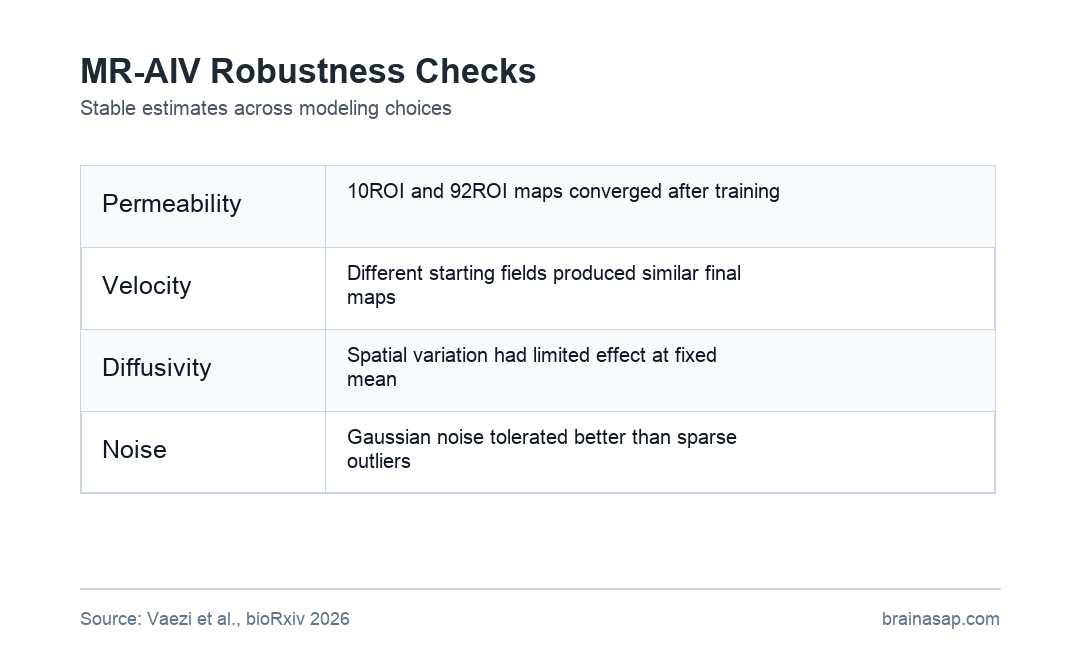
The 10-region ROI initialization and the more detailed 92-region ROI initialization produced similar predicted permeability distributions after training. A perturbed 92-region version also converged closely, supporting robustness to spatial perturbation.
- Binary map: Started from early-time tracer arrival and produced more deviation after training.
- 10ROI map: Used a compact anatomical prior and supported the recommended setup.
- 92ROI map: Used a more detailed anatomical prior but produced similar final estimates.
- Perturbed 92ROI map: Tested sensitivity to spatial disturbance and still converged near the unperturbed ROI result.
The recovered speed fields kept a bimodal structure, separating faster and slower flow regions. For ROI-based initializations, the fast-flow component was about 3 micrometers per second.
Different Velocity Starting Points Converged After Training
A second stress test asked whether initial velocity guesses controlled the final answer. Researchers compared two front-tracking velocity fields and a spatially uniform velocity field.
Despite very different starting distributions, the model converged to nearly identical predicted velocity distributions after training. Predicted permeability distributions also overlapped when the same universal 10ROI permeability map was used.
- Front tracking 1: Initial velocity came from one thresholding criterion.
- Front tracking 2: Initial velocity came from a second thresholding criterion.
- Uniform velocity: The model started from a constant 0.1 mm/min field across the brain domain.
Practical deployment depends on that stability. If final maps depend heavily on arbitrary starting velocity guesses, cross-subject comparisons become fragile.
Diffusivity Tests Supported a Uniform-Diffusivity Assumption
The study also tested diffusivity assumptions. Diffusivity describes how tracer spreads by diffusion, separate from bulk flow.
When the mean diffusivity was preserved, spatial diffusivity variations did not strongly change predicted speed and permeability maps. High- and low-valued regions remained visually similar across cases.
- Mean value mattered: Changing the overall mean diffusivity affected the model in a physically consistent direction.
- Spatial pattern mattered less: Heterogeneous maps with the same mean produced similar inferred structures.
- Practical implication: A uniform diffusivity assumption may be acceptable for the tested operating regime.
The result supports a narrower claim: the tested framework was not highly unstable when spatial heterogeneity was added at a fixed mean value.
For future neurological studies, that supports using a simpler diffusivity setup when the research question is about reproducible flow-field structure rather than subject-specific diffusion microphysics.
Gaussian Noise Was Tolerated Better Than Sparse Outliers
Real dynamic MRI data include noise and artifacts, so researchers added synthetic noise to concentration fields. Two scenarios mattered: distributed Gaussian noise and sparse, high-magnitude outliers.
MR-AIV was more robust to Gaussian noise, where error is spread across the data. It was more sensitive to sparse outliers, where a small number of points carry large errors.
That boundary is useful. Future MR-AIV workflows may need outlier detection and preprocessing steps before relying on inferred brain-fluid maps.
The main limitation is that this was a methods robustness study, including synthetic concentration tests and model-comparison logic. It supports deployment choices, but it does not yet show clinical diagnostic performance.
The next step is validation against independent physiological benchmarks, repeated scans, and disease cohorts where altered clearance is expected. Until then, MR-AIV is best viewed as a promising mapping framework rather than a clinical readout.
Citation: DOI: 10.64898/2026.04.14.718498. Vaezi et al. Robust MR-AIV: a systematic study of robustness and reproducibility for MRI-based brain fluid transport mapping. bioRxiv. 2026.
Study Design: Computational methods and robustness study of a physics-informed neural-network framework for estimating brain-fluid transport from dynamic contrast-enhanced MRI.
Sample/Model: MR-AIV simulations and MRI-derived concentration-field analyses testing initialization, permeability, diffusivity, signal-concentration mapping, and noise assumptions.
Key Statistic: ROI-based initialization recovered a fast-flow component near 3 micrometers per second and preserved similar spatial speed/permeability patterns across initialization tests.
Caveat: The preprint supports methodological robustness, not clinical diagnosis or patient-level prediction.