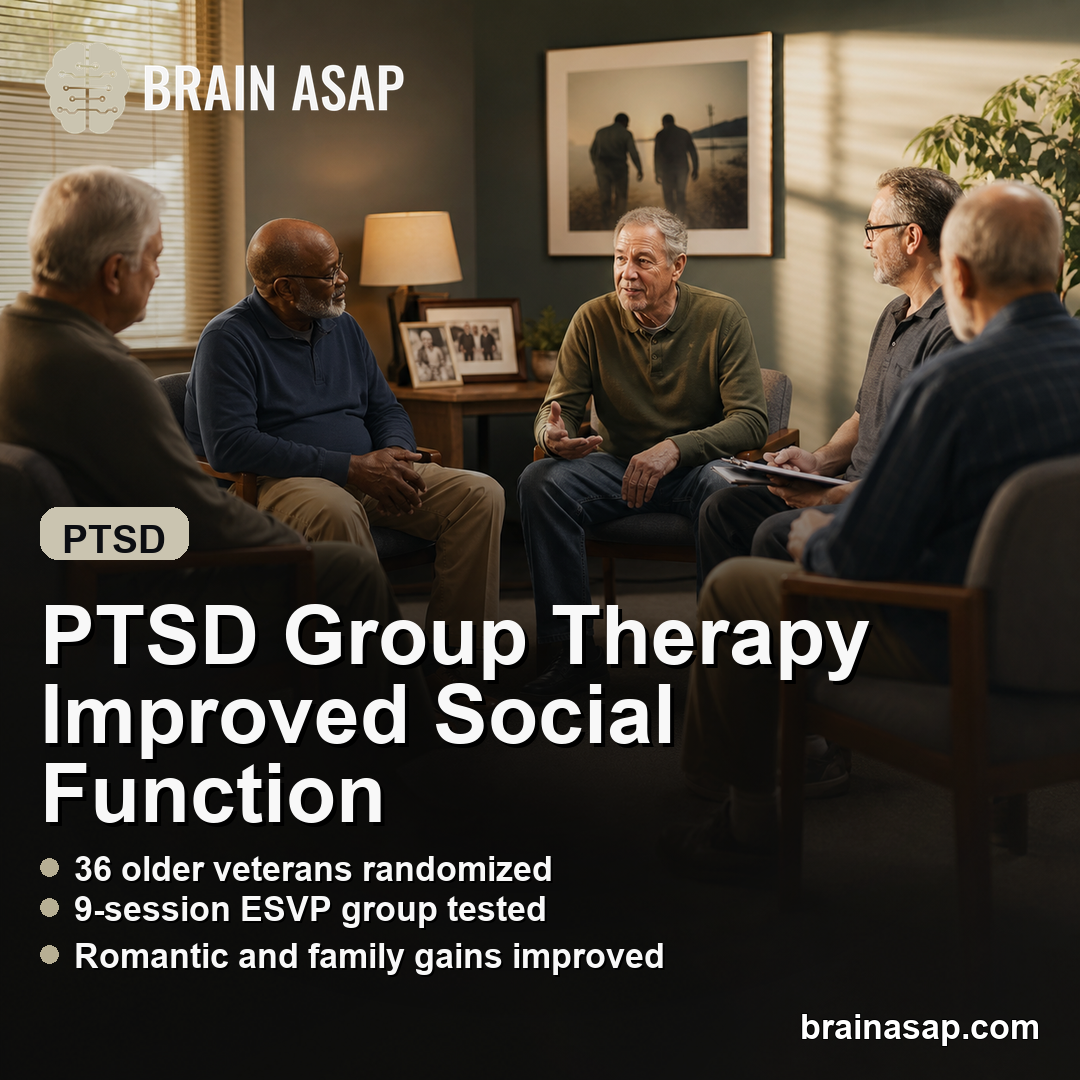
TL;DR: A 2026 pilot randomized trial in Psychological Services found that a 9-session social-function group for older veterans with PTSD was feasible and acceptable, with stronger relationship gains than a support group in romantic and family functioning.
Key Findings
- 36 randomized veterans: Participants were assigned to ESVP or a support-group comparison condition.
- 34 started treatment: 2 support-group participants dropped out before intervention sessions began.
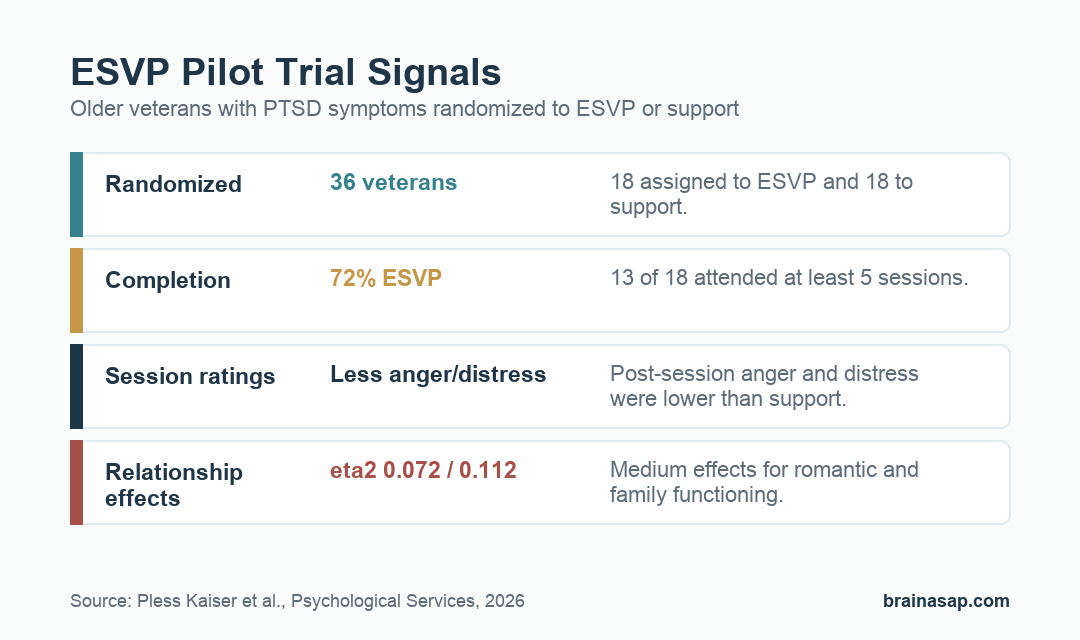
- 72% ESVP completers: 13 of 18 veterans assigned to ESVP attended at least 5 of 9 sessions.
- Lower anger and distress: ESVP session ratings showed less anger (t = 3.59, p < 0.001) and distress (t = 3.44, p < 0.001) than support sessions.
- Relationship-specific gains: ESVP showed medium condition-by-time effects for romantic relationships and family functioning.
Source: Psychological Services (2026) | Pless Kaiser et al.
Enhancing Social Function for Older Veterans with PTSD (ESVP) is a group intervention built around social functioning rather than trauma processing alone.
The pilot tested enrollment, attendance, session tolerance, and early relationship-function gains.
That focus is important because PTSD can damage social life through estrangement, anger, avoidance, communication problems, and reduced social activity. In later life, those problems can overlap with loneliness, medical burden, retirement, bereavement, and shrinking social networks.
ESVP Tested a Nine-Session Social Function Group
The trial randomized 36 U.S. military veterans aged 60 or older to ESVP or a support-group comparison condition.
The final intervention sample included 34 veterans after 2 support-group participants could not be reached before sessions began.
The sample ranged from 61 to 85 years, with a mean age of 71.62. Most participants were men, most were White, and more than half met criteria for current PTSD.
Baseline symptoms were clinically meaningful. PTSD symptom scores ranged from 6 to 61, and 19 veterans met current PTSD criteria on structured clinical interview.
- ESVP content: 9 sessions covered social function, communication, anger management, social support, social activities, and life review.
- Comparison condition: the support group provided structured social support and take-home work.
- Outcome frame: researchers measured feasibility, acceptability, and social-function change at baseline, post-intervention, and 6-month follow-up.
This was a pilot study, so ESVP should not be read as standard care yet. The immediate test was whether the intervention was plausible enough to justify larger evaluation.
Enrollment Was Possible, but Recruitment Was Not Easy
The researchers attempted to contact 270 veterans. Of 117 assessed for eligibility, 74 were eligible and 36 enrolled. That produced an enrollment-to-assessment ratio of 31% and an enrollment-to-eligibility ratio of 48%.
Recruiting socially isolated older adults into a group focused on social function is inherently difficult. The authors noted that social-function framing itself can be a barrier for people who are less socially engaged.
- Contact barrier: 110 veterans were not screened because they could not be reached, had died, or moved away.
- Eligibility barrier: 43 assessed veterans were ineligible because of trauma/PTSD criteria, severe mental illness, neurocognitive disorder, or current PTSD treatment.
- Interest barrier: 29 eligible veterans declined, though some said they might participate later.
ESVP Sessions Had High Acceptability and Lower Distress
Engagement supported feasibility. Veterans assigned to ESVP attended an average of 6.56 sessions, and 13 of 18 attended at least 5 sessions. Support-group participants attended an average of 5.62 sessions, with 11 of 16 considered completers.
Session ratings were also favorable. ESVP relevance averaged 3.78 of 4, and satisfaction averaged 3.83 of 4. These ratings did not significantly differ from the support group.
- Feeling better: ESVP participants rated themselves as more improved than support participants, t = 3.81, p < 0.001.
- Lower anger: post-session anger was lower in ESVP than support, t = 3.59, p < 0.001.
- Lower distress: post-session distress was lower in ESVP than support, t = 3.44, p < 0.001.
- Skills use: ESVP participants reported more frequent anger-management and coping-skill use outside sessions.
Older veterans with PTSD can avoid interventions that seem emotionally destabilizing. In this pilot, the more structured social-function group was not less acceptable than support.
Romantic and Family Function Improved More Than General Socializing
The social-function results were relationship-specific. ESVP showed a medium condition-by-time effect for romantic relationships, eta squared = 0.072. ESVP participants improved from baseline to post-intervention and did not show a rebound by six-month follow-up.
Family functioning showed a similar pattern, with a medium condition-by-time effect of eta squared = 0.112. Support-group participants did not show the same family-function improvement.
Friendships and socializing looked different. The condition-by-time effect was essentially absent, eta squared = 0.009. Both groups plausibly helped friendship and socializing because both created regular social contact.
- Close relationships: ESVP fits romantic and family problems because it teaches communication and anger-management skills.
- General socializing: even a support group can help by creating peer contact and routine conversation.
- Follow-up need: booster sessions or modular sessions may be needed to maintain gains for some veterans.
This PTSD Social-Function Result Needs a Larger Trial
The study supports ESVP as a candidate intervention, not a settled treatment. The sample was small, baseline groups differed on PTSD severity and romantic-function impairment, and the support group was an active comparison rather than a minimal control.
Still, the pilot gives a clear next step. Older veterans with PTSD are a reasonable target for treatment that names social functioning directly, especially when the problem is family communication, anger, distress, or intimate relationship strain.
A larger trial could test durable benefit beyond support-group contact, identify which veterans benefit most, and evaluate whether social-function screening improves recruitment and targeting.
Citation: DOI: 10.1037/ser0000962. Pless Kaiser et al. Feasibility, Acceptability, and Outcomes: A Pilot Trial of the Enhancing Social Function in Older Veterans with PTSD (ESVP) Group Intervention. Psychological Services. 2026;23(2):293-306.
Study Design: Pilot randomized trial comparing ESVP with a support-group condition.
Sample Size: 36 randomized older U.S. veterans with military-related trauma and PTSD symptoms; 34 began intervention.
Key Statistic: ESVP showed medium condition-by-time effects for romantic relationship functioning (eta squared = 0.072) and family functioning (eta squared = 0.112).
Caveat: Small pilot sample, baseline group imbalances, and active support comparison limit efficacy conclusions.