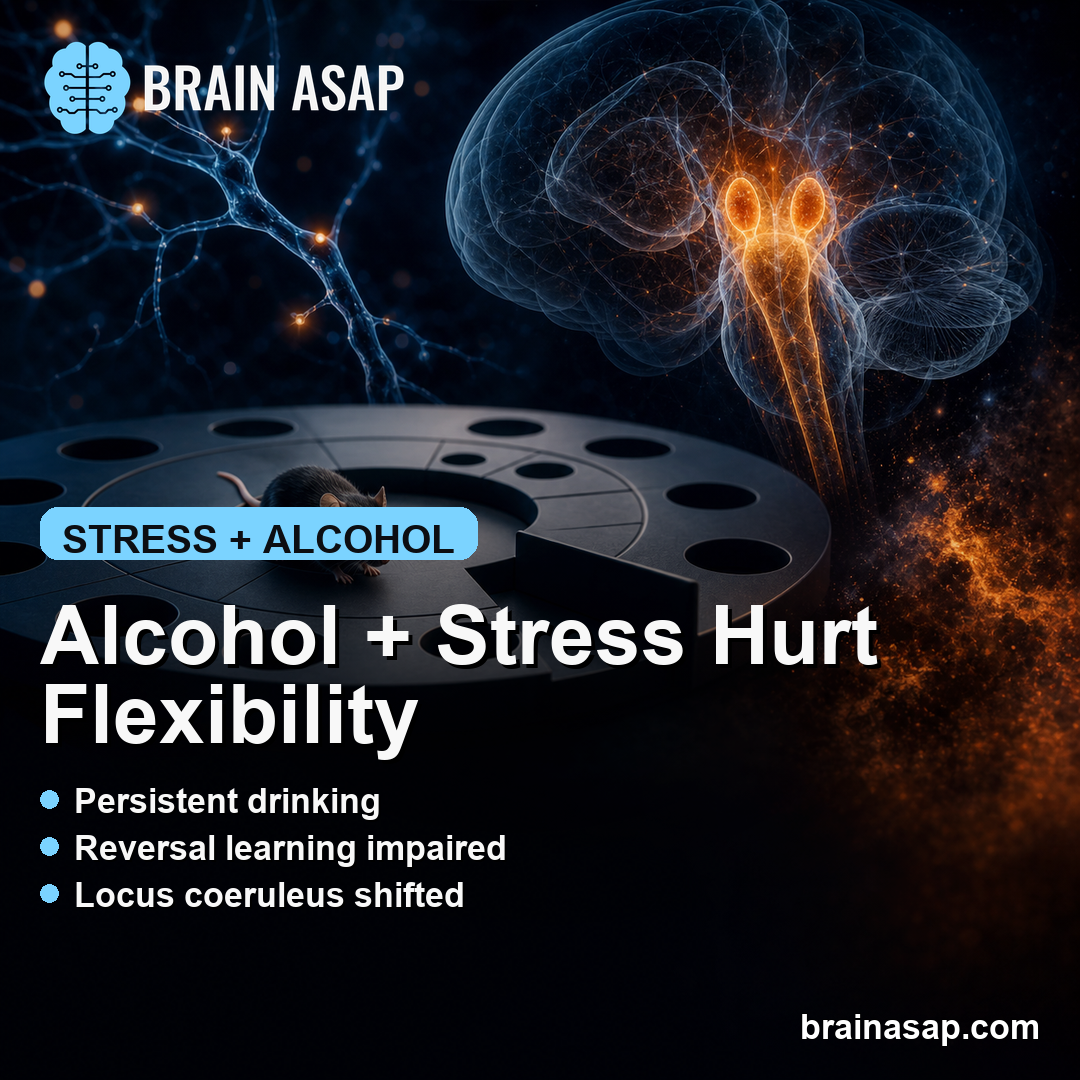
TL;DR: A 2026 mouse study in Alcohol: Clinical and Experimental Research found that chronic intermittent ethanol plus repeated forced-swim stress left mice drinking more alcohol months later and impaired reversal learning in midlife, alongside locus coeruleus signs of oxidative stress and weaker adrenergic autoregulation.
Key Findings
- Persistent effects reached midlife: The experiment followed 55 C57BL/6J mice from young adult alcohol-plus-stress exposure into midlife testing.
- Alcohol intake stayed elevated: Mice with ethanol-plus-stress history kept higher voluntary alcohol drinking at about 11 months old, after months away from the exposure cycles.
- Spatial learning looked intact: Initial Barnes maze performance did not differ clearly between the exposed and control groups.
- Reversal learning was impaired: The exposed mice spent less time in the new target quadrant and made more errors when the escape location changed.
- Locus coeruleus biology shifted: The exposed mice showed higher 4-HNE, a marker of oxidative lipid damage, and a 22% reduction in α2A-adrenergic receptor expression.
Source: Alcohol: Clinical and Experimental Research (2026) | Revka et al.
Alcohol and Stress Left a Persistent Drinking Pattern
The study tested a simple but important question: can heavy alcohol exposure plus repeated stress in young adult mice leave a midlife trace after a long break from the original exposure?
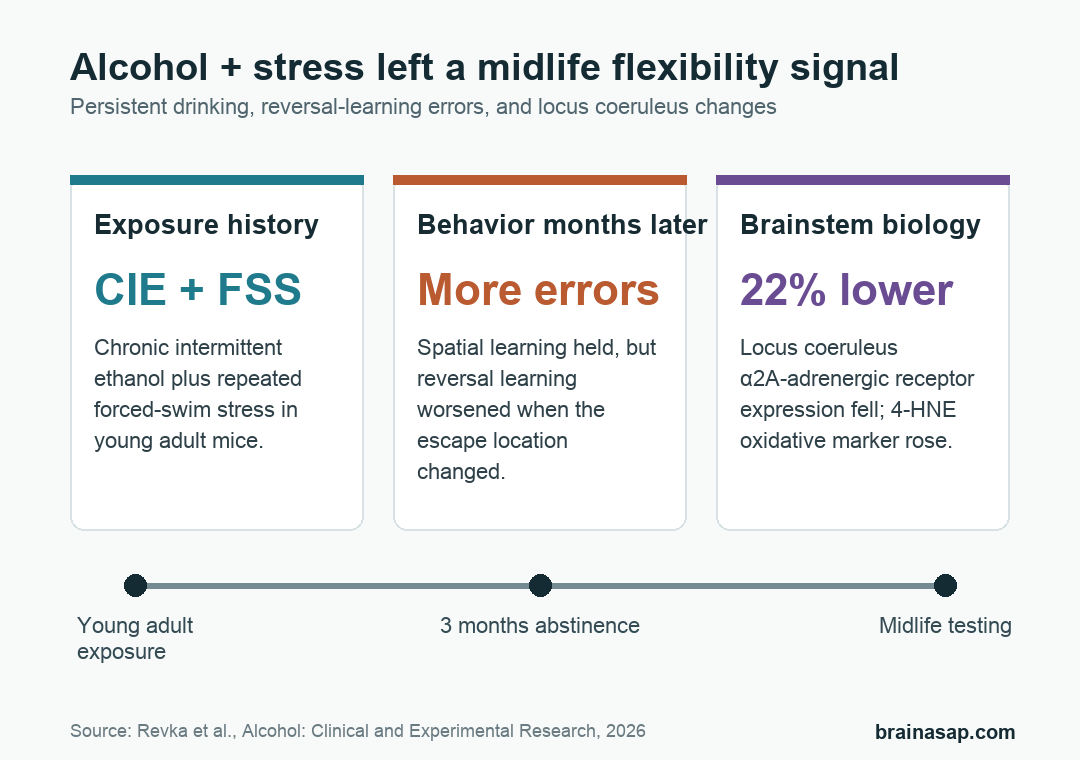
The researchers used chronic intermittent ethanol (CIE), an alcohol-vapor exposure model, paired with forced-swim stress (FSS). Control mice received air exposure without forced-swim stress.
After four alternating cycles, the mice had about 3 months of home-cage abstinence before midlife testing.
The drinking result was durable. Mice with a CIE/FSS history drank more alcohol than controls after the original exposure cycles and still showed higher voluntary intake at about 11 months of age.
- Control group: Most air/no-stress mice were classified as low drinkers in midlife.
- Alcohol-plus-stress group: Most CIE/FSS mice were classified as high drinkers in midlife.
- Stability: Drinking classification stayed stable across aging in most animals in both groups.
The paper is not only showing an acute withdrawal effect. The exposure history appeared to leave a longer-lasting vulnerability in stress- and reward-related behavior.
The Cognitive Problem Appeared When the Rule Changed
The Barnes maze separated ordinary spatial learning from cognitive flexibility, the ability to adapt when a learned rule stops working.
During the first test, the animals learned where the escape box had been placed. In the reversal phase, the target moved to the opposite side of the maze.
Initial spatial learning did not clearly differ between groups. That is a useful boundary because it argues against a broad inability to use the maze, remember the environment, or move around the platform.
The deficit appeared when the task changed. CIE/FSS mice spent less time in the new target zone and made more errors during reversal testing.
A composite performance score also showed worse reversal performance in the exposed group compared with controls.
- Intact first rule: Time in the target zone, primary latency, and errors did not show clear group differences during the original spatial test.
- Impaired new rule: The exposed mice struggled when the target location changed.
- Executive function angle: The pattern points more toward impaired flexibility than a general spatial-memory failure.
For a human reader, the closest translation is not “alcohol plus stress erased memory.” The narrower interpretation is that prior alcohol-plus-stress exposure made the brain less flexible when an old solution had to be updated.
Locus Coeruleus Changes Matched the Flexibility Result
The locus coeruleus is a small brainstem nucleus that supplies much of the brain’s norepinephrine, a neuromodulator involved in arousal, attention, stress responses, and flexible behavior. It is also vulnerable in several age-related neurodegenerative conditions.
The team focused on the locus coeruleus because it sits at the intersection of stress biology, alcohol-related adaptation, and cognitive flexibility.
In the exposed mice, the region showed several signs of altered cellular integrity.
- Oxidative stress: 4-hydroxynonenal (4-HNE), a lipid-peroxidation marker, was higher in the locus coeruleus of CIE/FSS mice.
- Cell-death signal: Cleaved caspase-6 showed a nonsignificant increase, so the paper treats that result as suggestive rather than definitive.
- Autoregulatory brake: α2A-adrenergic receptor expression was 22% lower, suggesting weaker feedback control over locus coeruleus norepinephrine signaling.
The receptor finding is especially relevant because α2A receptors help the locus coeruleus restrain its own activity.
If that brake is weakened, stress-linked norepinephrine signaling may become harder to regulate.
What the Study Does and Does Not Show About Dementia Risk
The authors frame the work partly around accelerated cognitive aging and dementia vulnerability. Heavy alcohol use, chronic stress, and locus coeruleus degeneration all have links to later-life brain health.
Still, this was a mouse study, not a human dementia trial. It does not prove that people with alcohol use disorder and chronic stress will develop the same locus coeruleus changes or a specific dementia outcome.
The value is more mechanistic: it shows a plausible path by which early adult alcohol-plus-stress exposure could leave a midlife cognitive and brainstem signature.
- Strongest evidence: Persistent drinking and reversal-learning impairment after the exposure history.
- Mechanistic clue: Locus coeruleus oxidative stress and reduced α2A-adrenergic receptor expression.
- Main caveat: Mouse exposure models help test mechanisms, but they are not direct clinical forecasts for humans.
A practical next step would be finding accessible markers of locus coeruleus integrity in people with chronic alcohol and stress histories. The paper mentions possibilities such as locus coeruleus imaging, blood-based assays, early cognitive tests, or salivary α-amylase reactivity.
Why the Finding Is More Specific Than Alcohol Hurts the Brain
The useful part of this paper is its specificity. The finding is not a generic warning that alcohol and stress are bad.
It identifies a behavioral phenotype, a brainstem target, and two measurable biological changes that persisted into midlife.
The specificity also keeps the interpretation restrained. The exposed mice could still learn the first maze location, but they were worse at updating behavior when the rules changed.
The locus coeruleus findings give that selective cognitive deficit a plausible stress-neuromodulation context.
For alcohol-use-disorder research, the study points toward a long-term question: whether cognitive inflexibility after repeated alcohol and stress exposure is partly maintained by altered norepinephrine regulation.
If that link holds up, prevention and treatment work may need to pay closer attention to the brain systems that help people shift behavior after stress, not only to systems that drive craving.
Citation: DOI: 10.1111/acer.70273. Revka O et al. Impact of chronic alcohol and stress on mid-life cognition and locus coeruleus integrity in mice. Alcohol: Clinical and Experimental Research. 2026;50(3):e70273.
Study Design: Mouse experiment using chronic intermittent ethanol exposure plus repeated forced-swim stress, followed by midlife drinking, Barnes maze, and locus coeruleus tissue assays.
Sample/Model: 55 C57BL/6J mice, with 27 assigned to CIE/FSS and 28 assigned to air/no-stress control conditions.
Key Statistic: α2A-adrenergic receptor expression in the locus coeruleus was 22% lower in CIE/FSS mice than controls, while reversal-learning performance was impaired.
Caveat: The study tested a controlled mouse model; it cannot by itself establish human dementia risk or clinical treatment effects.