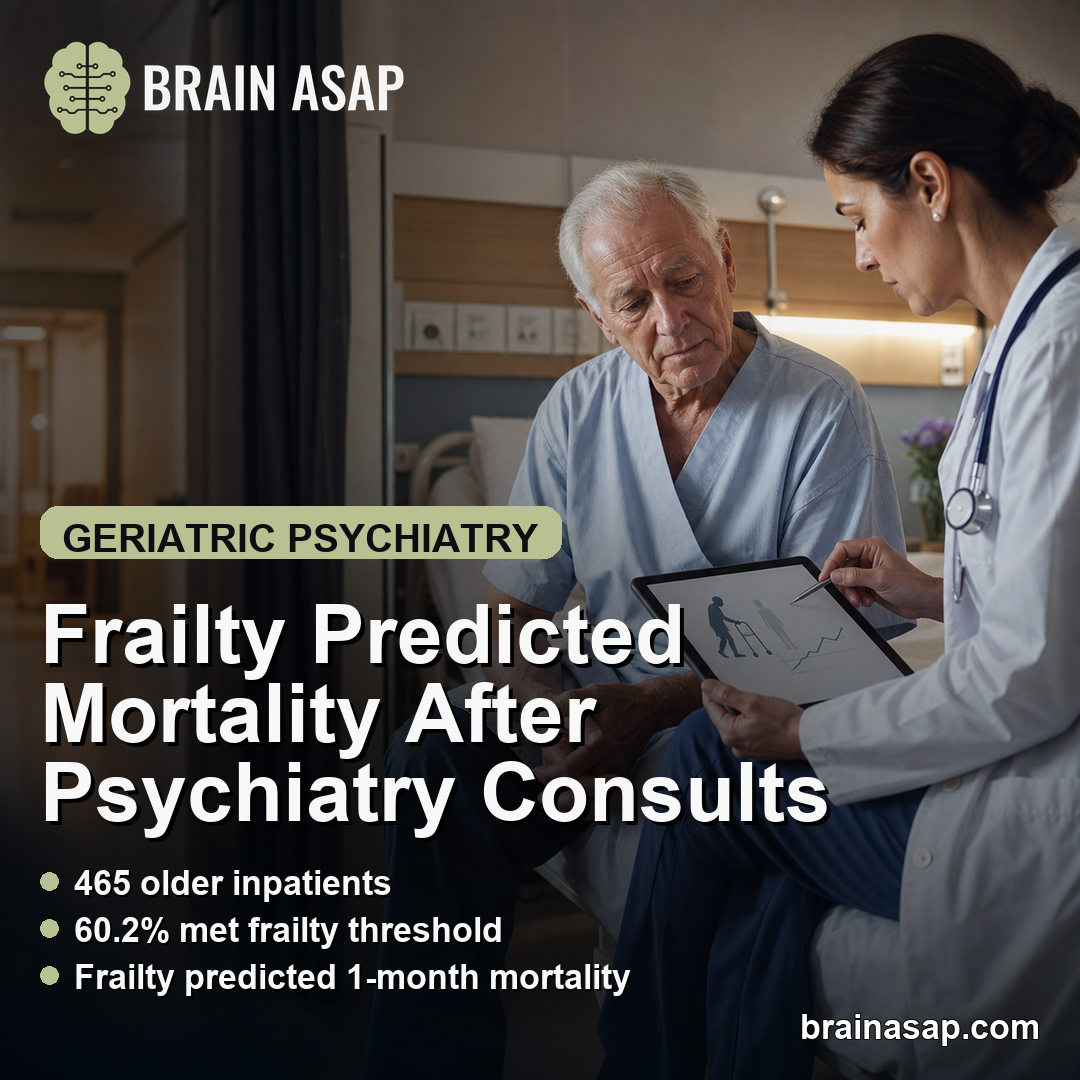
TL;DR: A 2026 preprint in medRxiv reported that frailty and medical comorbidity predicted short-term outcomes more clearly than psychiatric history among older adults evaluated by consultation-liaison psychiatry teams in Spanish general hospitals.
Key Findings
- 465 older inpatients: The prospective OLD-3 cohort included adults aged 65 years and older referred to consultation-liaison psychiatry in 10 Spanish hospitals.
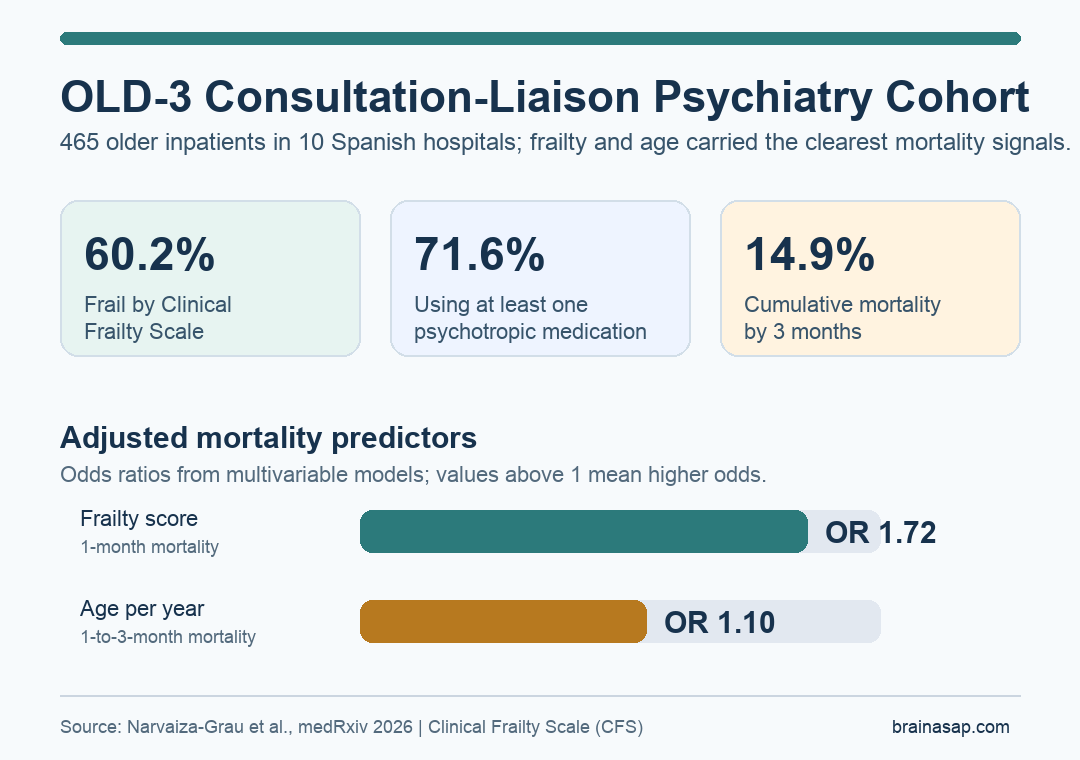
- 60.2% frailty: Among 460 assessed patients, 277 met the study’s frailty threshold on the Clinical Frailty Scale.
- 71.6% psychotropic use: Before admission, 333 of 465 patients were receiving at least one psychotropic medication, most often antidepressants or benzodiazepines.
- 1-month mortality link: Each higher Clinical Frailty Scale point was associated with higher 1-month mortality after discharge (adjusted OR 1.72; 95% CI, 1.17-2.54).
- 14.9% 3-month mortality: Cumulative mortality reached 14.9% by 3 months, with age independently predicting deaths between 1 and 3 months.
Source: medRxiv (2026) | Narvaiza-Grau et al.
Consultation-liaison psychiatry teams are often asked to evaluate older hospitalized adults whose psychiatric symptoms are mixed with delirium, infection, surgery, heart failure, cancer, medication effects, and loss of independence.
The OLD-3 study tested a practical question in that setting: when older patients are referred for psychiatric consultation during a hospital stay, do psychiatric variables or geriatric vulnerability markers better predict early outcomes?
Frailty Was Common in Older Psychiatry Consultation Patients
The cohort included 465 consecutive patients aged 65 years or older who were evaluated by consultation-liaison psychiatry services between January and July 2024.
Mean age was 77.4 years, 55.9% were women, and 61.7% were at least 75 years old. Most evaluations happened on medical wards rather than surgical wards or intensive care units.
- Medical wards: 359 of 465 evaluations, or 77.2%, occurred on medical services.
- Medical complexity: The median age-adjusted Charlson Comorbidity Index was 5, and 59.6% scored at least 5 points.
- Functional decline: Median Barthel Index fell from 90 before admission to 60 at admission, showing a large drop in basic daily function.
- Frailty burden: The median Clinical Frailty Scale score was 4, and 37.0% had moderate-to-severe frailty.
The Clinical Frailty Scale is a 9-point clinician-rated scale that summarizes vulnerability from very fit to terminally ill. In this study, patients with scores of 4 or higher were classified as frail.
That threshold mattered because frailty was not just background description. It was one of the clearest predictors of early mortality after discharge.
Psychiatric Diagnoses Were Frequent but Did Not Explain Most Outcomes
Psychiatric history was common: 68.8% of patients had a documented prior psychiatric condition. Mood disorders were the largest prior-diagnosis group, followed by persistent depressive disorder, adjustment disorders, anxiety disorders, psychotic disorders, and substance-related disorders.
Consultation also uncovered new psychiatric diagnoses. After assessment, 55.8% of patients received a new diagnosis, and delirium was the most frequent primary diagnosis among those with complete diagnostic data.
- Delirium: 108 of 426 patients with complete diagnosis data, or 25.4%, had delirium as the primary post-consultation diagnosis.
- Adjustment disorders: 102 patients, or 23.9%, had an adjustment or trauma-related diagnosis.
- Major depression: 48 patients, or 11.3%, had major depressive disorder as the primary diagnosis.
The main interpretation is not that psychiatric symptoms were unimportant. Rather, in this medically complex inpatient group, frailty, comorbidity, age, and functional status predicted outcomes more clearly than psychiatric history alone.
That distinction is clinically useful. A patient referred for agitation, depression, anxiety, or treatment adjustment may still need a geriatric risk assessment because the short-term danger may be tied to vulnerability, mobility, delirium risk, or medication burden.
Psychotropic Polypharmacy Tracked Falls Before Admission
Before admission, 333 patients were taking at least one psychotropic medication. Antidepressants were used by 49.0%, benzodiazepines by 42.6%, antipsychotics by 23.0%, and mood stabilizers by 13.5%.
Falls were also common. Among 464 patients with data, 28.4% had fallen at least once in the prior 6 months.
- Antidepressant exposure: Falls were more frequent among antidepressant users than nonusers, 59.4% versus 46.6% in the fall/no-fall comparison.
- Mood stabilizers: Mood stabilizer exposure was also more common among patients with falls, 19.6% versus 11.7%.
- Psychotropic polypharmacy: Use of at least two psychotropic classes was higher in the fall group, 47.0% versus 35.6%.
The adjusted fall model did not leave age, frailty, or functional indices as independent predictors. The medication signal is therefore more descriptive than causal, especially because sicker patients may receive more medication for reasons linked to the same fall risk.
Still, the pattern supports structured medication review. In older inpatients, a psychiatric consultation can also be a chance to review benzodiazepines, antipsychotics, sedating antidepressants, and combinations that may worsen mobility or cognition.
Frailty Predicted 1-Month Mortality and Age Predicted Later Mortality
Mortality was high for a consultation-liaison psychiatry cohort. In-hospital mortality was 5.6%. Among patients with available follow-up, another 4.9% died by 1 month after discharge.
Between 1 and 3 months after discharge, 22 additional deaths occurred. Cumulative mortality by 3 months reached 14.9%.
The adjusted mortality models separated two timing patterns:
- In-hospital mortality: Frailty trended higher but did not reach statistical significance after adjustment (OR 1.37; 95% CI, 0.97-1.94).
- 1-month mortality: Each higher Clinical Frailty Scale point was independently associated with higher mortality (OR 1.72; 95% CI, 1.17-2.54).
- 1-to-3-month mortality: Age was the independent predictor, with an adjusted OR of 1.10 per year (95% CI, 1.03-1.17).
The delirium result needs careful interpretation. Delirium appeared associated with lower 1-month mortality in the adjusted model, but the researchers emphasized that the analysis included only patients who survived hospitalization, so survivor bias may have distorted that estimate.
The safer reading is that delirium marked a medically vulnerable subgroup, while the most stable post-discharge predictors were frailty at 1 month and age across the later follow-up window.
Older Age Was Linked to Less Specialized Mental Health Follow-Up
The cohort also showed an access pattern. Among patients with psychiatric history, older age was associated with lower odds of prior follow-up in community mental health or addiction-treatment services.
At discharge, only 25.4% of patients were referred to mental health services. Older age and higher medical comorbidity were associated with a lower probability of mental health referral, while female sex was associated with a higher probability.
- Age and prior care: Each additional year of age was linked to lower odds of prior specialized follow-up (OR 0.95; 95% CI, 0.92-0.99).
- Age and discharge referral: Each additional year was also linked to lower odds of mental health referral at discharge (OR 0.96; 95% CI, 0.93-0.99).
- Comorbidity and referral: Higher Charlson comorbidity score was associated with lower discharge referral odds (OR 0.90; 95% CI, 0.82-1.00).
Those numbers do not prove ageism by themselves. Discharge planning in a medically frail patient may reasonably prioritize rehabilitation, long-term care, or social-health placement.
Even so, the findings point to a common problem in geriatric psychiatry: older adults can have substantial psychiatric morbidity while the care plan is dominated by medical and functional needs.
OLD-3 Supports Geriatric Assessment Inside Liaison Psychiatry
The study’s practical message is narrow and useful. For older adults referred to consultation-liaison psychiatry, psychiatric diagnosis should be interpreted alongside frailty, function, comorbidity, mobility, and medication burden.
That does not turn psychiatrists into geriatricians. It argues for a shared workflow where psychiatric assessment includes enough geriatric information to estimate risk and coordinate follow-up.
- Preprint status: The source had not completed peer review and should not guide care by itself.
- Observational design: Associations cannot prove that frailty or medications caused the outcomes.
- Routine diagnoses: Psychiatric diagnoses came from clinical practice rather than structured research interviews.
- Medication limits: The analysis recorded treatment presence, not dose, duration, adherence, or recent changes.
For clinicians and researchers, the strongest point is that psychiatric consultation in older hospitalized adults is also a frailty signal. When frailty is present, the post-discharge plan may need closer medical, functional, and psychiatric coordination than diagnosis alone would suggest.
Citation: DOI: 10.64898/2026.06.29.26356821. Narvaiza-Grau et al. Frailty outweighs psychiatric variables in predicting clinical outcomes among older adults receiving consultation-liaison psychiatry: a multicentre prospective cohort study (OLD-3 Study). medRxiv. 2026.
Study Design: Multicenter prospective observational cohort with 1-month and 3-month post-discharge follow-up.
Sample Size: 465 adults aged 65 years and older evaluated by consultation-liaison psychiatry teams in 10 Spanish general hospitals.
Key Statistic: Clinical Frailty Scale score independently predicted 1-month mortality after discharge (adjusted OR 1.72; 95% CI, 1.17-2.54).
Caveat: The preprint used routine clinical diagnoses and observational models, so it cannot prove causal effects of frailty, psychiatric history, or medication exposure.