TL;DR: Portable electroencephalography (EEG) recordings tracked perinatal anxiety most consistently in a preliminary medRxiv preprint, with delta power carrying the clearest longitudinal marker and alpha power appearing in visit-specific anxiety analyses.
Key Findings
- First-trimester marker: Relative delta power before 16 gestational weeks was associated with third-trimester PHQ-9 depression and GAD-7 anxiety scores.
- Delta-anxiety link: Across the full perinatal window, lower relative delta power was associated with higher anxiety severity in mixed models.
- Alpha-anxiety pattern: Relative alpha power showed positive anxiety links around 20 weeks and postpartum, with an overall trend in the longitudinal model.
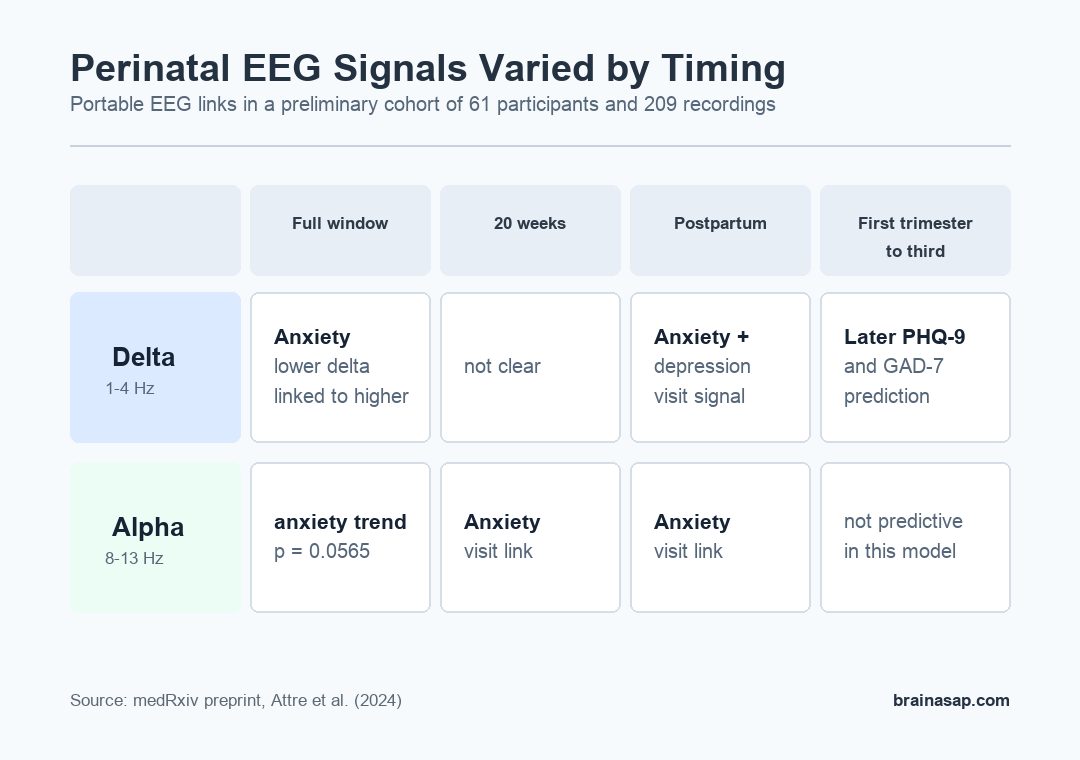
- Postpartum readout: Relative delta power was associated with postpartum anxiety and depression scores in cross-sectional analyses.
- Preprint boundary: The work followed 61 participants and 209 portable EEG recordings, but it has not been peer reviewed or validated as a clinical test.
Source: medRxiv preprint (2024) | Attre et al.
Perinatal depression and anxiety are common, but the brain activity behind them is still difficult to measure in ordinary care. Standard screening relies on symptoms, while many biological studies have been small, cross-sectional, or focused on later pregnancy.
This preprint tested a practical route into the problem: portable EEG, also called pEEG. Instead of asking only whether symptoms were present, the researchers followed brain-wave activity from early pregnancy through postpartum and compared it with PHQ-9 depression and GAD-7 anxiety scores.
Portable EEG Followed Symptoms From Early Pregnancy to Postpartum
The cohort included 61 pregnant participants and 209 pEEG recordings. Participants were followed longitudinally from early pregnancy through the postpartum period, with recordings and symptom measures collected across multiple visits.
The sample was intentionally diverse. The abstract reports that 45% of participants were Non-Hispanic Black and 32% were Hispanic, addressing a gap in perinatal brain studies that often underrepresent groups with higher maternal-health risk.
- Depression measure: PHQ-9 scores were used to track depression symptoms.
- Anxiety measure: GAD-7 scores were used to track anxiety symptoms.
- Brain measure: Portable EEG estimated relative power across frequency bands such as delta, theta, alpha, beta, and gamma.
Symptoms were highest at the first visit. Mean PHQ-9 and GAD-7 scores were both 4.7 early in pregnancy, then generally declined later in pregnancy and postpartum.
This timing explains why the strongest forward-looking EEG result started in the first trimester.
Delta Power Carried the Strongest Longitudinal Anxiety Signal
Across the full perinatal window, the clearest mixed-model finding involved relative delta power. Lower relative delta power was associated with higher anxiety severity, with the preprint reporting p < 0.05 for the longitudinal anxiety model.
The same overall model did not identify a brain-wave band that predicted depression severity across the entire perinatal window. The split narrows the interpretation: the strongest whole-window finding was not a broad mood marker, but a more specific anxiety-linked delta result.
- Direction: Lower relative delta power tracked higher anxiety severity in the longitudinal model.
- Specificity: Depression did not show the same full-window EEG association.
- Power limit: The preprint estimated statistical power of 51% for the delta-anxiety mixed model, so replication is needed.
Delta waves are often discussed in sleep and low-frequency brain activity, but this analysis does not show that one EEG snapshot can identify perinatal anxiety. The finding is a candidate biological marker that needs stronger validation.
Alpha Power Appeared Most Clearly Around Anxiety Visits
Relative alpha power showed a different pattern. In the overall mixed model, alpha’s positive association with anxiety was close to conventional significance but did not cross it, with p = 0.0565 and low reported power.
Visit-specific analyses were more suggestive. Relative alpha power was positively associated with GAD-7 anxiety scores around 20 weeks of pregnancy and again in the postpartum window.
- 20-week readout: Higher relative alpha power was linked with anxiety around the second visit.
- Postpartum readout: Higher relative alpha power was also linked with postpartum anxiety.
- No broad claim: The alpha result was not a stable depression marker across the full study window.
The visit-dependent pattern fits the broader physiology of pregnancy: brain, hormone, sleep, stress, and immune states change across gestation and after delivery. A finding visible at one window does not automatically carry the same meaning at another.
Early Delta Power Pointed Toward Later Pregnancy Symptoms
The most practical result came from early pregnancy. First-trimester relative delta power, measured before 16 gestational weeks, was associated with later third-trimester symptom scores around 36 weeks.
Specifically, first-trimester delta power was associated with third-trimester PHQ-9 depression scores at p < 0.05 and third-trimester GAD-7 anxiety scores at p < 0.01. The anxiety prediction had estimated statistical power above 80% in the preprint.
- Forward-looking marker: Early delta power pointed toward later pregnancy symptoms.
- Third-trimester endpoint: The marker was strongest for symptoms measured around 36 gestational weeks.
- Postpartum limit: First-trimester waves did not predict postpartum mental-health scores in this preliminary dataset.
Changes in delta power over time also mattered. Increases in relative delta power from earlier pregnancy to the third trimester were positively associated with third-trimester depression and anxiety scores.
From third trimester to postpartum, the direction shifted for anxiety, underscoring why timing is central to interpreting perinatal EEG.
The EEG Results Need Validation Before Screening
This is not evidence that portable EEG can diagnose perinatal depression or anxiety in clinic. The preprint is preliminary, the sample was modest, and the device setup differs from high-density laboratory EEG systems.
The paper’s real contribution is narrower: it shows that portable EEG can be collected repeatedly in a diverse perinatal cohort and that some frequency-band findings, especially delta and alpha, appear to track symptom timing.
- Peer-review status: The paper is a medRxiv preprint and has not been certified by peer review.
- Device boundary: Portable EEG is practical, but validation against higher-density EEG systems remains necessary.
- Clinical boundary: No screening threshold, sensitivity, specificity, or treatment decision rule was established.
The next useful step is larger longitudinal validation, especially with postpartum follow-up and infant outcomes. The practical takeaway is limited: early-pregnancy delta power deserves replication as a risk marker, while symptom screening and clinical evaluation remain the usable tools now.
Citation: DOI: 10.1101/2024.10.23.24315990. Attre et al. Electroencephalography Markers of Perinatal Depression and Anxiety in a Diverse Longitudinal Cohort: A Preliminary Study. medRxiv. 2024.
Study Design: Longitudinal portable EEG preprint following pregnant participants from early pregnancy through postpartum.
Sample Size: 61 participants and 209 portable EEG recordings.
Key Statistic: First-trimester relative delta power was associated with third-trimester PHQ-9 depression and GAD-7 anxiety scores.
Caveat: The source is a preliminary preprint with a modest sample, no validated clinical threshold, and a portable EEG method that needs broader replication.