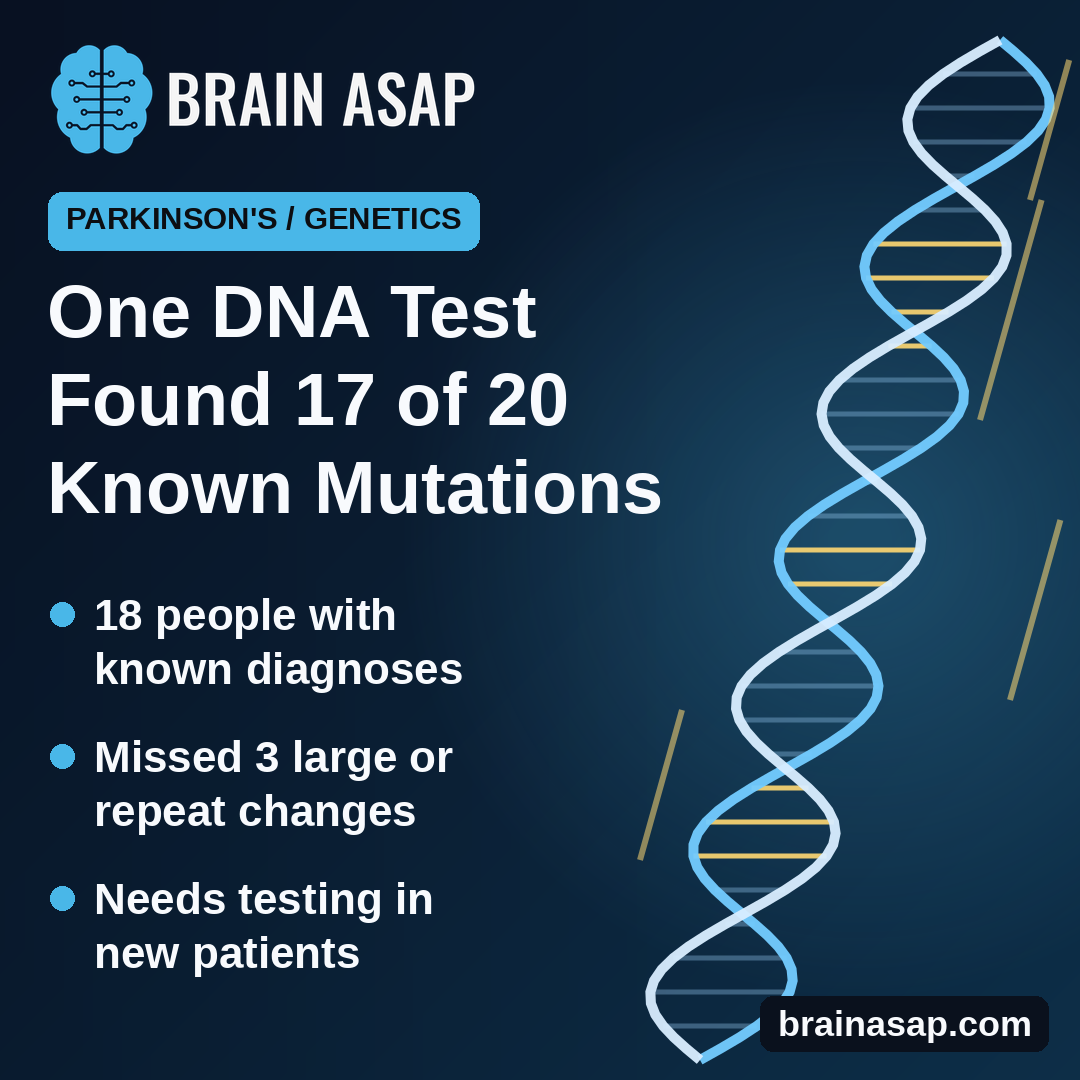
TL;DR: A single long-read DNA test covering 564 genes found 17 of 20 known disease-causing changes in 18 people with Parkinson’s or inherited repeat disorders. It missed three large or repetitive changes, so it needs more work before it could replace several separate tests.
Key Findings
- 17 of 20 found (85%): In people whose genetic cause was already known.
- Standard software alone found 12: Five more needed extra tools or a manual look.
- Missed 3: A tripled SNCA gene and two long repeat expansions.
- Three people per run: Sharing a sequencing run keeps costs down.
Source: npj Parkinson’s Disease (2026) | Fienemann et al.
Up to 15% of people with Parkinson’s carry a gene change linked to the disease. Finding it can mean several rounds of testing, because different kinds of DNA changes need different lab methods: one for single-letter spelling errors, another for missing or extra chunks of DNA, and another for long stretches of repeated letters.
A team at the University of Lübeck in Germany built one test meant to catch all of these at once.
One Panel, Many Kinds of DNA Change
The test uses Nanopore long-read sequencing, which reads DNA in long stretches instead of short fragments. That makes it better at spotting big rearrangements and long repeats.
It also uses “adaptive sampling”: as DNA passes through the machine, software keeps reading only pieces from the 564 chosen genes and skips the rest. Those genes are linked to Parkinson’s, repeat-expansion disorders such as Huntington’s disease and some inherited ataxias, and related movement disorders.
Tested on People With Known Answers
To check the test, the researchers ran it on 18 people whose genetic results were already known from earlier testing:
- 7 with Parkinson’s gene changes: In LRRK2, PRKN, SNCA or RAB32 (one also carried a GBA1 change).
- 8 with repeat expansions: Including in HTT (Huntington’s), ATXN genes and C9orf72.
- 3 with no known genetic cause: Two with Parkinson’s and one with frontotemporal dementia.
Three people’s DNA shared each sequencing run, and coverage averaged 24 reads per position.
17 of 20 Known Changes Found
Out of 20 expected disease-causing changes, the panel found 17 (85%, 95% CI 62% to 97%). The standard automated software called only 12; the other five turned up with specialized tools or a manual look at the data.
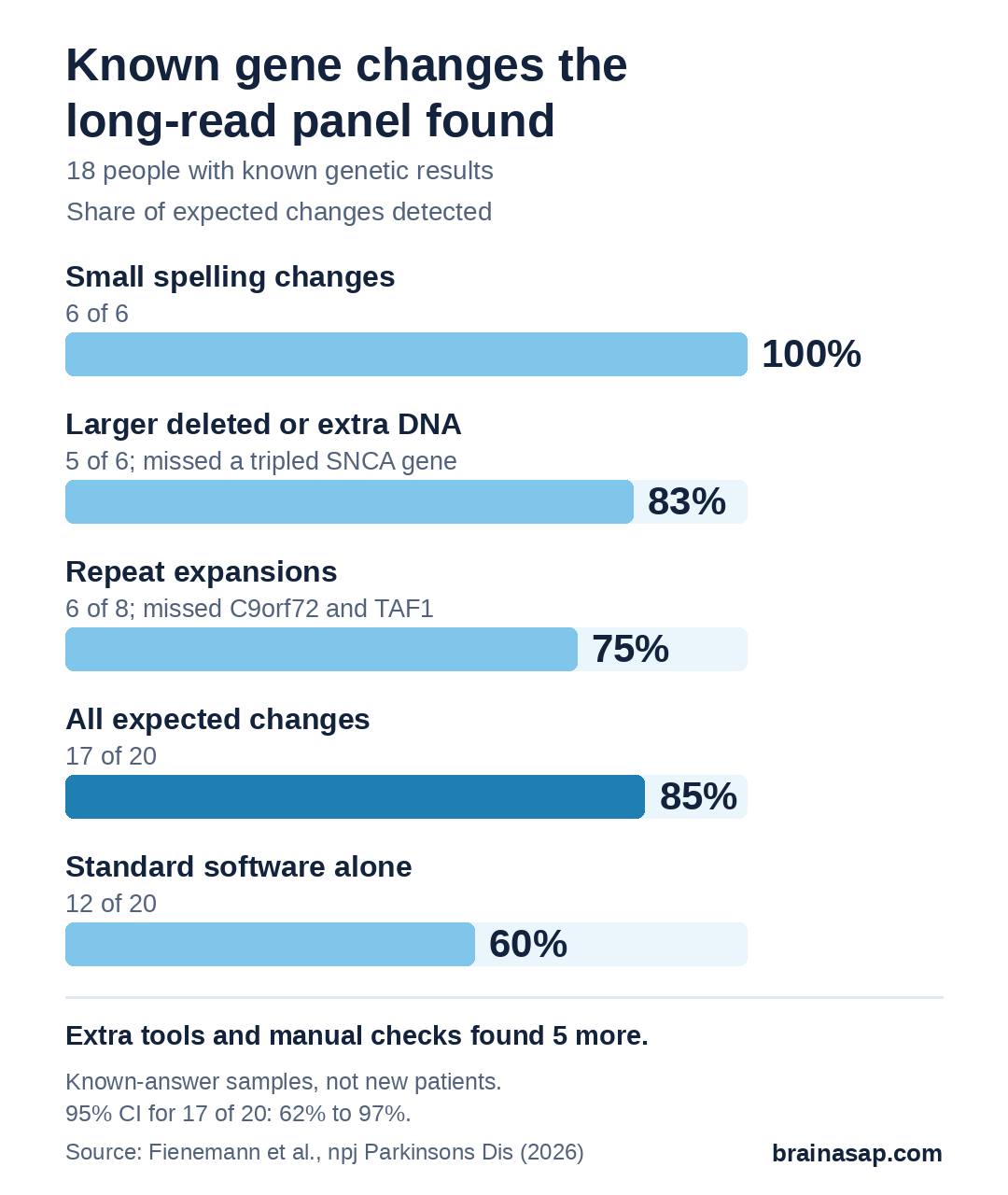
The three misses were:
- A tripled SNCA gene: A 1.7-million-letter extra copy region that the software did not flag.
- A C9orf72 repeat expansion: Seen in the reads, but its size could not be pinned down.
- A TAF1 repeat insertion: Not detected, partly due to how the reference genome handles that spot.
The panel also flagged additional variants in five people, in genes such as STXBP2 and ALS2. These need expert interpretation and are not automatically the cause of disease.
Why 85% Is Not a Real-World Hit Rate
- Known answers: Testing people with already-confirmed variants is not the same as screening new patients.
- Tiny sample: 18 people; the 95% range for the detection rate runs from 62% to 97%.
- Uneven coverage: Some genes, including GBA1 and TAF1, had lower read depth.
- Software gaps: Better analysis tools are needed to call large changes and repeats automatically.
A Promising All-in-One Test, Still in Development
The idea of a single test that catches spelling errors, big rearrangements and repeats could shorten the path to a genetic diagnosis for people with Parkinson’s and related conditions. The authors suggest two samples per run instead of three could improve repeat detection.
The next step is to test it on new patients without known results, and see how often it finds a cause that standard testing would miss.
Citation: DOI: 10.1038/s41531-026-01585-4. Fienemann A, Prietzsche JC, Laß J, et al. Unified long-read panel for Parkinson’s and repeat expansion disorders. npj Parkinsons Dis. 2026;12:233.
Study Design: Diagnostic validation of an adaptive-sampling Nanopore long-read panel (564 genes) in samples with known variants.
Sample Size: 18 individuals (15 positive controls, 3 negative disease controls); 20 expected pathogenic variants.
Key Statistic: 17/20 detected (85%; Clopper-Pearson 95% CI 62% to 97%); 12/20 by the standard workflow alone.
Caveat: Small, selected validation set; missed an SNCA triplication and two repeat expansions; bioinformatics still needs improvement.