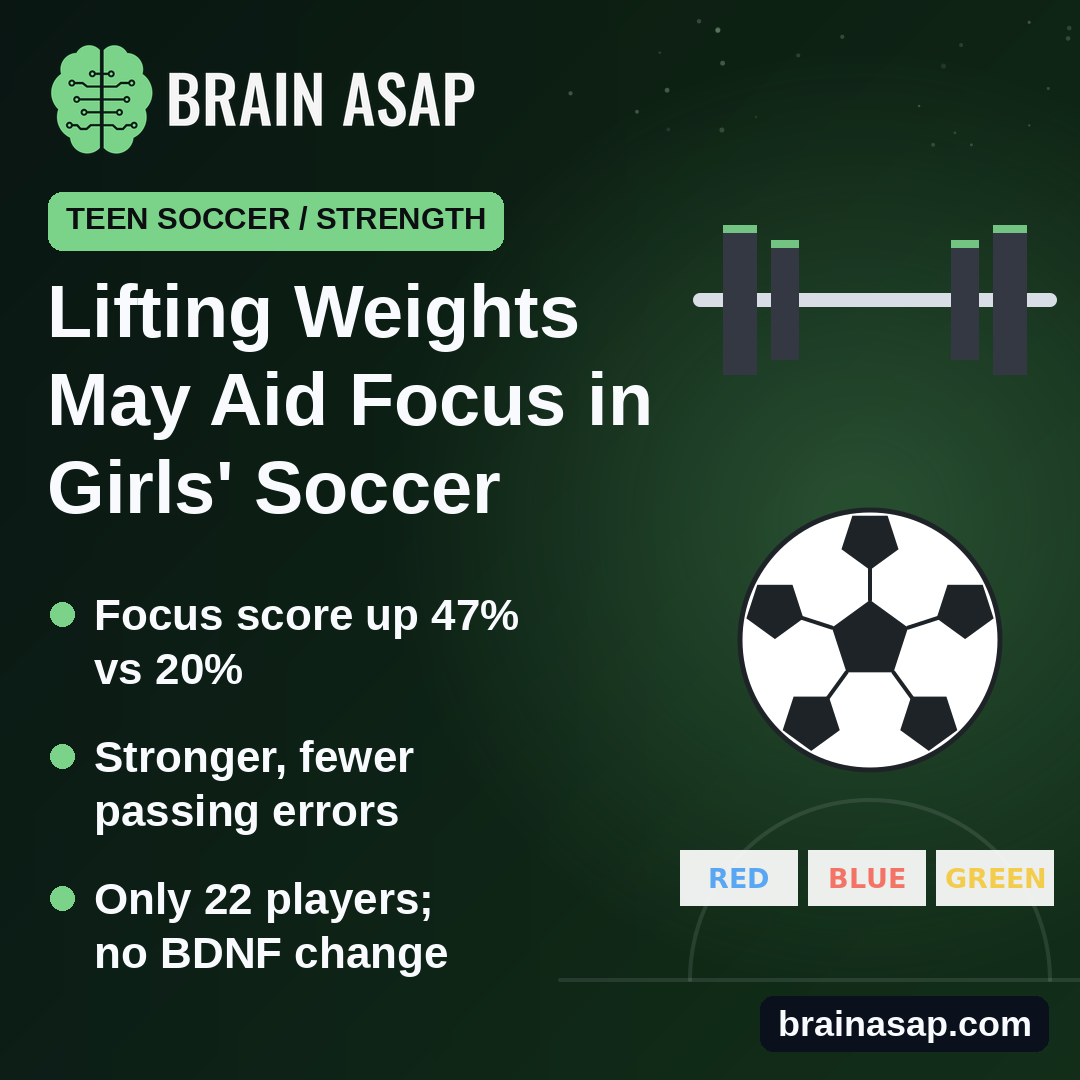
TL;DR: Teenage girls on a national youth soccer team who swapped two practices a week for weight training got stronger and did better on a classic focus test than teammates who kept their usual practice. Blood markers often linked to brain growth did not change.
Key Findings
- 22 players, 12 weeks: Weight training plus soccer vs soccer only, same total training load.
- Focus test: Correct answers on the hardest Stroop task rose 47% with weight training vs 20% with soccer only.
- Stronger and sharper on the ball: Leg press up 57% vs 32%; passing-test penalties dropped.
- No change in BDNF or IGF-1: Blood growth factors stayed flat in both groups.
- No injuries: Attendance was about 99% in both groups.
Source: Sports Medicine – Open (2026) | Bousselmi et al.
Coaches sometimes worry that time in the weight room takes away from time with the ball. But soccer also asks a lot of the brain: reading play, ignoring distractions, switching focus fast. Could lifting weights help with that too?
Researchers in Tunisia tested the idea with players from the country’s national under-15 girls’ team.
Two Weight Sessions in Place of Two Soccer Practices
Twenty-two players, average age about 15, were randomly split into two groups for 12 weeks during their competitive season:
- Weight training group (11 players): Two full-body sessions a week of bench press, lat pull-downs and leg press at 60% to 80% of their maximum lift, plus three soccer practices.
- Soccer-only group (11 players): Their usual five soccer practices a week.
Total training load was nearly identical in both groups, so the comparison is about the type of training, not the amount.
Bigger Jump on a Classic Focus Test
The Stroop test asks people to name the ink color of a word that spells a different color, such as “RED” printed in blue. It is a standard measure of focus and the ability to override an automatic response. Players had 45 seconds per task, and the score was the number of correct answers.
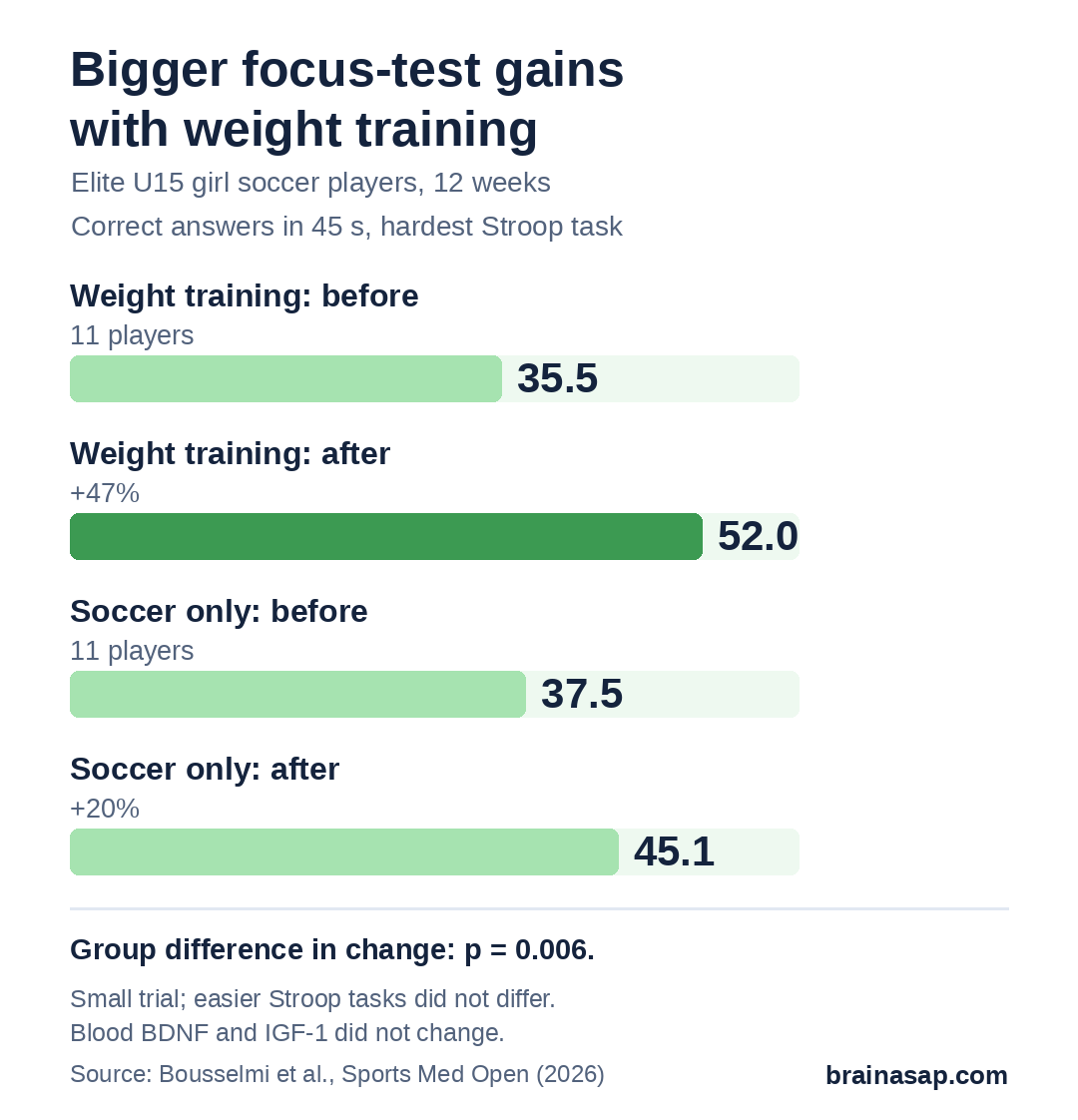
Both groups improved on the hardest version, which is common with practice. But the weight training group went from about 36 to 52 correct answers, a 47% rise, while the soccer-only group went from about 38 to 45, a 20% rise. The difference between groups was statistically significant (p = 0.006).
On the two easier Stroop tasks, reading words and naming colors, the groups did not differ.
Stronger Legs, Fewer Passing Errors
As expected, the weight training group gained more strength:
- Leg press: +57% vs +32%
- Lat pull-down: +39% vs +14%
- Bench press: +25% vs +7%
On a soccer passing test, penalty seconds for errors fell by about two-thirds in the weight training group, with little change in the soccer-only group. Passing speed itself did not change. The weight training group also lost a little body fat and gained some body weight.
Gains on the focus test did not track gains in strength or passing, so the two improvements may have separate causes.
Brain Growth Factors Did Not Budge
The team also measured BDNF and IGF-1 in the blood, two proteins often linked to brain plasticity and exercise. Neither changed in either group. So the study cannot point to a biological reason for the better focus scores.
Eleven Players per Group Is a Small Sample
- Tiny groups: 11 players each, all from one elite team.
- Many outcomes tested: Authors note a higher chance of false positives.
- One focus test: No check of real-game decision-making.
- Puberty and cycles: Hormone differences were not controlled.
- Registered late: The trial was registered after it started.
Weight Training Looks Safe and Useful for Young Female Players
For coaches of girls’ teams, this adds to evidence that supervised weight training during the season can make players stronger without injuries or lost conditioning. The focus-test result is a promising extra, but a single small trial is not enough to say lifting sharpens the mind.
A larger study that also tests on-field decisions would show whether the brain benefit is real and whether it shows up in games.
Citation: DOI: 10.1186/s40798-026-01103-z. Bousselmi M, Zouhal H, Darragi M, et al. Effects of strength training on cognitive function, brain-derived neurotrophic factor and insulin-like growth factor 1 in highly-trained young female soccer players. Sports Med Open. 2026;12:138.
Study Design: Randomized controlled trial with active control, 12 weeks in-season.
Sample Size: 22 Tunisian national U15 female players (11 per group).
Key Statistic: Stroop word-color correct answers 35.5 to 52.0 (weight training) vs 37.5 to 45.1 (soccer only); group-by-time p = 0.006.
Caveat: Very small sample; multiple outcomes; no change in BDNF or IGF-1.