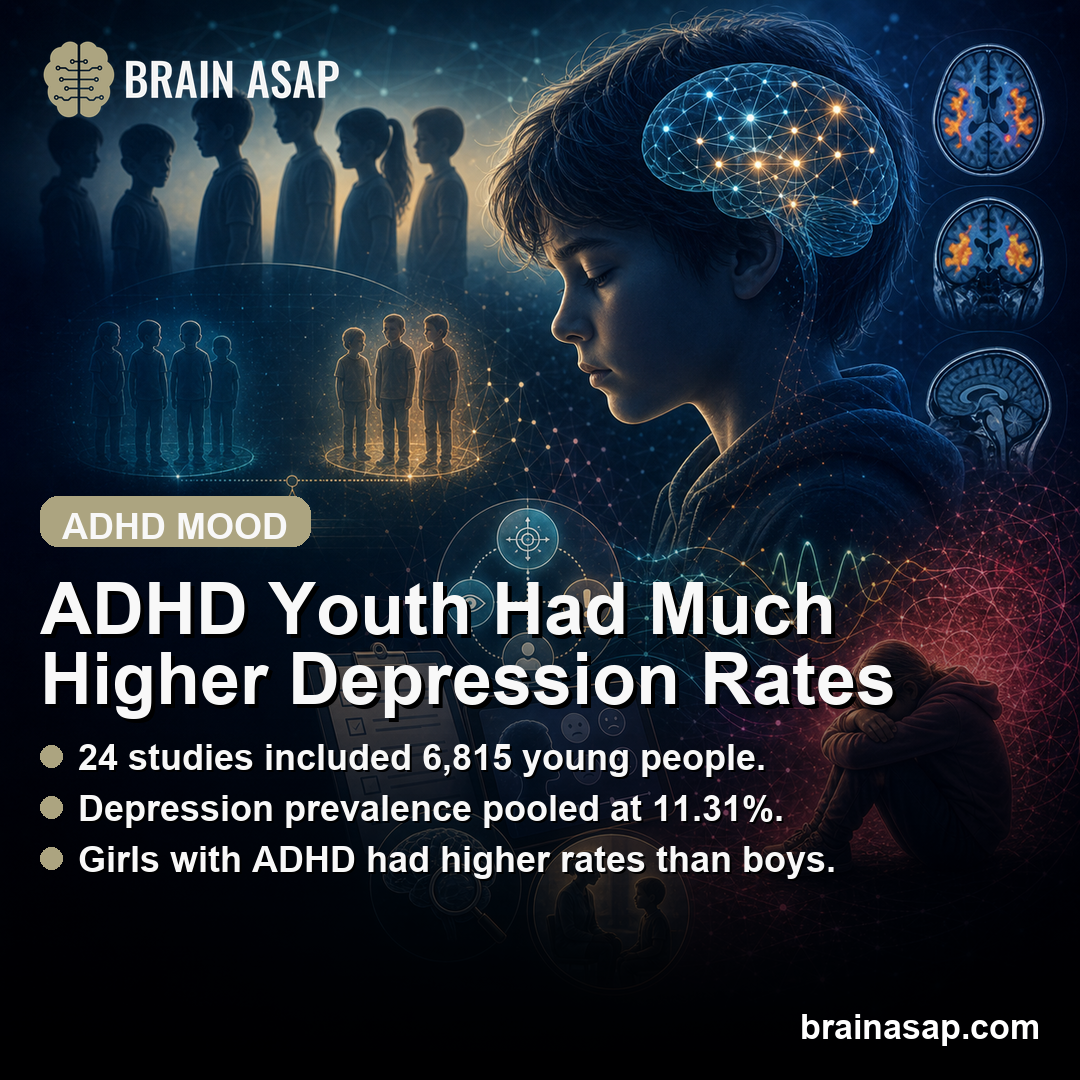
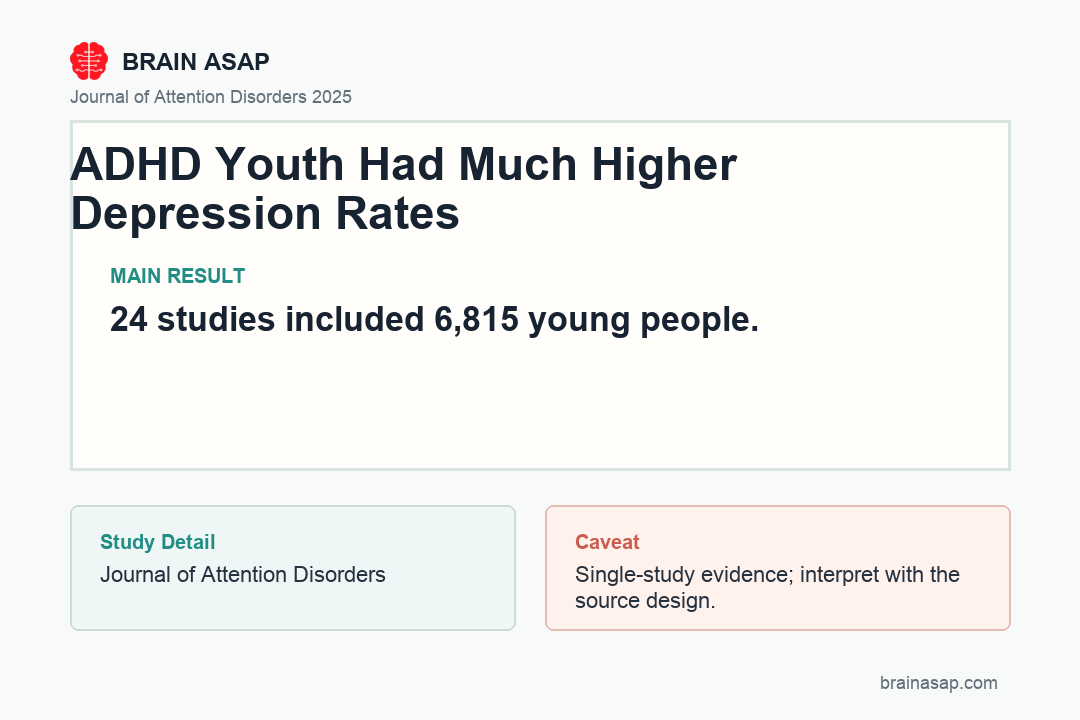
TL;DR: A 2025 meta-analysis in the Journal of Attention Disorders pooled 24 studies (N=6,815) and estimated that 11.31% of children and adolescents with ADHD had co-occurring depression — about six times the rate seen in neurotypical peers in head-to-head case-control studies (~12% vs ~2%).
Key Findings
- Pooled depression rate of 11.31% across 24 studies: The meta-analysis combined 6,815 children and adolescents (~5,000 with ADHD) and estimated an overall depression prevalence of 11.31%.
- About six times higher than peers in case-control comparisons: Across seven case-control studies, depression was present in roughly 12% of young people with ADHD versus roughly 2% of neurotypical peers.
- Girls with ADHD had more than double the rate of boys: Pooled depression prevalence was about 21% in girls with ADHD versus about 9% in boys with ADHD.
- Assessment method drove a roughly 2.5-fold spread: Studies using both diagnostic interviews and questionnaires reported depression in about 21% of cases; studies using interviews alone reported about 8.4%.
- Study-to-study variability was very large: Individual study rates ranged from 1.7% to 60%, reflecting differences in age range, depression assessment, and ADHD case definition.
- Symptom overlap likely biased measurement in both directions: ADHD inattention, restlessness, and irritability share surface features with depression, which can inflate questionnaire scores and let interviewers attribute depressive features to ADHD instead.
Source: Journal of Attention Disorders (2025) | Wang et al.
ADHD causes inattention, impulsivity, and motor restlessness as its core symptoms.
Co-occurring mental health conditions are less commonly discussed among people with ADHD, even though clinicians have noted depression as a frequent companion diagnosis for years.
This systematic review and meta-analysis estimates the size of that overlap.
Wang Pooled 24 Studies of 6,815 Children Aged 5 to 19
Researchers combined 24 studies that measured depression in children and adolescents with ADHD.
The methodology and sample behind the pooled estimate:
- Sample: 6,815 young people across 24 studies, with ~5,000 carrying an ADHD diagnosis.
- Age range: Roughly 5 to 19 years old.
- Sex distribution: Boys made up more than 76% of the ADHD samples, reflecting a real-world diagnostic skew rather than a sampling choice.
- Exclusion: Participants with intellectual disability were excluded — intellectual disability independently shapes depression severity and would have muddied the ADHD-specific signal.
- Depression assessment: Clinical interviews, standardized questionnaires, or both, depending on the study.
The variation in assessment method turned out to be one of the strongest moderators of the prevalence estimate, which the analysis returns to later.
Depression Was About Six Times More Common in ADHD Than in Peers
The strongest comparison in the analysis came from seven case-control studies.
These studies recruited an ADHD group and a matched non-ADHD comparison group from the same context, which controls for differences in recruitment setting, baseline mood symptoms, and local diagnostic culture that can otherwise distort prevalence estimates.
Across those seven studies, depression was present in roughly 12% of young people with ADHD and roughly 2% of neurotypical peers.
The pooled prevalence across all 24 studies was 11.31%, very close to the case-control estimate.
Both estimates support the same conclusion: depression is meaningfully more common in young people with ADHD than in matched peers, and the difference is clinically important.
Girls With ADHD Had More Than Double the Depression Rate of Boys
Within the ADHD samples, girls had a pooled depression prevalence of about 21%. Boys with ADHD were near 9%.
That difference is larger than the female-skewed depression rates typically reported for adolescents in general-population studies.
Researchers point out a structural issue with this estimate. Girls are severely under-represented in ADHD research, for two reasons:
- Historical under-diagnosis: ADHD has been under-diagnosed in girls for decades, partly because diagnostic criteria were calibrated against boys’ presentations.
- Recruitment skew: Hyperactive-impulsive presentations more common in boys tend to attract clinical attention earlier, so male-skewed clinical samples flow into research samples.
That recruitment skew likely produces a sample of girls with ADHD whose presentations are more severe or more visible, which may push the within-group depression estimate upward.
Either way, the results support treating co-occurring depression as a default screening priority for girls diagnosed with ADHD, not as a rare add-on consideration.
Combined Interviews and Questionnaires Reported 21% Depression vs 8.4% for Interviews Alone
Studies that combined diagnostic interviews and standardized questionnaires reported pooled depression rates near 21%.
Studies relying on interviews alone reported rates closer to 8.4%.
That is a roughly 2.5-fold spread driven not by anything about the kids, but by the assessment method.
The pattern is consistent with a known measurement problem in psychiatric epidemiology:
- Standardized questionnaires: Capture self-reported or parent-reported symptom load, which can be inflated when symptoms overlap with another condition.
- Structured clinical interviews: Require a clinician to map symptoms to specific diagnostic criteria, which tends to be more conservative.
- Combining the two: Catches cases that interviews miss while also raising false-positive risk on the questionnaire side.
The true rate for any given clinical population probably sits between the two estimates.
The wide spread suggests current depression instruments do not separate cleanly from ADHD symptomatology in this age group.
Symptom Overlap Biases Measurement in Both Directions
The most useful contribution of the meta-analysis is its discussion of diagnostic overlap.
ADHD core features — inattention, restlessness, irritability, and motivational changes — share surface features with depression. That overlap creates two opposite measurement biases that can appear in the same dataset:
- Overreporting on questionnaires: A child whose ADHD presents with irritability and concentration problems may answer “yes” to depression-screen items that are not really capturing depression. Parents reporting on the child face the same trap.
- Underdetection in interviews: A clinician anchored on the ADHD diagnosis may attribute depressive features to the ADHD — reading low motivation as inattention, or sleep disturbance as restlessness — and miss a co-occurring depressive episode.
Both error directions are plausible.
The wide between-study spread is consistent with both biases occurring across the literature simultaneously.
The researchers call for depression measures validated specifically for ADHD populations rather than continuing to use tools designed for neurotypical populations.
Causality, Medication Effects, and Non-English Studies Were Out of Reach
- Causality is not addressed: The pooled estimate captures co-occurrence, not direction. Whether ADHD-related impairment drives depression, whether shared neurodevelopmental risk produces both, or whether bidirectional dynamics are present is a separate question.
- Medication effects were not isolated: The included studies varied in whether participants were medicated for ADHD, and the meta-analysis did not produce a clean estimate of how stimulant or non-stimulant treatment changes depression rates.
- English-language studies only: The review excluded non-English research, which may exclude relevant work from regions where ADHD diagnostic and treatment patterns differ.
- High heterogeneity: Individual-study rates ranged 1.7% to 60%. The 11.31% pooled estimate is a useful summary, not a precise epidemiological constant.
Routine depression screening should be part of pediatric ADHD care: The clinical implications are narrower than the prevalence estimates suggest, but concrete:
- Routine depression screening: Co-occurring depression should be a default screening element in pediatric ADHD care rather than an add-on triggered only by overt symptoms.
- Higher-risk subgroup: Girls with ADHD warrant closer mood-symptom monitoring than current diagnostic patterns suggest.
- Method-aware interpretation: A single questionnaire may overestimate, and a brief interview may underestimate. Combining methods and interpreting in the context of ADHD symptom overlap is the more defensible approach.
- ADHD-specific instruments: The field needs depression measures validated specifically for ADHD populations. The methodological gap the meta-analysis documents is not a niche issue — it shapes whether kids get treated for a condition that meaningfully affects their functioning.
Citation: DOI: 10.1177/10870547251341597. Wang S, Stewart TM, Ozen I, Mukherjee A, Rhodes SM. Rates of Depression in Children and Adolescents With ADHD: A Systematic Review and Meta-Analysis. Journal of Attention Disorders. 2025.
Study Design: Systematic review and meta-analysis of 24 studies measuring depression in children and adolescents with ADHD, with case-control and subgroup analyses by sex and assessment method.
Sample Size: 6,815 children and adolescents aged ~5–19 across 24 studies; ~5,000 with ADHD; participants with intellectual disability excluded.
Key Statistic: Pooled depression prevalence 11.31% in young people with ADHD; ~12% vs ~2% in seven case-control comparisons against neurotypical peers; girls ~21% vs boys ~9%; interview-plus-questionnaire studies ~21% vs interview-only ~8.4%.
Caveat: Substantial between-study heterogeneity (individual rates 1.7%–60%); English-language studies only; medication effects not separately estimated; ADHD–depression symptom overlap likely produced measurement error in both directions.