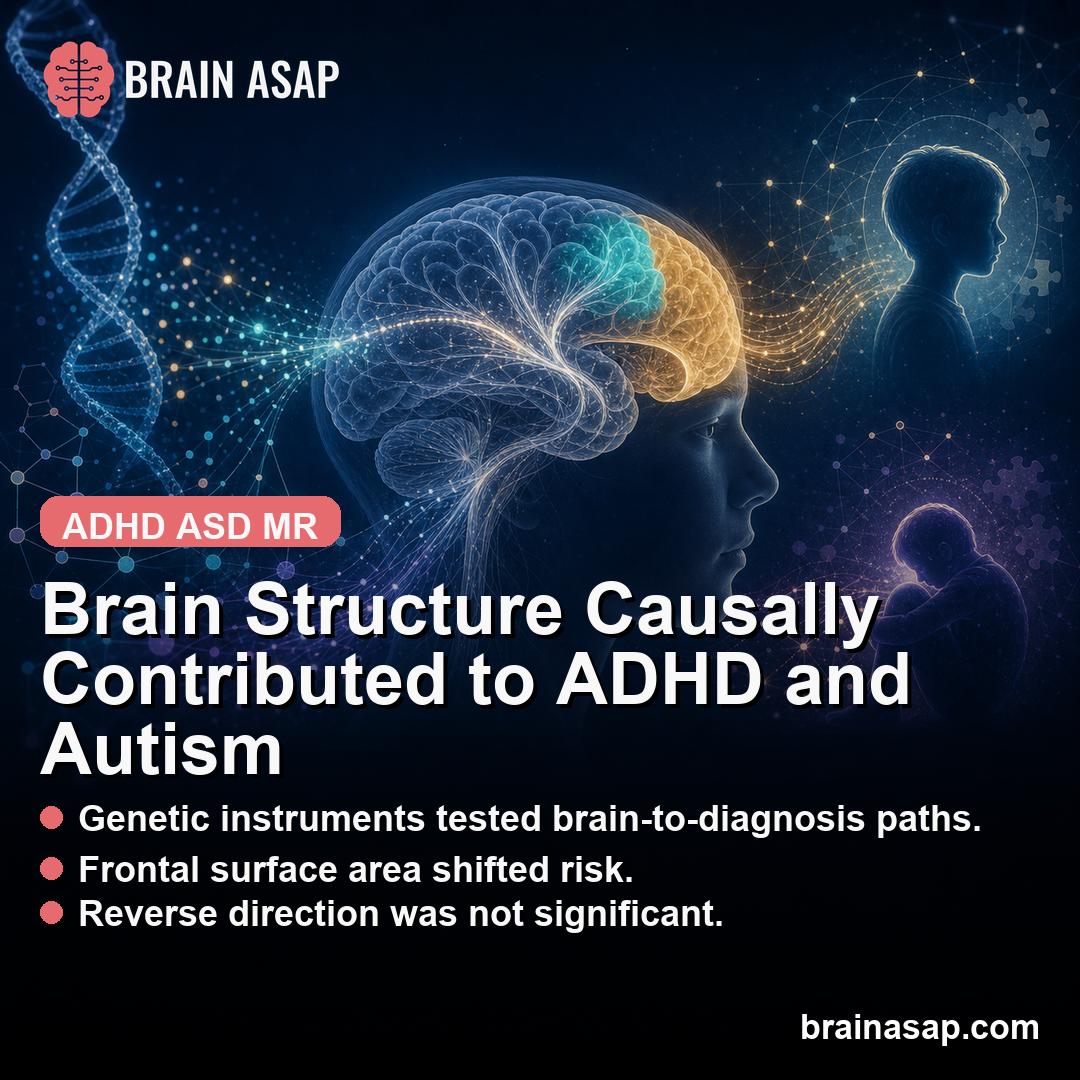
TL;DR: A 2026 Mendelian randomization study in Progress in Neuro-Psychopharmacology & Biological Psychiatry used genetic data to test direction of effect between brain structure and neurodevelopmental conditions, and found that increased surface area in the superior frontal gyrus raised ADHD risk while increased surface area in the orbital frontal gyrus protected against autism — with the reverse direction (conditions reshaping brain) not statistically significant.
Key Findings
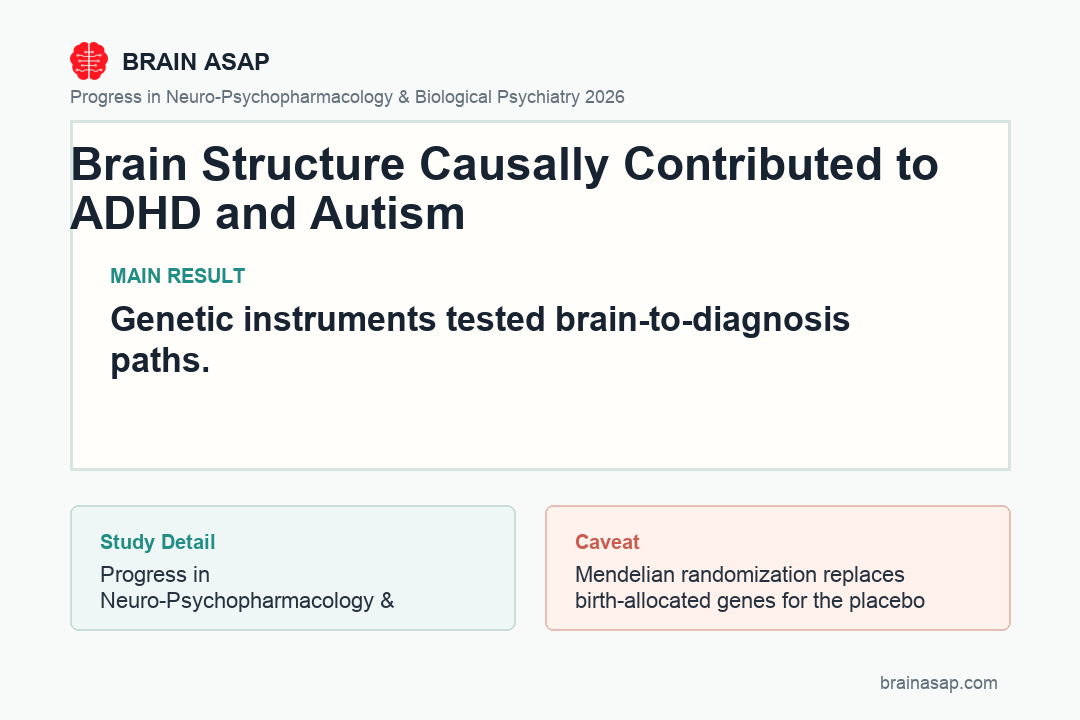
- Brain structure causally contributed to ADHD and ASD risk: Mendelian randomization analyses found that genetic variants shaping specific brain regions tracked with diagnoses of ADHD and autism spectrum disorder, supporting a brain-shape-drives-condition direction.
- Larger superior frontal gyrus surface area raised ADHD risk: The superior frontal gyrus, which is involved in executive functioning and impulse control, showed a causal contribution to ADHD when genetic variants favored expanded cortical surface area in that region.
- Larger orbital frontal gyrus surface area protected against autism: Increased surface area in the orbital frontal gyrus, which processes social and emotional information, was associated with lower autism risk in the genetic analysis.
- White matter pathways contributed too: Inferior fronto-occipital fasciculus organization contributed to ADHD risk; reduced internal capsule integrity contributed to autism risk — specific connectivity tracts were implicated for each condition.
- Reverse direction was not significant: When researchers ran the analysis the other way — testing whether genetic risk for ADHD or autism reshaped brain structure over time — the results were not statistically significant, supporting the brain-to-behavior causal direction rather than the reverse.
- Mendelian randomization replaces birth-allocated genes for the placebo lottery: Because each person’s genetic variants were assigned randomly at conception, this design helps separate true causal effects from confounding in a way that observational brain-imaging studies cannot.
Source: Progress in Neuro-Psychopharmacology & Biological Psychiatry (2026) | Zhao et al.
Brain imaging has shown for decades that people with ADHD and autism spectrum disorder often have small structural differences compared to typically developing peers.
What imaging cannot answer is the timing question: do the structural differences come first and contribute to the condition, does the condition gradually reshape the brain, or does some third factor cause both?
This Mendelian randomization study uses genetics to test the direction of effect, and finds the brain-shape-first reading better fits the data.
How Mendelian Randomization Acts Like a Natural Randomized Trial
Mendelian randomization is a genetics-based study design built to imitate the logic of a randomized clinical trial.
The core idea:
- Genetic variants are assigned at conception: Which version of each gene a person inherits is essentially random — not influenced by lifestyle, environment, or downstream conditions.
- Some variants reliably shape specific traits: Specific genetic markers reliably make brain folds slightly thicker, white matter tracts slightly more organized, or surface area slightly larger.
- Researchers asked whether trait-shaping variants were over-represented in disease groups: If the variants that reliably build a particular brain structure are also more common in people diagnosed with ADHD or autism, that suggests the brain structure causally contributes to the condition.
The design helps rule out the reverse-causation explanation, since genetic variants are fixed at birth and cannot be reshaped by living with a developmental condition.
The Superior Frontal Gyrus Causally Contributed to ADHD
The frontal lobe sits behind the forehead and supports decision-making, social behavior, and attention.
The Zhao team found that one specific frontal region, the superior frontal gyrus, contributed causally to ADHD.
The relevant findings:
- Increased surface area in the superior frontal gyrus raised ADHD risk: Genetic variants associated with greater surface area in this region were over-represented in people diagnosed with ADHD.
- The region is functionally relevant: The superior frontal gyrus has been linked in earlier imaging work to executive functioning and the ability to suppress impulsive responses — both of which are common challenges in ADHD.
- The implication is developmental: The result suggests that altered tissue maturation, producing a larger surface area than typical in this specific region, contributes to the behavioral phenotype rather than reflecting a downstream consequence of it.
The Orbital Frontal Gyrus Protected Against Autism
For autism, the implicated region was different.
The orbital frontal gyrus sits just above the eyes and helps process incoming sensory information and interpret the emotional states of other people.
The genetic analysis found that larger surface area in this region was associated with lower autism risk.
The researchers interpret the orbital frontal gyrus result as evidence that a more expansive processing area may buffer some social and communicative features of autism.
That framing remains hypothesis rather than proven mechanism, but the directional result is robust to the genetic-instrument check.
White Matter Pathways Were Implicated, Differently for Each Condition
Beyond gray-matter surface area, the researchers analyzed white matter tract organization — the long-distance fiber bundles that carry signals between distant brain regions.
- For ADHD — inferior fronto-occipital fasciculus: This tract connects visual processing centers at the back of the brain to language and decision-making centers at the front. Its developmental organization contributed causally to ADHD risk in the analysis.
- For autism — internal capsule: Reduced structural integrity in the specific pathway carrying visual sensory data through the deep brain to the cortex contributed to autism diagnoses.
The pattern reinforces the gray-matter findings: the implicated brain features are not random and not shared between conditions. Each developmental condition has a distinct set of structural contributors.
The Reverse Direction Failed Significance Testing
The researchers also ran their analyses backward: do the genetic variants that increase risk for ADHD or autism cause the brain structures to physically change over time?
The reverse-direction results were not statistically significant.
That asymmetry between forward and reverse models is the core of the causal claim. If both directions were significant, the design could not distinguish brain-causes-condition from condition-causes-brain.
The fact that only the forward direction reaches significance supports the reading that brain structure differences are upstream of the developmental conditions, not downstream consequences of living with them.
Genetic Instrument Coverage, Effect Sizes, and Pleiotropy Are the Standard Constraints
- Genetic instruments capture only part of the variance: The variants used to estimate brain structure explain only a fraction of structural variability. Effects on traits driven by environmental or non-genetic developmental processes are not captured.
- Effect sizes are modest at the individual level: Like all polygenic-instrument analyses at population scale, the relationships are statistically robust but cannot be used to predict any single person’s diagnosis from their brain structure.
- Ancestry composition limits generalization: The genetic datasets behind Mendelian randomization studies tend to over-represent European-ancestry populations. The findings may not transfer cleanly to populations underrepresented in the source data.
- Mediation pathways were not fully tested: Whether brain structure influences ADHD or autism risk through a particular cognitive, behavioral, or developmental mediator is a separate research question.
- Pleiotropy is the standard concern: Genetic variants can affect multiple traits. Mendelian randomization assumes the genetic instruments are working through brain structure rather than another shared pathway, and that assumption can never be perfectly verified.
Distinct frontal-region biology is the main interpretation: The actionable takeaways are mechanistic rather than clinical:
- Distinct frontal-region biology for ADHD vs autism: ADHD and autism implicate different frontal-lobe regions and different white matter tracts. This is consistent with the long-running clinical observation that they are distinct conditions, not variants of a single underlying disorder.
- Developmental rather than degenerative: The brain-structure-first finding fits a model in which atypical tissue maturation contributes to the behavioral phenotype, not one in which living with the condition gradually reshapes the brain.
- Potential biomarker direction: Specific frontal-region surface area and tract-organization measures may be candidate biomarkers for early identification, though the effect sizes here are too modest for individual-level diagnostic use.
- The reverse-causal alternative is weaker: Future work explaining brain differences in ADHD or autism does not need to assume the condition itself caused them. The causal arrow appears to run the other way.
Citation: DOI: 10.1016/j.pnpbp.2026.111631. Zhao Y, Zhang Y, Li T. Causal relationships between ADHD, ASD and brain structure: A mendelian randomization study. Progress in Neuro-Psychopharmacology & Biological Psychiatry. 2026.
Study Design: Mendelian randomization analysis using large population genetic datasets, testing causal effect of brain structural variation (gray matter surface area, white matter tract organization) on ADHD and autism diagnoses, with reverse-direction tests for completeness.
Sample Size: Tens of thousands of individuals across the brain-structure and disease-diagnosis genetic datasets.
Key Statistic: Larger superior frontal gyrus surface area causally raised ADHD risk; larger orbital frontal gyrus surface area causally lowered autism risk; inferior fronto-occipital fasciculus organization contributed to ADHD; internal capsule integrity contributed to autism. Reverse-direction analyses (condition reshaping brain) were not statistically significant.
Caveat: Genetic instruments capture only part of brain-structure variance; effect sizes are modest at the individual level; ancestry composition limits generalization to non-European populations; pleiotropy assumptions can never be fully verified.