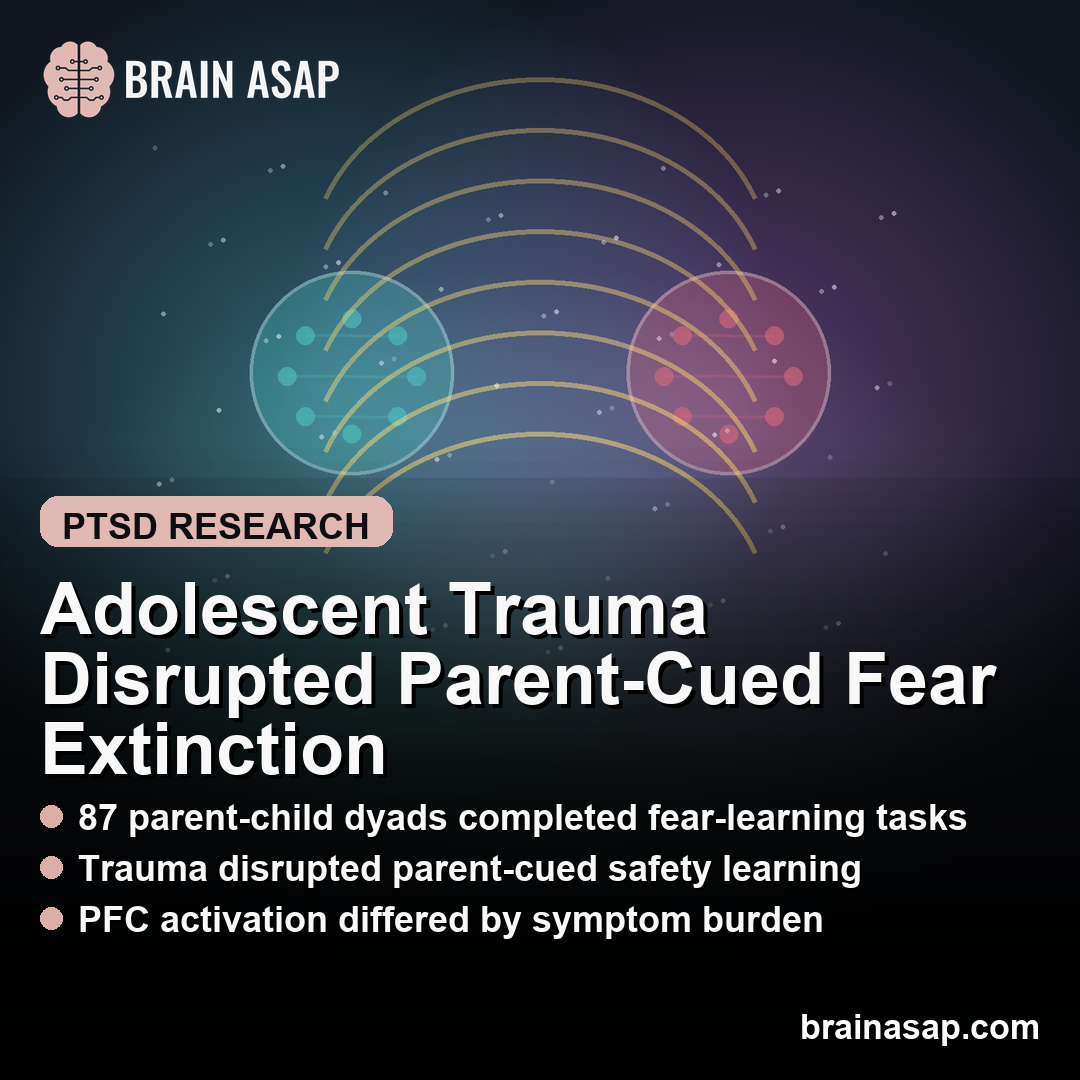
TL;DR: A 2026 study in Biological Psychiatry: Global Open Science found that trauma-exposed adolescents, especially those with higher posttraumatic stress symptoms, showed disrupted parent-cued fear extinction across skin-conductance, behavioral-learning, and functional MRI (fMRI) measures.
Key Findings
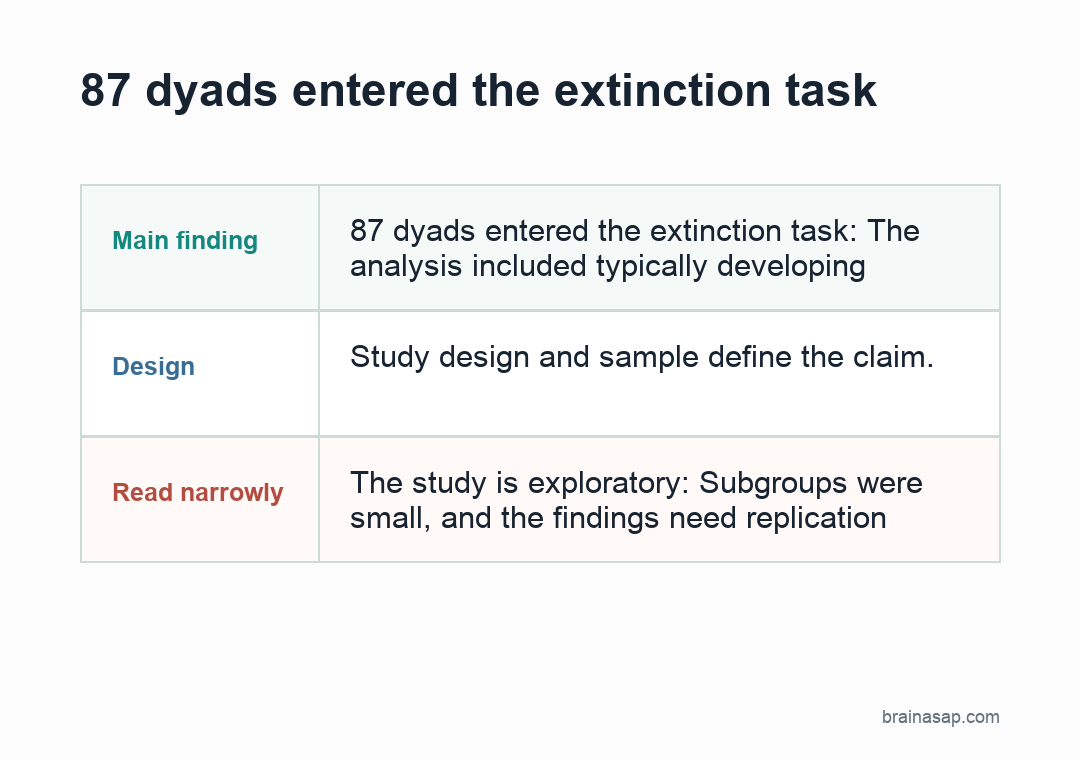
- 87 dyads entered the extinction task: The analysis included typically developing adolescents and trauma-exposed adolescents with lower or higher posttraumatic stress symptoms.
- Parent-child synchrony lost its usual safety effect: In typically developing youths, stronger autonomic synchrony with a parent was linked to lower arousal during early vicarious extinction, but trauma-exposed youths did not show the same link.
- High-symptom youths reacted more to safety cues: Trauma-exposed adolescents with higher posttraumatic stress symptoms showed increasing skin-conductance arousal to the safety cue during vicarious extinction.
- Prefrontal recruitment differed by symptom burden: Vicarious extinction separated groups in dorsomedial PFC, dorsal anterior cingulate cortex, dorsolateral PFC, and ventrolateral PFC measures.
- The study is exploratory: Subgroups were small, and the findings need replication before they can guide pediatric PTSD diagnosis or treatment selection.
Source: Biological Psychiatry: Global Open Science (2026) | Heyn et al.
Adolescents often learn whether a situation is safe by watching a parent. In trauma research, parent-watching matters because fear extinction is not only an individual learning problem.
Fear extinction can also be a social-learning problem. A caregiver’s reaction helps the child decide whether a cue still predicts danger.
Researchers studied this parent-child safety-learning pathway in adolescents with and without trauma exposure. The trauma-linked result was more specific than general anxiety.
The study found a breakdown in how parent-cued vicarious extinction connected physiology, behavior, and prefrontal brain recruitment.
Adolescents Watched a Parent Model Safety Learning
Researchers enrolled 87 parent-child dyads who at least partly completed a 3-day fear-learning and extinction protocol.
Youths were split into typically developing adolescents, trauma-exposed adolescents with lower posttraumatic stress symptoms, and trauma-exposed adolescents with higher posttraumatic stress symptoms.
The task used conditioned stimuli, mild electrodermal shock, and repeated safety learning. Youths completed the paradigm during functional MRI (fMRI), while researchers measured shock expectancy, skin conductance, and brain activation.
The design separated three related forms of learning:
- Acquisition: Youths learned which cues could predict shock.
- Direct extinction: Youths saw the cue without shock and learned that the threat had changed.
- Vicarious extinction: Youths watched a video of their own parent completing extinction, making the parent a safety-learning cue.
The third condition asks whether an adolescent’s body and brain can use a parent’s calm exposure to a previously threatening cue as evidence that the cue is now safe.
Trauma Exposure Changed the Parent-Child Synchrony Result
The clearest physiology result involved parent-child autonomic synchrony, meaning coordinated skin-conductance patterns between the parent and adolescent during the extinction task.
In typically developing youths, stronger synchrony was linked to lower early arousal during vicarious extinction.
Trauma-exposed youths did not show the same safety-linked relationship. Their physiological coupling with the parent did not translate into the expected reduction in arousal to the vicarious safety cue.
The synchrony findings separated the groups in two ways:
- Typical-development pattern: More parent-child synchrony corresponded with lower arousal during early parent-modeled safety learning.
- Trauma-exposed pattern: Synchrony was no longer reliably tied to lower arousal, suggesting the parent cue was not being used in the same regulatory way.
- High-symptom pattern: In adolescents with higher posttraumatic stress symptoms, more synchrony was linked to worse behavioral retention of vicarious extinction.
The high-symptom synchrony result changes how the physiology should be read. The paper does not imply that parent-child physiological connection is bad.
After trauma, coupling may sometimes reflect shared threat arousal rather than effective co-regulation.
High-Symptom Youths Responded Differently to Safety Cues
Skin-conductance results added a more direct arousal measure. During vicarious extinction, typically developing and lower-symptom trauma-exposed youths showed stable or decreasing arousal across safety-cue trials.
Adolescents with higher posttraumatic stress symptoms showed a different pattern: arousal increased to the safety cue.
This is a concrete way to understand the clinical result. The high-symptom group showed a different arousal trajectory, not a small delay in relaxing.
Their body response to a cue that should be becoming safer moved in the wrong direction during parent-modeled learning.
The behavioral and physiology measures pointed toward the same interpretation:
- Safety cue problem: The high-symptom group showed rising arousal during repeated safety-cue exposure.
- Retention problem: Parent-child synchrony was negatively associated with later behavioral extinction retention in the high-symptom group.
- Trauma-load check: The significant physiology and fMRI group effects remained after researchers controlled for cumulative trauma load.
The study separated trauma exposure from posttraumatic stress symptom burden. The clearest impairment was exposure plus higher symptom severity.
Prefrontal fMRI Patterns Differentiated Symptom Load
The fMRI results made the social-learning finding more specific. During vicarious extinction, group differences appeared in dorsomedial prefrontal cortex, dorsal anterior cingulate cortex, right caudate/nucleus accumbens, and parietal regions.
Trial-related effects also appeared in left dorsolateral PFC and right ventrolateral PFC.
In the dorsal anterior cingulate cortex, typically developing and lower-symptom trauma-exposed youths showed similar activation. Higher-symptom trauma-exposed youths showed lower recruitment during vicarious extinction.
In dorsolateral PFC, typically developing youths showed high early activation that decreased over time. The high-symptom group started lower and increased later.
Researchers interpreted the late dorsolateral PFC increase cautiously. It may reflect delayed, effortful processing during a task that typically developing youths handle earlier and more efficiently.
A practical translation is that higher-symptom adolescents may be spending more cognitive-control effort after the safety cue has already become difficult to use.
Dyadic Safety Learning Could Become a Pediatric PTSD Treatment Target
The study’s treatment implication is limited to one candidate mechanism. If parent-modeled safety learning is disrupted in adolescent trauma and PTSD, dyadic interventions may need to rebuild the regulatory function of parent-child coupling.
That would mean strengthening parent-supported safety learning, not only exposing the youth to feared cues.
This interpretation fits trauma-focused cognitive behavioral therapy and other family-involved care, but the study does not prove that any specific therapy should change.
It identifies a candidate mechanism: parent-child synchrony that supports safety consolidation rather than shared threat arousal.
Several limitations keep the result exploratory:
- Small subgroups: Splitting the sample by trauma exposure and symptom burden reduced power for smaller effects.
- Single classification point: The study did not track how vicarious extinction and posttraumatic stress symptoms changed across development.
- Unmeasured moderators: Puberty, sleep, stress, hormones, and inflammatory markers could affect fear-extinction biology.
- Mechanism still incomplete: Activation findings do not fully map functional connectivity between prefrontal regions, amygdala, hippocampus, and parent-child physiology.
Even with those limits, the study gives pediatric PTSD research a more specific question. The next step is testing when a parent’s safety cue helps an adolescent downshift fear.
The harder question is when trauma turns that same dyadic cue into another source of persistent arousal.
Citation: DOI: 10.1016/j.bpsgos.2026.100714. Heyn SA, DiMaio S, Herringa RJ. Neurobiological signatures of dyadic transmission of fear extinction in adolescent trauma exposure and posttraumatic stress. Biological Psychiatry: Global Open Science. 2026;6:100714.
Study Design: Three-day parent-child fear acquisition, direct extinction, vicarious extinction, and recall paradigm with behavioral, skin-conductance, and functional MRI measures.
Sample Size: 87 parent-child dyads at least partly completed the paradigm, including typically developing youths and trauma-exposed youths with lower or higher posttraumatic stress symptoms.
Key Statistic: During vicarious extinction, high-symptom trauma-exposed youths showed increasing arousal to the safety cue (F1,159 = 4.81, p = .029), and parent-child synchrony related differently to early arousal and extinction retention across groups.
Caveat: The study is exploratory, subgroup sizes were small, and the dyadic fMRI findings need replication in larger longitudinal samples.