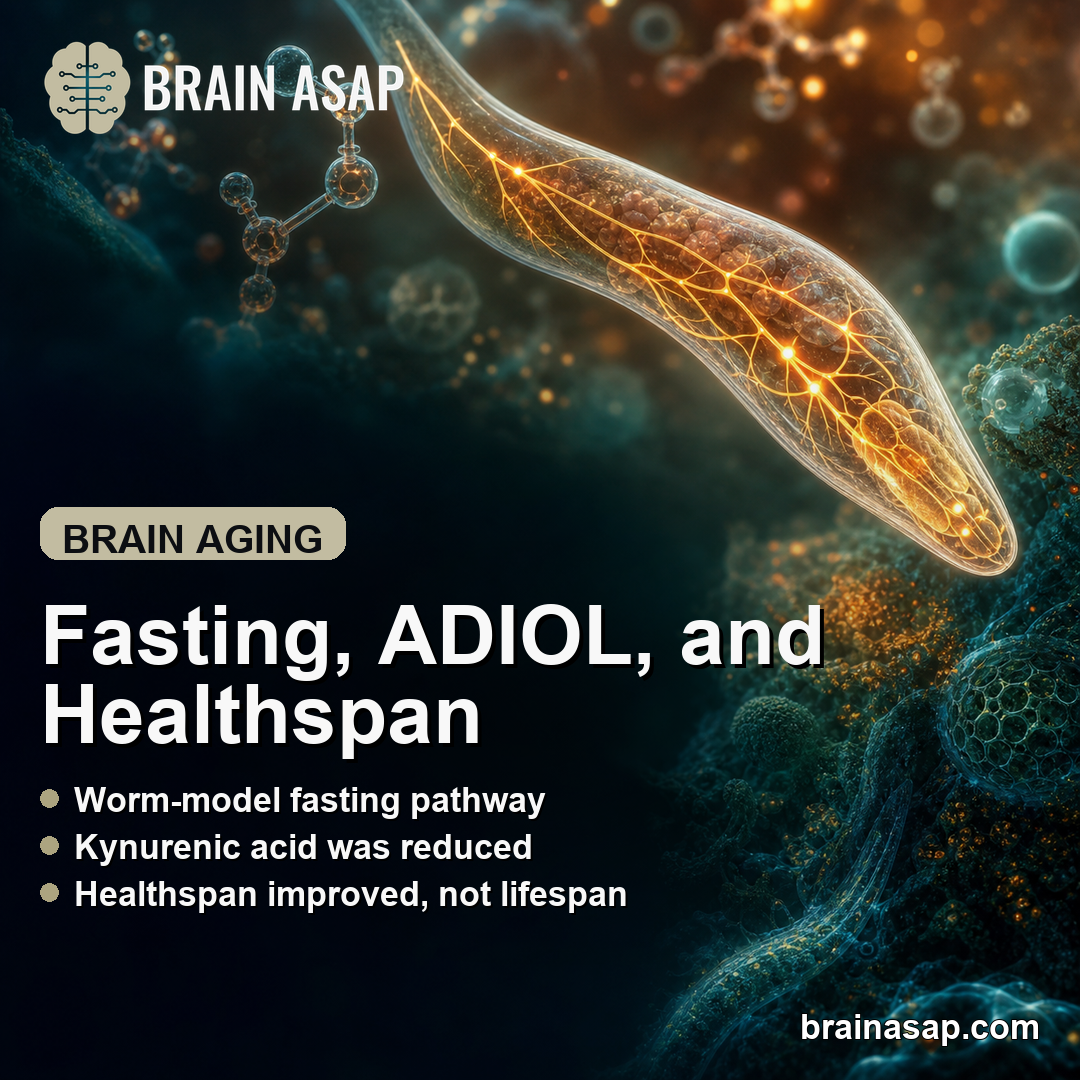
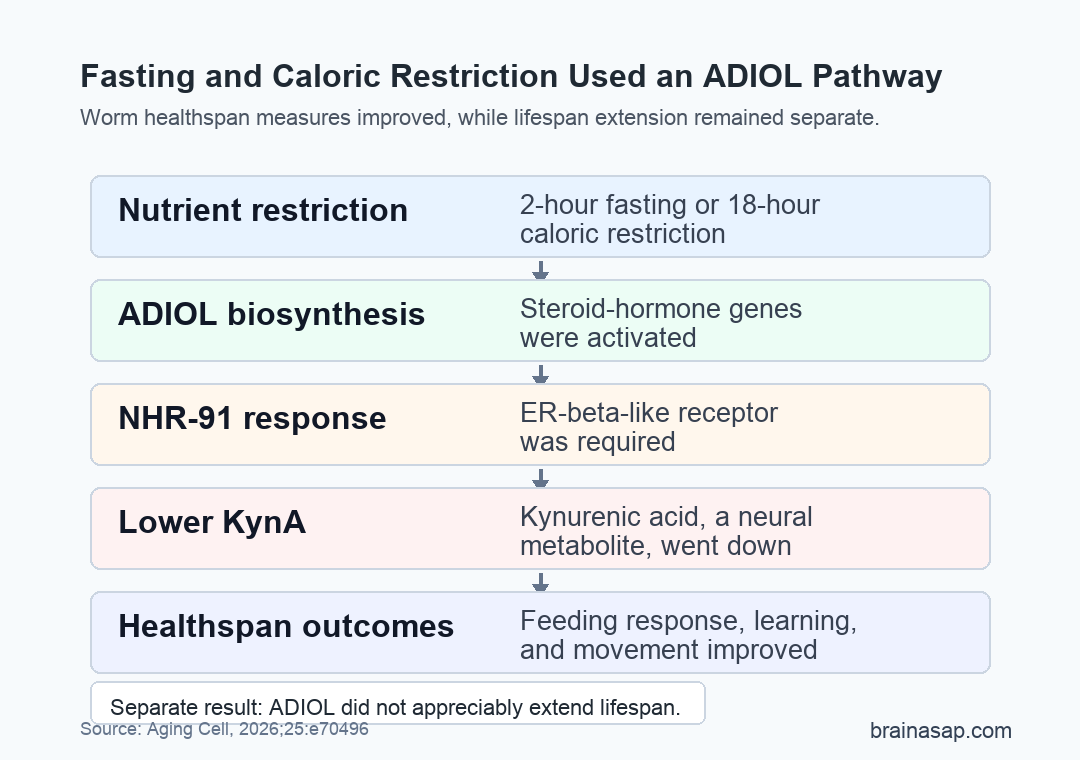
TL;DR: A 2026 study in Aging Cell found that fasting and caloric restriction activated ADIOL, a steroid hormone, through an NHR-91-kynurenic acid pathway that improved several healthspan measures in worms without extending lifespan.
Key Findings
- ADIOL was the central hormone: 5-androstene-3beta,17beta-diol (ADIOL) linked nutrient restriction to healthier function in C. elegans worms.
- NHR-91 was required: The pathway depended on NHR-91, a worm receptor related to mammalian estrogen receptor beta.
- Kynurenic acid was reduced: ADIOL acted through lower kynurenic acid (KynA), a tryptophan-derived neuromodulatory metabolite tied to learning and movement.
- Healthspan improved: ADIOL supported post-fasting feeding behavior, associative learning, and movement during aging.
- Lifespan did not increase: The pathway improved functional aging measures but was not needed for caloric-restriction lifespan extension.
Source: Aging Cell (2026) | Guijarro-Hernández et al.
5-androstene-3beta,17beta-diol (ADIOL) is a steroid hormone made from the same broad hormone-biosynthesis route that produces sex steroids. In this study, researchers treated it less like a minor hormone intermediate and more like a metabolic messenger.
The work used Caenorhabditis elegans, a short-lived worm model often used in aging biology. It did not test fasting effects in people.
The experiment tested whether one hormone pathway can connect nutrient restriction to neural and behavioral function during aging.
Fasting and Caloric Restriction Activated ADIOL Biology
The study started from a known link between ADIOL, NHR-91, and kynurenic acid (KynA). KynA is made from tryptophan metabolism and can influence glutamate-related neural activity.
Researchers then asked whether physiological nutrient states, not just synthetic compounds, used the same pathway. They tested acute fasting, caloric restriction, and genetic models that mimic aspects of dietary restriction.
- Fasting model: Worms were removed from food for a short period, then returned to food.
- Caloric restriction model: Worms were kept on a diluted bacterial food source for 18 hours.
- Genetic restriction models: The study used long-lived dietary-restriction-related mutants such as daf-2, mxl-3, and eat-2.
Those conditions increased transcription of several genes implicated in ADIOL biosynthesis. The response partly depended on NHR-131, a transcription factor tied to ADIOL production in the worm.
NHR-91 Linked ADIOL to Worm Feeding and Learning
The first functional readout was pharyngeal pumping, the worm’s rhythmic feeding motion. Wild-type worms normally reduce pumping when food is removed and show a short post-fasting increase when food returns.
That post-fasting pumping increase failed in worms lacking NHR-91 or NHR-131. Adding ADIOL restored the response in NHR-131-deficient worms, which are predicted to have a biosynthesis problem, but not in NHR-91-deficient worms, which cannot properly respond to ADIOL.
The same logic extended to learning. In young worms and aging worms, ADIOL-related signaling supported associative learning, a behavioral test that depends on conserved glutamate-related learning machinery.
- Hormone supply: NHR-131 helped activate genes involved in making ADIOL.
- Hormone response: NHR-91 was required for worms to respond to ADIOL.
- Neural output: NHR-91 action in RIM neurons, a pair of sensory-integration interneurons, was enough to restore key ADIOL responses.
Nutrient restriction did not simply make worms live longer or eat differently. In these experiments, it used a defined hormone-receptor route to change neural-state-dependent behavior.
Kynurenic Acid Connected the Pathway to Neural Function
Kynurenic acid (KynA) is a metabolite in the kynurenine pathway, a branch of tryptophan metabolism. In worms and mammals, KynA can affect neural signaling; higher KynA has often been linked to worse learning or memory performance.
In this paper, ADIOL worked through lower KynA. Fasting and caloric restriction changed kynurenine-pathway metabolites, and several experiments pointed to KynA reduction as the downstream step connecting ADIOL to behavior.
- Low-KynA mutants: Worms genetically shifted toward lower KynA showed better healthspan-related traits.
- High-KynA mutants: Worms shifted toward higher KynA showed worse movement and did not respond normally to ADIOL.
- Supplement experiments: Adding KynA reduced the functional benefits of ADIOL or caloric restriction in several tests.
The study also measured very different baseline amounts of kynurenine-pathway metabolites. Tryptophan levels were far higher than KynA levels, showing that the pathway’s smallest pools can still carry biological effects.
ADIOL Improved Healthspan Without Extending Lifespan
The clearest aging distinction was between healthspan and lifespan. Healthspan here meant maintained function, such as learning capacity, feeding behavior, and movement. Lifespan meant how long the worms lived.
NHR-91 and NHR-131 mutants showed earlier or stronger functional decline. ADIOL supplementation improved several age-sensitive functions, including learning and swimming-like movement measured by thrashing.
But ADIOL did not appreciably extend lifespan. Caloric restriction still extended lifespan in NHR-91 mutants, and the loss of NHR-91 did not erase lifespan extension in long-lived daf-2, mxl-3, or eat-2 mutant backgrounds.
- Learning capacity: ADIOL-related signaling helped maintain associative learning as worms aged.
- Feeding response: Post-fasting pumping depended on the ADIOL-NHR-91 route.
- Mobility: ADIOL improved thrashing in aged adult worms, especially when experiments avoided FUDR, a common worm-aging-study drug with known side effects.
That separation is biologically important. The pathway was not a generic longevity switch; it was a route by which dietary restriction preserved function during aging, even when lifespan was controlled by other mechanisms.
The Human Link Is Plausible, Not Proven
ADIOL exists in mammals, and it can bind estrogen receptor beta. The kynurenine pathway also has known relevance to neuroprotection, inflammation, and cognition.
Those overlaps make the pathway relevant to brain-aging biology, but this study does not show that ADIOL supplementation improves human cognition, movement, or healthy aging. It shows a mechanistic pathway in worms, then notes that some parts of the pathway have mammalian counterparts.
Main limitation: the experimental organism is C. elegans. Worm aging is useful for pathway discovery, but human dietary restriction, steroid signaling, sex biology, and brain aging are far more complex.
The supported conclusion is specific: in this worm model, fasting and caloric restriction used ADIOL-NHR-91 signaling to lower KynA and preserve functional aging measures, while lifespan extension followed a mostly separate route.
Citation: DOI: 10.1111/acel.70496. Guijarro-Hernández et al. Fasting and caloric restriction activate an ADIOL-NHR-91-kynurenine pathway signaling axis to promote healthspan. Aging Cell. 2026;25:e70496.
Study Design: Mechanistic C. elegans aging study using fasting, caloric restriction, genetic mutants, hormone supplementation, behavioral assays, RT-qPCR, and metabolite measurements.
Sample/Model: Worm experiments included wild-type animals plus NHR-91, NHR-131, kynurenine-pathway, and dietary-restriction-related mutant strains.
Key Statistic: ADIOL did not extend wild-type lifespan, while NHR-91 was required for multiple fasting/caloric-restriction healthspan effects.
Caveat: The work is a worm-model mechanism study, so human healthspan or supplementation claims require separate mammalian and clinical evidence.