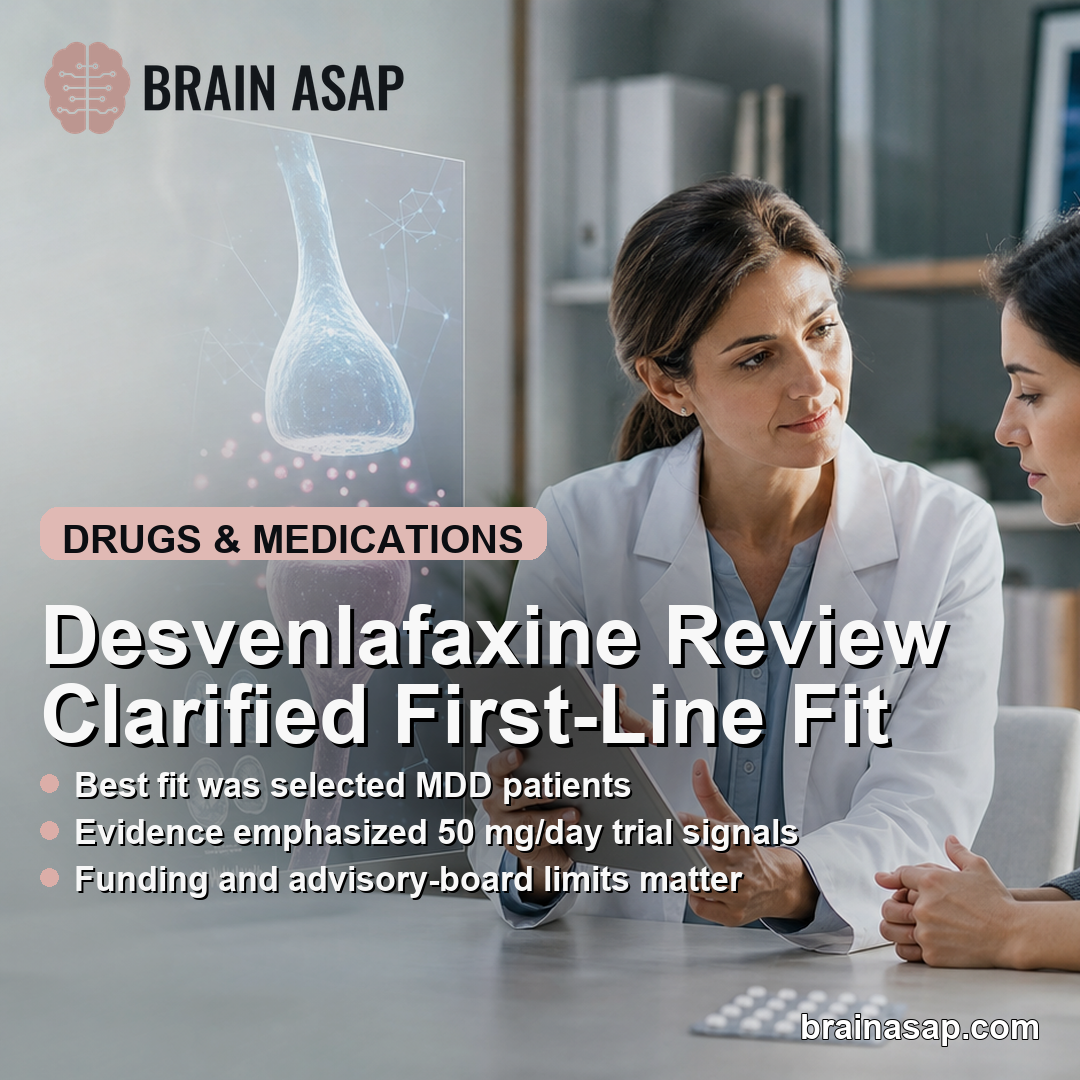
TL;DR: A 2026 narrative review in Clinical Drug Investigation argued that desvenlafaxine, a serotonin-noradrenaline reuptake inhibitor (SNRI), may be a first-line major depressive disorder option for selected patients, especially when fatigue, cognitive complaints, polypharmacy, or tolerability concerns shape the treatment choice.
Key Findings
- Review plus consensus: The source combined a PubMed-based narrative review with a December 2024 advisory-board discussion involving psychiatrists and Neuraxpharm representatives.
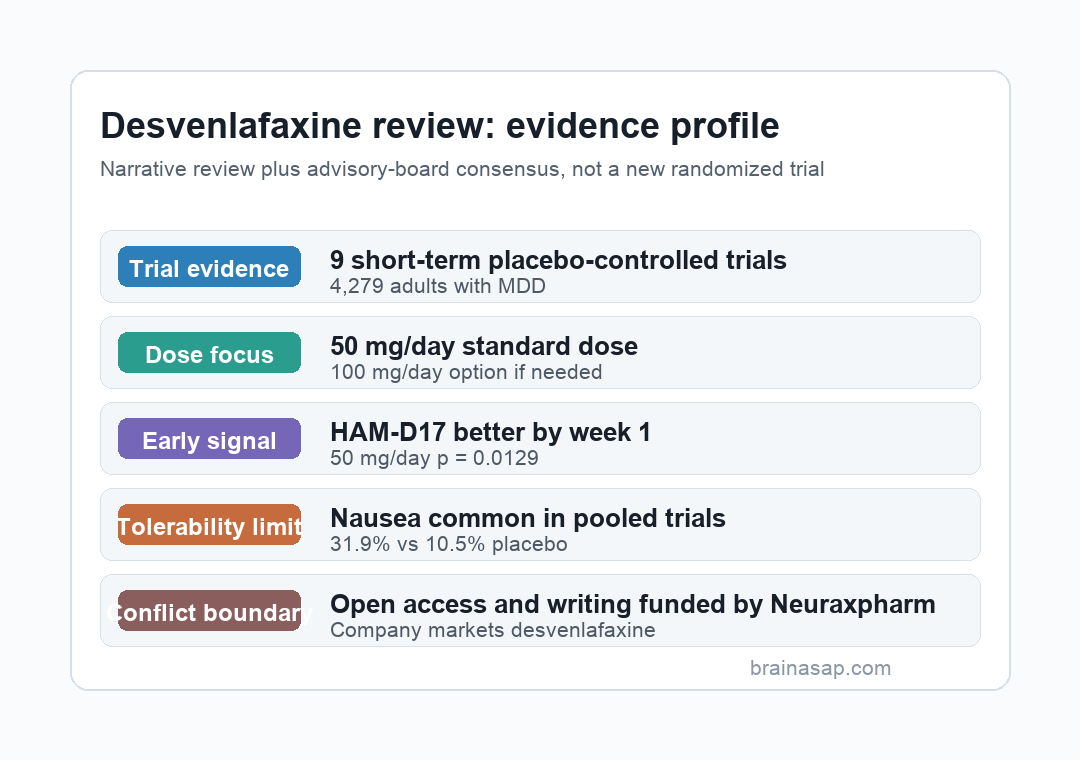
- 4,279 trial participants: Pooled efficacy evidence drew on 9 short-term placebo-controlled trials of desvenlafaxine in adults with major depressive disorder.
- Week-1 symptom signal: In a post hoc meta-analysis, 50 mg/day desvenlafaxine reduced HAM-D17 depression scores more than placebo by week 1 (p = 0.0129).
- 50 mg/day dose focus: The review emphasized the standard 50 mg/day dose because higher doses add adverse-event risk without markedly greater efficacy for most patients.
- Funding boundary: Neuraxpharm funded the work, the open-access fee, and medical writing support, and company representatives attended the advisory board.
Source: Clinical Drug Investigation (2026) | Carmassi et al.
Desvenlafaxine is an SNRI used for major depressive disorder (MDD). Unlike selective serotonin reuptake inhibitors (SSRIs), which primarily target serotonin, SNRIs act on serotonin and noradrenaline pathways.
This review asked whether desvenlafaxine should be considered earlier in treatment for some MDD patients. Its conclusion was a patient-selection argument based on pharmacology, prior trials, and expert consensus, not a universal replacement for SSRIs.
Desvenlafaxine Review Combined Trial Evidence With Advisory-Board Opinion
The source was a narrative review, not a new randomized trial. Researchers searched PubMed in August 2024 and added studies known to the authors, then integrated discussion from a virtual advisory board held on December 16, 2024.
The advisory board included psychiatrists from Italy, Germany, Spain, Ireland, and Portugal, together with representatives from Neuraxpharm, which markets desvenlafaxine.
- Evidence source: Published desvenlafaxine trials, pooled analyses, pharmacokinetic studies, and selected real-world data.
- Consensus source: A clinician advisory-board discussion focused on who might benefit from desvenlafaxine as first-line therapy.
- Conflict source: Neuraxpharm funded the work and open-access publication fee, and medical writing support was also funded by Neuraxpharm.
That structure sets the confidence level. Trial data can support efficacy and tolerability claims, but the first-line positioning depends partly on expert judgment and a sponsor-linked consensus process.
50 mg/Day Desvenlafaxine Was the Main Dose Argument
The review described desvenlafaxine as an extended-release medication available in 50 mg and 100 mg tablets. It emphasized 50 mg/day as the recommended starting and standard dose for most patients.
The dose argument was practical. The source noted that doses above 50 mg/day have been studied and can be effective, but they do not appear to add markedly greater efficacy for most patients and are more likely to increase adverse reactions and discontinuation.
- Standard dose: 50 mg/day was presented as the usual effective dose and can reduce the need for titration.
- Higher dose option: 100 mg/day can be considered when response is insufficient, but the review did not frame routine escalation as necessary.
- Renal caution: Severe renal impairment may require 50 mg every other day because desvenlafaxine is mainly excreted in urine.
The pharmacokinetic discussion also emphasized limited cytochrome P450 metabolism. Because desvenlafaxine is minimally metabolized by CYP2D6, the review argued that it may be useful when drug-drug interactions or CYP2D6 variability are concerns.
Nine Placebo-Controlled Trials Supported Depression Symptom Efficacy
The main efficacy base came from 9 short-term placebo-controlled trials that together included 4,279 adult outpatients with MDD. Among them, 1,714 received desvenlafaxine 50 mg, 870 received 100 mg, and 1,695 received placebo.
In a post hoc meta-analysis of those trials, patients receiving desvenlafaxine 50 mg/day had greater reductions in 17-item Hamilton Rating Scale for Depression (HAM-D17) scores than placebo by week 1 (p = 0.0129), week 2 (p = 0.0002), and week 8 (p < 0.0001).
Another integrated analysis reported significantly higher remission rates at week 8 for both 50 mg/day and 100 mg/day compared with placebo. The review also cited indirect comparison data showing no significant efficacy difference between desvenlafaxine and venlafaxine at an 8-week endpoint.
Fatigue, Cognition, and Work Function Drove Patient-Profile Claims
The review gave special attention to patients whose depression includes fatigue, low energy, cognitive complaints, or work impairment. A pooled analysis of the 9 short-term trials found significant improvement in energy and lassitude-related outcomes versus placebo.
In employed adults with MDD, smaller studies suggested that fatigue and energy changes predicted work-function improvement. One cited study reported that change in patient-perceived fatigue had a stronger standardized association with Sheehan Disability Scale total score than overall depression-score change.
- Energy/lassitude: Pooled trial data found significant improvement on energy-related HAM-D17 and MADRS items.
- Perceived cognition: An 8-week employed-patient study reported a large improvement on the British Columbia Cognitive Complaints Inventory.
- Working memory: A placebo-controlled substudy in 81 employed adults found improved working-memory quality but not attention power or continuity.
- Function: The review connected symptom changes to occupational and daily-function outcomes, not only mood-score changes.
Those subgroup claims are plausible but uneven. Some came from pooled randomized trials, while others came from small open-label or subgroup analyses that need less confident wording.
Tolerability Claims Included Nausea, Weight, Sexual Side Effects, and Blood Pressure
Safety was not framed as side-effect-free treatment. In an integrated analysis of 9 short-term randomized placebo-controlled trials involving 2,950 patients, adverse events were reported by 86.3% of desvenlafaxine-treated patients versus 74.5% of placebo-treated patients.
Nausea was the most common adverse event, reported by 31.9% of desvenlafaxine patients versus 10.5% of placebo patients. Overall adverse-event discontinuation was 12% with desvenlafaxine versus 3% with placebo, but at the 50 mg/day dose it was 4%, close to the 3% placebo rate.
The review highlighted several tolerability areas:
- Weight: Short-term trials showed a small mean weight decrease with desvenlafaxine rather than weight gain.
- Sexual side effects: Spontaneously reported sexual adverse events were described as relatively low, though not absent.
- Blood pressure: Short-term treatment was linked to small but statistically significant blood-pressure increases, so monitoring was recommended.
- Discontinuation: Withdrawal symptoms may be more common or severe than with some antidepressants, so the authors advised planned tapering.
The practical distinction is between better fit and risk-free fit. Desvenlafaxine may fit some patients better than alternatives, but nausea, blood pressure, renal dosing, suicidality warnings, and discontinuation planning still belong in the decision.
First-Line Use Was Proposed for Selected MDD Patient Profiles
The review acknowledged that some guidelines recommend SSRIs as first-line MDD options, while others do not mandate a specific first-line drug class. Its recommendation was narrower: consider desvenlafaxine early when patient features match the drug profile.
The clearest proposed profiles were working-age adults with fatigue or cognitive symptoms, perimenopausal or menopausal women, patients with polypharmacy concerns, and patients with non-psychiatric comorbidities where drug-drug interaction risk is important.
The funding and conflict disclosures are part of the evidence. Neuraxpharm funded the review and medical writing support, and 2 authors were full-time employees of the company.
Those disclosures do not invalidate the cited trials, but they raise the bar for independent confirmation of the first-line positioning.
Citation: DOI: 10.1007/s40261-026-01576-6. Carmassi et al. Desvenlafaxine as a Potential First-Line Treatment for Major Depressive Disorder: A Comprehensive Review and Consensus-Based Clinical Perspective on Efficacy, Safety and Patient Selection Profiles. Clinical Drug Investigation. 2026.
Study Design: Narrative review plus consensus-based clinical perspective from an advisory-board discussion.
Sample/Model: Review-level source; main pooled efficacy evidence cited 9 short-term placebo-controlled trials with 4,279 adult MDD outpatients.
Key Statistic: Desvenlafaxine 50 mg/day reduced HAM-D17 scores more than placebo by week 1 (p = 0.0129) in a post hoc meta-analysis of 9 trials.
Caveat: Neuraxpharm funded the work and medical writing support, and company representatives participated in the advisory-board process.