In Borderline Personality Disorder, Loneliness Tracked a Gap Between Self-View and Expectations
TL;DR: In borderline personality disorder, loneliness was higher when patients rated themselves as especially prosocial and justice-sensitive but did not expect the same level of fairness or concern from other people.
Key Findings
- Self-view and expectations diverged in BPD: Treatment-seeking patients showed bigger gaps between their own social values and what they expected from others.
- That gap tracked loneliness: The BPD group saw their own resource-sharing preferences as more other-oriented than controls did, and that more prosocial self-view was tied to higher loneliness.
- Expectations of others did not differ: The groups were not separated by expecting others to be dramatically more selfish.
- Loneliness rose with prosocial self-view: In the BPD group only, stronger self-rated prosociality tracked higher loneliness.
- Justice sensitivity mattered most for observer and beneficiary roles: Loneliness tracked gaps in concern about injustice to others or injustice one benefits from.
Source: Comprehensive Psychiatry (2026) | Vonderlin et al.
Borderline personality disorder is often described through emotional storms, unstable relationships, and fear of abandonment. This paper points to a quieter mechanism that can make social life feel punishing: patients may see themselves as strongly fair and other-oriented while expecting less fairness or concern from other people.
The gap between self-rated fairness and expected fairness from others is not just a philosophical disagreement about morality. It can shape how everyday interactions are interpreted: whether a delayed reply feels neutral, whether a small slight feels intentional, and whether another person seems likely to repair harm.
A Lonely Person Can Still Be Highly Prosocial
The easy caricature of borderline personality disorder is that relationships fail because emotions run hot and conflict follows. This study complicates that picture. The patients did not look like people indifferent to fairness or other people’s outcomes.
Instead, they tended to view themselves as unusually prosocial. In a slider task that asked participants to allocate resources between themselves and a stranger, the BPD group rated their own social value orientation as more other-regarding than healthy controls did.
That detail changes how loneliness should be read. A person can want fairness, mutual care, and principled behavior, yet still feel socially cut off if they expect other people to fall short of those standards.
A Slider Task Made Social Ideals Measurable
The study enrolled 60 people diagnosed with borderline personality disorder and 60 healthy comparison participants matched on sex and education. Each group included 52 women and 8 men, so the sample profile limits how broadly the result can be generalized.
Participants completed a social value orientation task, which turns a moral preference into a set of choices. They repeatedly divided resources between themselves and a stranger, allowing the researchers to estimate whether someone leaned toward self-maximizing, equality, or joint benefit.
The same logic was applied to expectations. Participants also judged what social value orientation they expected other people to have. The main construct was the gap between self-rating and expected-other rating, which the paper calls a self-other mismatch.
Justice Sensitivity Measured Reactions to Different Kinds of Unfairness
The researchers also measured justice sensitivity, a trait-like tendency to notice and react to unfairness. Importantly, the inventory distinguishes several positions: being the victim, witnessing injustice, benefiting from injustice, or perpetrating it.
The BPD group showed a stronger gap between how justice-sensitive they saw themselves and how justice-sensitive they expected others to be. The loneliness link was most visible for observer and beneficiary perspectives: situations where someone sees another person harmed, or sees themselves benefiting from unfairness.
That pattern fits the paper’s central idea. Loneliness may deepen when a person expects other people to care less about unfairness, especially unfairness that harms someone else or unfairly benefits the self.
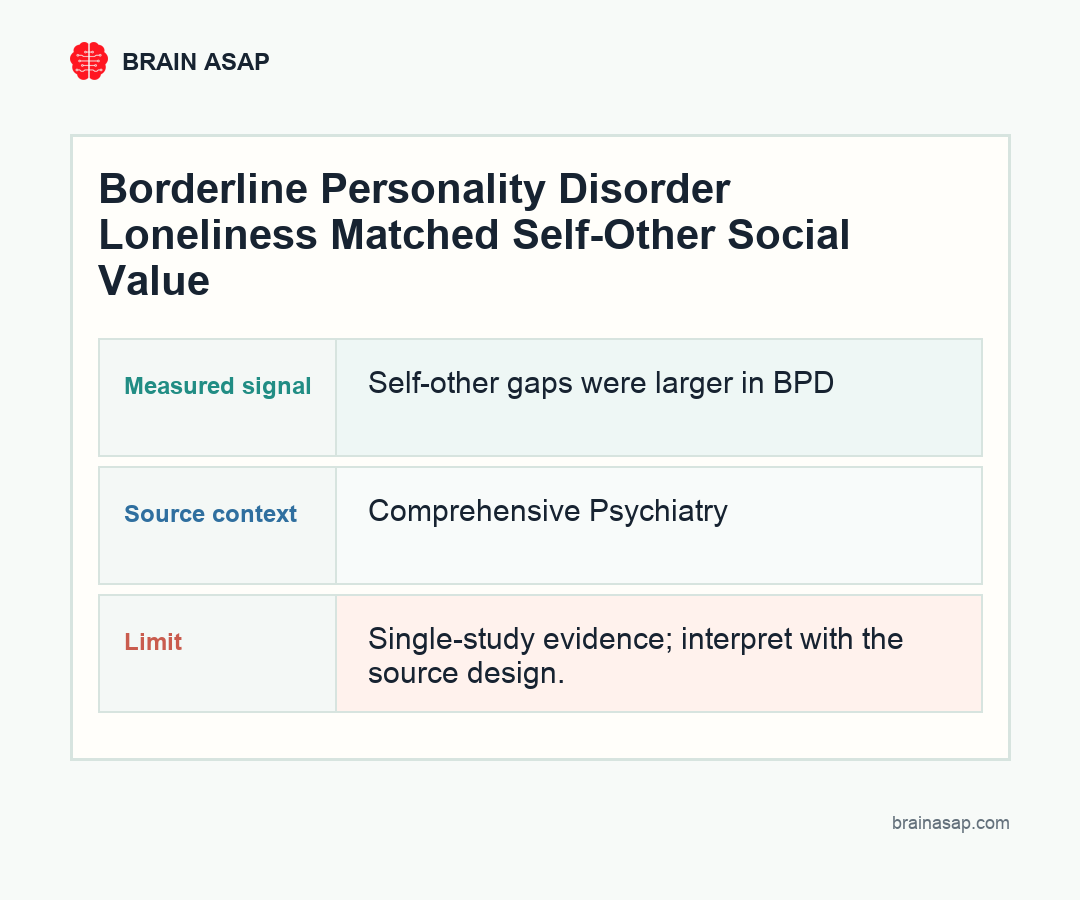
The Gap Between Self-Rating and Expected-Other Rating Did the Work
The most interesting finding is what did not happen. The groups did not differ much in their expectations about other people’s social value orientation. The BPD group was not simply more cynical about everyone else.
The sharper difference came from the relation between self-view and expectation. Seeing oneself as especially prosocial while expecting ordinary or lower prosociality from others creates an interpersonal asymmetry. Every ambiguous exchange can become a test of whether the other person will act fairly or dismiss the harm.
In the BPD group, higher self-rated prosociality was associated with higher loneliness. That association was absent in controls. The same self-image that is plausibly protective in one context may become painful when paired with mistrust, disappointment, and repeated social rupture.
The pattern can be summarized as three separable pieces:
- Self-view: BPD patients rated their own social value orientation as more other-regarding.
- Expectation of others: the groups did not differ strongly in expected social value orientation for other people.
- Loneliness link: loneliness rose when patients rated themselves as more prosocial while expecting less prosociality from others.
Why the Result Needs Careful Reading for Treatment-Seeking BPD
Borderline personality disorder is not only an emotion-regulation disorder. It is also a disorder of expectations: what a look means, whether someone will stay, whether repair is possible, and whether fairness will be returned.
This study suggests that clinicians often need to listen for expectation gaps, not only abandonment fear. A patient may describe loneliness as a reaction to being let down by others, while the underlying mechanism includes high social ideals colliding with low expectations of other people.
The ideals can be sincere and socially valuable. The clinical problem is the distance between ideals and expectations, which can become a source of chronic social pain. Therapy that helps patients test expectations, tolerate ambiguity, and distinguish unfairness from disappointment matters because everyday interactions are being interpreted through that distance.
The clinical point is subtle: a prosocial self-image can hurt when it becomes a constant comparison against anticipated disappointment. That may help explain why loneliness can persist even when the person wants connection and cares strongly about fairness.
In practice, that means the treatment target may include how patients judge other people’s intentions, not only emotion intensity. The question is how a patient learns to estimate another person’s fairness without turning every ambiguous cue into proof that the relationship is unsafe.
A Cross-Sectional Snapshot Cannot Prove the Cycle
The cross-sectional study cannot show whether the self-view-versus-expectation gap causes loneliness, whether loneliness sharpens the gap, or whether both are driven by a third factor such as depression, trauma history, or broader interpersonal sensitivity. It also lacked a clinical control group, so the expectation mechanism may not be unique to BPD.
The sample was treatment-seeking and predominantly female. That gives the findings direct clinic relevance, but it limits how far they can be stretched across men with BPD, community samples, or people with other personality disorders.
A stronger follow-up would compare BPD with depression, social anxiety, and trauma-related disorders while measuring the same gaps between self-ratings and expectations of others. That would show whether this is a BPD-specific pattern or a broader pathway into loneliness across psychiatric conditions. Longitudinal data would also show whether expectation gaps soften when loneliness improves.
Still, the paper offers a useful reframing. Loneliness in BPD does not always begin with wanting too much from others. Sometimes it begins with expecting too little fairness or concern from others while holding oneself to a standard that turns every mismatch into social pain.
Paper: Loneliness in borderline personality disorder: The role of misalignments between self-view and social expectations in social value orientation and justice sensitivity. Comprehensive Psychiatry. 2026;146:152663. DOI: 10.1016/j.comppsych.2026.152663
Authors: Vonderlin et al.
Study Design: Cross-sectional laboratory study of social value orientation, expected social values of others, justice sensitivity, and loneliness.
Sample Size: 60 treatment-seeking patients with borderline personality disorder and 60 matched healthy controls.
Key Statistic: The BPD group showed larger gaps between self-ratings and expectations of others, and loneliness in BPD tracked higher prosocial self-view plus justice-sensitivity gaps for observer and beneficiary scenarios.
Important Caveat: This design cannot show whether expectation gaps cause loneliness, loneliness sharpens those gaps, or both reflect another clinical factor over time in treatment-seeking patients with BPD across settings.