Exercise May Improve Movement, Freezing and Balance in Parkinson’s, Review Finds
Exercise May Improve Movement, Freezing and Balance in Parkinson's, Review Finds

TL;DR: Pooling 20 small trials in Parkinson’s disease, structured exercise improved movement-exam scores, freezing while walking and one balance test compared with usual care. The strongest evidence was for the movement exam, and no one type of exercise stood out. Key Findings 20 trials, 714 people: Tai chi, dance, treadmill, yoga, strength, water exercise and …
Read more

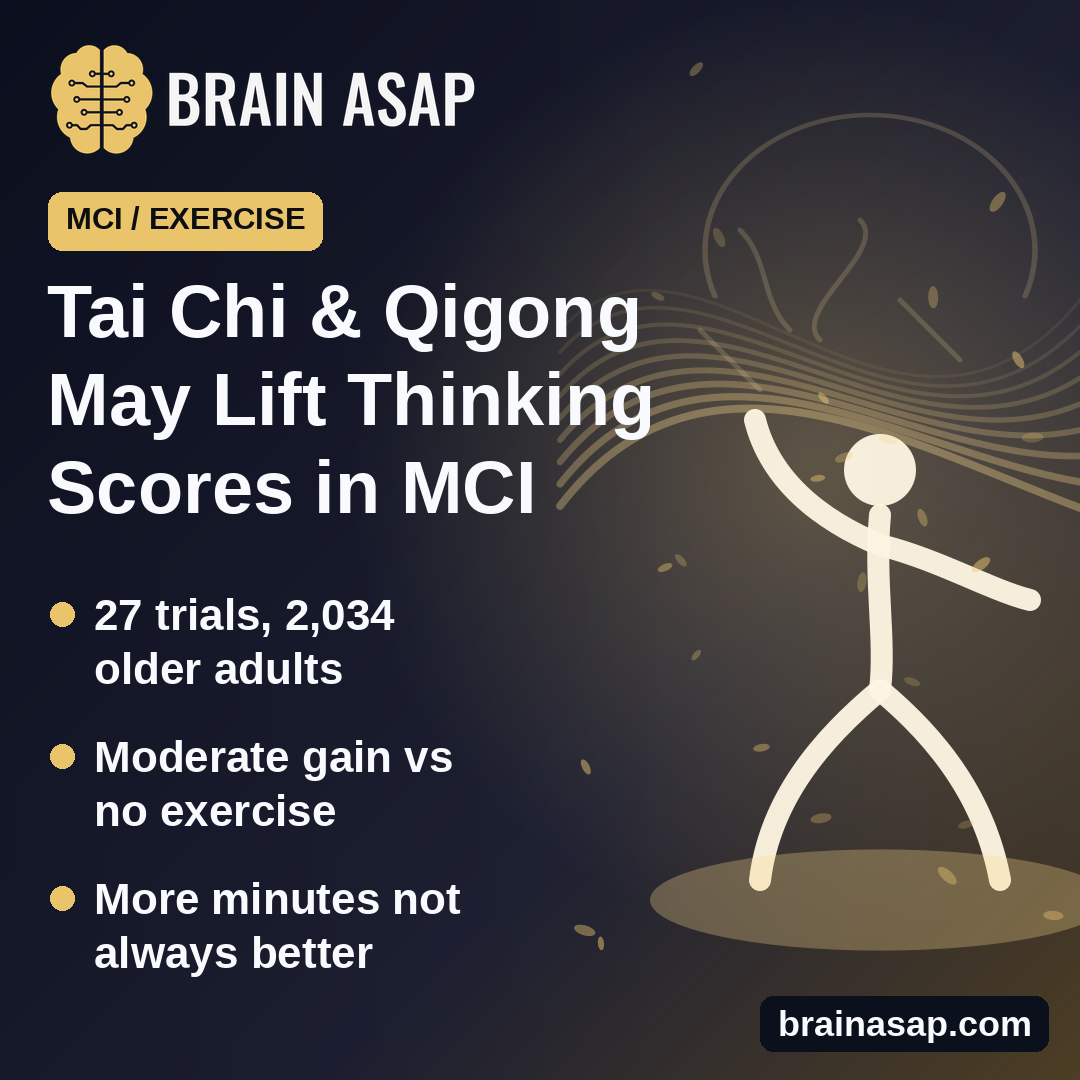
Tai Chi and Qigong May Boost Thinking Scores in Mild Cognitive Impairment

Tai Chi and Qigong May Boost Thinking Scores in Mild Cognitive Impairment

TL;DR: Across 27 trials in older adults with mild memory and thinking problems, tai chi and qigong classes lifted overall thinking scores by a moderate amount compared with no exercise. More weekly minutes were not always better, and the dosing patterns still need testing. Key Findings 27 randomized trials, 2,034 people: All aged 60+ with …

Read more

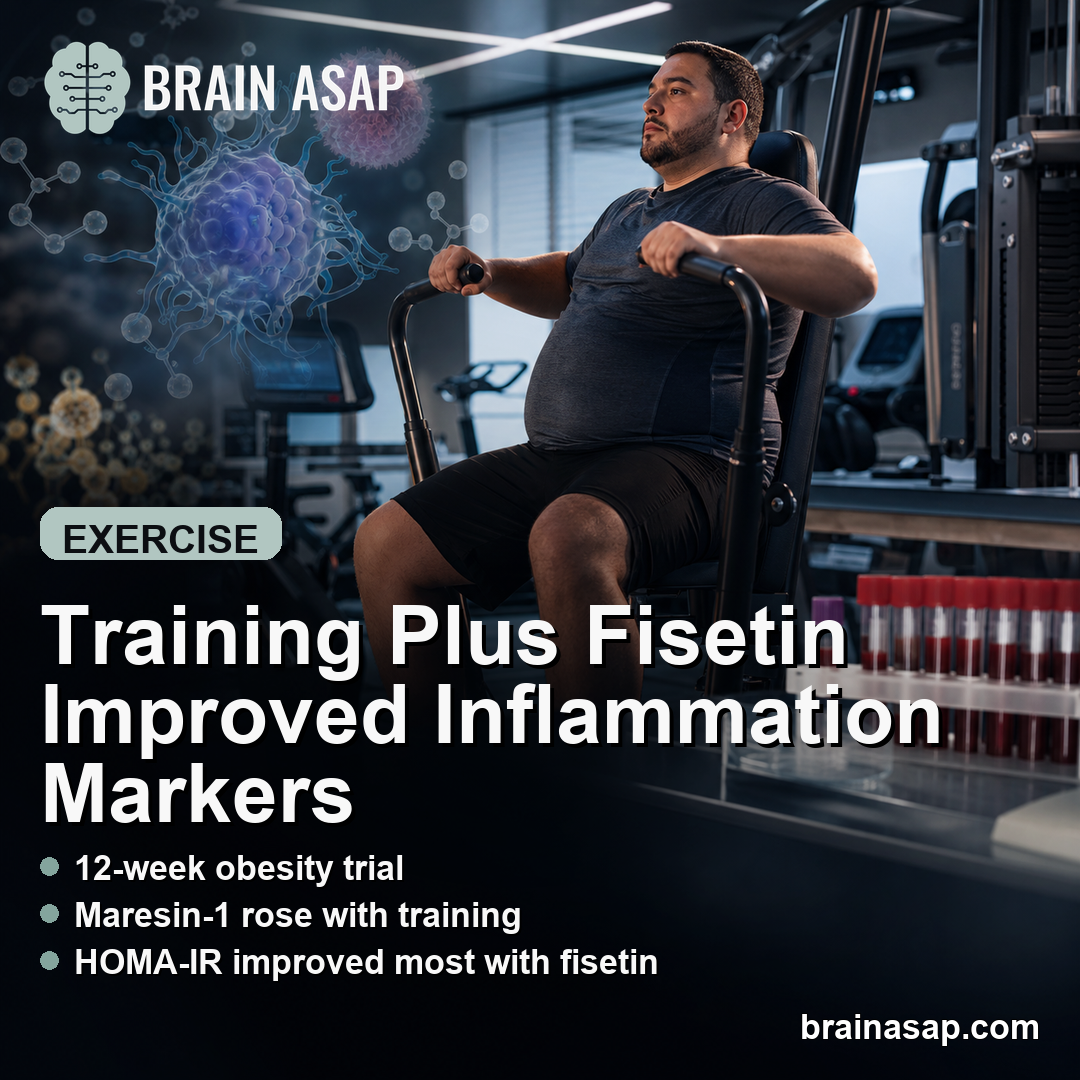
Fisetin Plus Training Improved Maresin-1 and HOMA-IR in Obesity Trial

Fisetin Plus Training Improved Maresin-1 and HOMA-IR in Obesity Trial

TL;DR: A 2026 randomized trial in Journal of the International Society of Sports Nutrition found that 12 weeks of combined interval resistance and aerobic training increased Maresin-1, an inflammation-resolving lipid mediator, in men with obesity, with the largest insulin-resistance improvement when training was paired with 200 mg/day fisetin. Key Findings 44 men completed the trial: …

Read more

Exercise and Fluoxetine May Converge on Alzheimer’s Disease Mechanisms

Exercise and Fluoxetine May Converge on Alzheimer's Disease Mechanisms

TL;DR: A 2026 review in International Journal of Molecular Medicine mapped how exercise and fluoxetine overlap in Alzheimer’s disease mechanisms such as mitochondrial quality control, oxidative stress, inflammation, and neuroplasticity, but clinical combination benefits remain unproven. Key Findings Review article, not trial: Wu and Li synthesized mechanistic evidence on exercise and fluoxetine in Alzheimer’s disease …

Read more

Hypothalamic SF1 Neurons Help Drive Exercise Endurance Gains

Hypothalamic SF1 Neurons Help Drive Exercise Endurance Gains

TL;DR: A 2026 mouse study in Neuron found that exercise activates ventromedial hypothalamic SF1 neurons, and that this brain response is required for normal endurance gains after training. Key Findings VMH SF1 neurons: Exercise increased activity-linked Bdnf expression in steroidogenic factor-1 neurons in the ventromedial hypothalamus. Training plasticity: Repeated exercise increased both intrinsic excitability and …

Read more

Group Exercise in Psychiatric Care Built Routine and Belonging

Group Exercise in Psychiatric Care Built Routine and Belonging

TL;DR: A 2026 mixed-methods study in BMC Psychiatry found that adults in psychiatric treatment valued group-based physical activity less as generic exercise and more as structured, socially supported care, with 97% of questionnaire participants saying they felt supported by activity leaders. Key Findings Real-world psychiatric care: The program was embedded in an Oslo outpatient clinic …

Read more

Exercise Before CBT Linked to Higher Depression Remission in Pilot Trial

Exercise Before CBT Linked to Higher Depression Remission in Pilot Trial

TL;DR: A 2026 randomized pilot trial in the Journal of Affective Disorders found that 30 minutes of moderate exercise before cognitive behavioral therapy (CBT) for major depressive disorder was linked to stronger therapy-process measures and higher exploratory remission than quiet rest before CBT. Key Findings Forty adults with major depressive disorder were randomized: Nineteen received …

Read more

Abdominal Muscle Contractions Drove Brain Motion and Interstitial Fluid Flow in Awake Mice

Abdominal Muscle Contractions Drove Brain Motion and Interstitial Fluid Flow in Awake Mice

TL;DR: A 2026 mouse study in Nature Neuroscience found that abdominal muscle contractions during locomotion drove directed brain motion and helped move interstitial fluid through brain tissue during wakefulness. Key Findings Brain motion was tightly coupled to locomotion, not heartbeat or breathing: Two-photon imaging in awake head-fixed mice showed dorsal cortex shifted relative to skull …

Read more

Five-Animal Play Improved GLP-1 and Glucose Control in Prediabetes

How Five-Animal Play Matched Probiotics in Prediabetes

How Five-Animal Play Matched Probiotics in Prediabetes TL;DR: 4 weeks of Huatuo Five-Animal Play improved glucose control and insulin resistance about as much as bifidobacterium capsules, outperforming low-intensity cycling on several metabolic markers, including Wnt5a. Key Findings Exercise shifted glucose and GLP-1: Researchers randomized 90 people with impaired glucose tolerance to bifidobacterium triple viable capsules, …

Read more

Vigorous Exercise Predicted Lower Dementia Risk in UK Biobank Accelerometer Data

Vigorous activity linked to lower dementia risk in UK Biobank accelerometer data

Vigorous Activity Linked to Lower Dementia Risk in UK Biobank TL;DR: In UK Biobank accelerometer data, the vigorous share of daily movement accounted for 32% of dementia’s population-attributable fraction versus just 8% for total activity volume — suggesting brief breathless bursts carry brain-health information that step counts miss. Key Findings Dementia favored intensity over volume: …

Read more