Monthly Lecanemab Maintained Alzheimer’s Blood Biomarker Changes After 18 Months

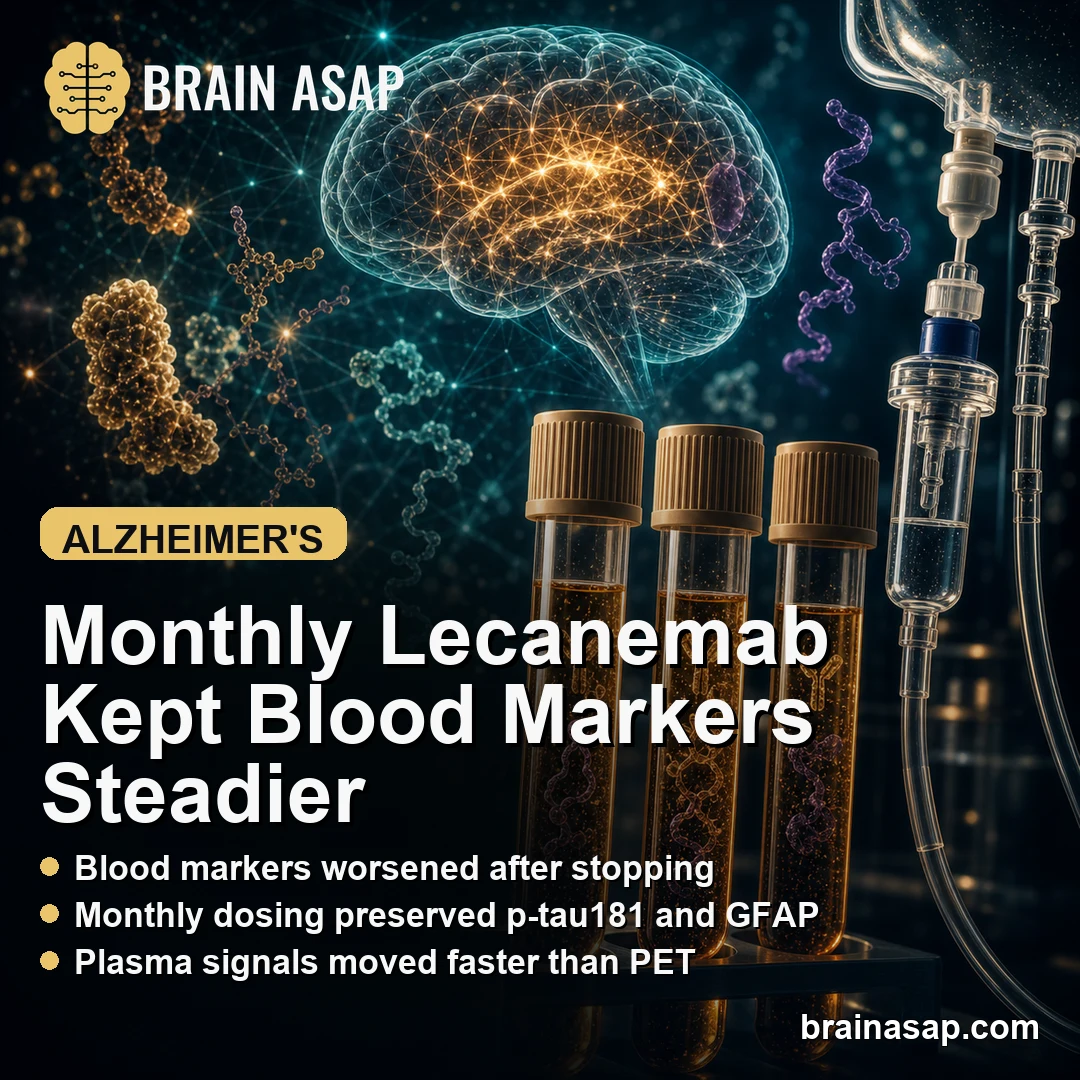
Monthly Lecanemab Maintained Alzheimer's Blood Biomarker Changes After 18 Months

TL;DR: A 2026 study in Alzheimer’s & Dementia: Translational Research & Clinical Interventions used lecanemab pharmacokinetic/pharmacodynamic modeling in early Alzheimer’s disease and found that blood biomarkers worsened after treatment stopped, while monthly maintenance dosing after 18 months was predicted to preserve most p-tau181 and GFAP, an astrocyte-inflammation protein. Key Findings Three plasma biomarkers improved: Lecanemab …

Read more

NYUCI-ES Adapted Dementia Caregiver Counseling for Chinese and Korean American Families

NYUCI-ES Adapted Dementia Caregiver Counseling for Chinese and Korean American Families

TL;DR: A 2026 descriptive study in JMIR Formative Research reported that the NYUCI-ES dementia-caregiver program required 24 documented cultural adaptations before and during delivery to Chinese and Korean American caregivers. Key Findings 24 adaptation strategies: Researchers identified 24 major changes to the dementia-caregiver intervention. Five adaptation elements: Changes were grouped into content, context, relationship fidelity, …

Read more

Amyloid PET Became Central to Alzheimer’s Antibody Eligibility

Amyloid PET Became Central to Alzheimer’s Antibody Eligibility

TL;DR: A 2026 narrative review in the Japanese Journal of Radiology reported that Alzheimer’s brain positron emission tomography (PET) imaging has shifted from supportive diagnosis toward treatment selection because amyloid PET is now central to confirming eligibility for anti-amyloid antibody therapy. Key Findings Three PET roles: The review separated FDG-PET, amyloid PET, and tau PET …

Read more

AI-Assisted Bayesian Inference Found Gamma-Secretase Alzheimer Pathways

AI-Assisted Bayesian Inference Found Gamma-Secretase Alzheimer Pathways

TL;DR: A 2026 medRxiv preprint applied ChatGPT-4o-assisted Bayesian-frequentist hybrid inference to Alzheimer’s single-nucleus RNA-seq data and identified gamma-secretase and HP1 transcription pathways that a no-evidence frequentist setting did not recover. Key Findings 427 ROSMAP samples: The application used postmortem prefrontal cortex single-nucleus RNA-seq data from 427 Religious Orders Study and Memory and Aging Project samples. …

Read more

Under-Mattress Sleep Sensors Predicted Next-Day Dementia Agitation Risk

Under-Mattress Sleep Sensors Predicted Next-Day Dementia Agitation Risk

TL;DR: A 2026 preprint in medRxiv found that under-mattress sleep sensors associated lower nighttime respiratory rate and more unstable nighttime movement with higher odds of next-day agitation in dementia, while the same features did not predict how severe agitation became once it occurred. Key Findings 55 dementia patients supplied the main dataset: Researchers matched 333 …

Read more

fMRI Biotypes Predicted tDCS Anxiety Response in Alzheimer’s-Risk Adults

fMRI Biotypes Predicted tDCS Anxiety Response in Alzheimer's-Risk Adults

TL;DR: A 2026 preprint on medRxiv used resting-state functional MRI (fMRI), a brain-connectivity scan taken while people are not doing a task, to divide older adults at Alzheimer’s risk into anxiety biotypes that responded differently to frontal-lobe tDCS stimulation. Key Findings Older-adult tDCS trial: The final sample included 199 older adults, with 99 sham tDCS …

Read more

Clomipramine Inhibited Itch and Improved Memory in Alzheimer’s Mice

Clomipramine Inhibited Itch and Improved Memory in Alzheimer's Mice

TL;DR: A 2026 mouse study in iScience found that blocking Itch, an E3 ubiquitin ligase involved in protein tagging, improved several memory-test readouts in an Alzheimer’s disease mouse model and reduced neuronal apoptosis, including when researchers used the existing drug clomipramine. Key Findings Two Itch strategies: Researchers tested AAV-delivered loss-of-function Itch mutants and clomipramine, a …

Read more

SPP1 Marked Shared Microglia Programs in Neurodegeneration

SPP1 Marked Shared Microglia Programs in Neurodegeneration

TL;DR: A 2026 study in Glia used human single-nucleus RNA sequencing datasets and mouse validation to identify a shared neurodegeneration-linked microglial transcription program, highlighting SPP1 as a disease-associated microglia marker. Key Findings Five disease contexts: The analysis integrated human microglia datasets from Alzheimer’s disease, Parkinson’s disease, amyotrophic lateral sclerosis, frontotemporal dementia, and aging. Single-nucleus RNA-seq: …

Read more

Blood Inflammation Linked to Brain White-Matter Microstructure

Blood Inflammation Linked to Brain White-Matter Microstructure

TL;DR: A 2026 medRxiv preprint linked higher blood inflammatory markers with diffusion MRI signs of altered white-matter microstructure in 457 dementia-free middle-aged and older adults, especially for a combined cytokine score and orientation dispersion index. Key Findings 457 dementia-free participants: The cross-sectional study examined adults with a mean age of 63.82 years and used blood …

Read more

Brain-Organ Hypersynchrony Linked to Alzheimer’s Cognitive Decline

Brain-Organ Hypersynchrony Linked to Alzheimer's Cognitive Decline

TL;DR: A 2026 medRxiv preprint used total-body tau PET in Alzheimer’s disease and found stronger brain-organ network synchrony, a pattern that tracked cognitive impairment through cortical tau burden and MRI markers of glymphatic dysfunction. Key Findings Small imaging cohort: Researchers compared 28 Alzheimer’s disease patients with 23 matched negative controls using positron emission tomography (PET), …

Read more