
TL;DR: A 2025 study in Neurology used a Kaiser Permanente target-trial emulation and found that starting a statin was not linked to higher or lower Alzheimer disease or related dementia incidence after the first year. The first-year diagnosis increase likely reflected more medical contact after a new prescription.
Key Findings
- No difference after year one: Statin initiators had essentially the same AD/ADRD hazard as matched noninitiators after the first year (HR 1.00, 95% CI 0.99-1.01).
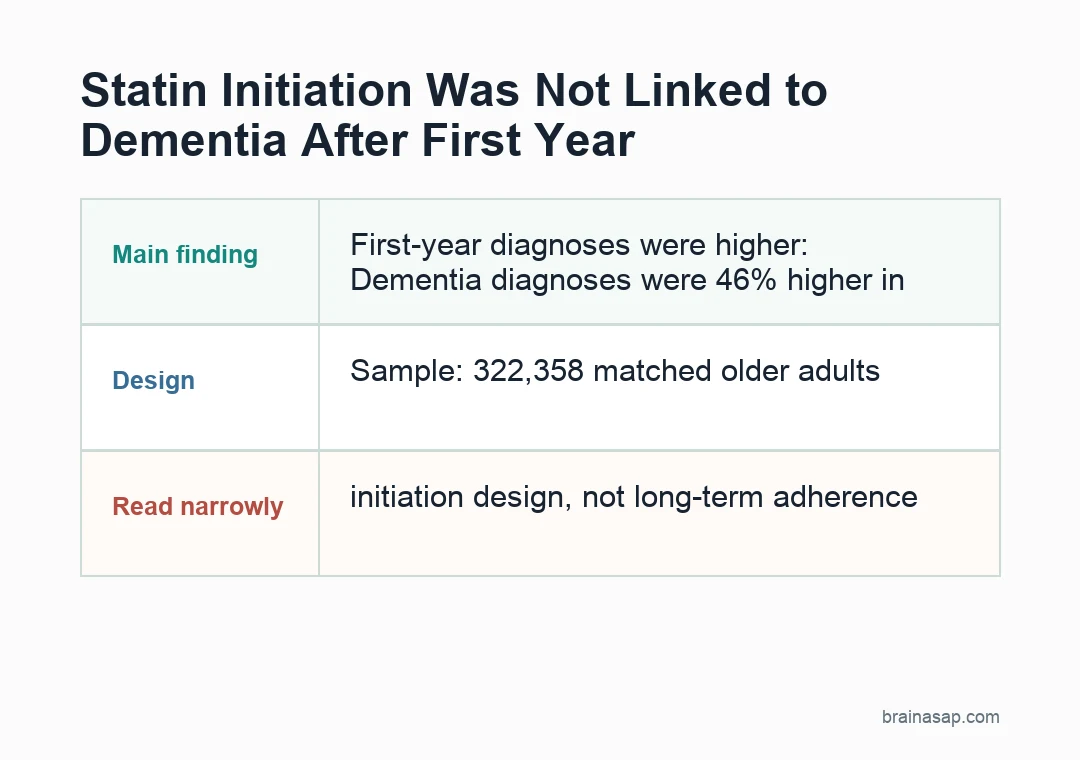
- First-year diagnoses were higher: Dementia diagnoses were 46% higher in the first year after statin initiation (HR 1.46, 95% CI 1.42-1.53), a pattern researchers linked to increased medical observation.
- Large real-world sample: The analytic sample included 322,358 unique matched Kaiser Permanente Northern California members, with mean age 67.4 years and 11.8 years of average follow-up.
- Survey and genetic checks agreed: Additional adjustment for sociodemographic variables and APOE-e4 count did not materially change the estimate.
- Intent-to-treat, not long-term dose: The design estimated the effect of starting statins, not the effect of remaining adherent to statins for decades.
Source: Neurology (2025) | Zimmerman et al.
Statin initiation sits in an awkward place in dementia research. High LDL cholesterol is tied to vascular disease and has been named as a modifiable dementia risk factor.
Cholesterol-lowering treatment can sound brain-protective for that reason. But people who receive statins also differ from people who do not, and dementia diagnoses can rise when a new medication brings more contact with clinicians.
Zimmerman et al. built the analysis around that problem. Instead of comparing all statin users with all nonusers, researchers emulated a target trial.
The clinical question was direct: what happened when older adults in Kaiser Permanente Northern California started a statin and were compared with closely matched people who had not started one at that same point?
A Target-Trial Design Tested Statin Initiation, Not Just Statin Use
The study used electronic health records from 1997 through 2020. Eligible participants were born before 1951 and had at least 4 years of Kaiser membership during the run-in window.
Participants also had no prior statin dispensing or AD/ADRD diagnosis during that run-in period.
Among 705,061 eligible participants, 264,294 initiated a statin between 2001 and 2010. Of those, 249,613 were matched with up to five noninitiators using age and LDL cholesterol.
That matching created an analytic sample of 322,358 unique participants. Mean baseline age was 67.4 years, 55.1% were female, and average follow-up was 11.8 years.
- Exposure: Starting a statin between 2001 and 2010.
- Comparison: Matched adults who had not started a statin at the same time point.
- Outcome: Alzheimer disease or related dementia diagnoses in routine health records.
LDL cholesterol was not treated as a vague background risk factor. It was part of how initiators and noninitiators were aligned at baseline.
The dementia question was therefore narrower than broad cardiovascular aging. Among people similar enough to compare, did the act of starting a statin lead to a different dementia trajectory?
The Main Estimate Was Null After the First Year
After the first year of follow-up, statin initiation was not associated with AD/ADRD incidence. In the full matched sample, the hazard ratio was 1.00 with a 95% confidence interval from 0.99 to 1.01.
That estimate is unusually precise for dementia epidemiology. It rules out even modest average differences in either direction for the target being measured.
- Full matched sample: HR 1.00 after the first year.
- Survey-covariate subsample: HR 1.01 after the first year.
- Survey plus genetics subsample: HR 0.97 after adjustment including APOE-e4 allele count.
Those estimates are not identical, but they point to the same practical conclusion. Starting a statin did not show a meaningful sustained association with routine-care dementia diagnoses.
The First-Year Increase Is Probably a Detection Effect
The confusing part is the first year. Statin initiators had a 46% higher hazard of AD/ADRD diagnosis in the first year after the prescription.
A simple headline could make that sound alarming, but the timing points in a different direction.
Starting a statin is usually not an isolated event. It can follow a cholesterol test, a cardiovascular risk discussion, medication counseling, repeat lab work, and more visits.
Older adults with more health-system contact are more likely to have cognitive symptoms noticed, documented, or coded. Researchers therefore split follow-up at one year.
- First year: Dementia diagnosis hazard was higher after statin initiation.
- First month: The strongest elevation appeared immediately after the prescription, HR 2.78.
- Afterward: The estimate moved close to null.
The timing fits detection and medical observation better than a rapid biological pathway in which statins cause dementia.
The Study Does Not Prove Statins Protect the Brain
The result also pushes back against the opposite overclaim. Many earlier observational studies suggested statins protected against dementia, but those studies were vulnerable to confounding.
People who initiate and adhere to preventive medications can have better access to care, different cardiovascular risk management, different education, and different health behaviors.
This study does not show a protective dementia effect from statin initiation. It shows that initiating statins was inconsistent with more than a 3% relative increase or decrease in AD/ADRD hazard after the first year.
That is narrower than saying “statins prevent dementia” or “statins cause dementia.” It is also more clinically useful, because it matches the actual comparison the researchers tested.
What This Means Clinically
The most practical reading is that dementia should not be the main argument for or against statin initiation in older adults. Statins still have cardiovascular indications, and cardiovascular health matters for brain aging.
But this study does not support using statins as a dementia-prevention treatment by themselves.
It also does not support avoiding statins because of long-term dementia fear. In this dataset, after the first year, statin initiators and matched noninitiators had nearly identical dementia incidence.
For patients and clinicians, the practical decision is ordinary: base statin use on cardiovascular risk, adverse effects, drug interactions, and patient context, not on the expectation of a major dementia effect.
Routine Diagnosis Records Set the Boundary
This was still an observational study, even though it used a target-trial emulation design. Matching and weighting can only address measured confounding.
Dementia diagnoses came from routine clinical records, not uniform research evaluations, so the outcome reflects real-world detection and coding practices.
The analysis was also intent-to-treat. It estimates what happened after statin initiation, not the biological effect of continuous statin exposure, adherence, drug intensity, LDL lowering, or starting treatment in midlife.
The bottom line is specific: in a very large older-adult health-system cohort with long follow-up, statin initiation did not meaningfully change AD/ADRD incidence after the first year.
Citation: DOI: 10.1212/WNL.0000000000213855. Zimmerman et al. Statin Initiation and Dementia Incidence in a Large Health Care System From 1997 to 2020: A Target Trial Emulation Study. Neurology. 2025;105:e213855.
Study Design: Target-trial emulation using Kaiser Permanente Northern California electronic health records, with nested survey and genetic covariate subsamples.
Sample Size: 322,358 unique matched participants; mean baseline age 67.4 years; average follow-up 11.8 years.
Key Statistic: AD/ADRD after first year: HR 1.00 (95% CI 0.99-1.01). First year after initiation: HR 1.46 (95% CI 1.42-1.53).
Caveat: Routine clinical diagnosis records and an intent-to-treat design do not measure lifelong adherence, statin intensity, LDL lowering, or midlife initiation.