TL;DR: A 2026 post-hoc analysis in International Clinical Psychopharmacology found that lurasidone 40 mg/day improved all 5 Positive and Negative Syndrome Scale (PANSS) symptom domains in acute schizophrenia over 6 weeks, with the largest effect on positive symptoms and later improvement in negative symptoms.
Key Findings
- 483 randomized patients: The JEWEL phase 3 trial assigned adults with acute schizophrenia exacerbation to lurasidone 40 mg/day or placebo.
- Five PANSS domains improved: Lurasidone beat placebo at week 6 on positive symptoms, negative symptoms, disorganized thought, hostility/excitement, and anxiety/depression.
- Largest positive-symptom effect: The positive-symptom domain had an effect size of 0.44, with mean PANSS change of -6.6 on lurasidone versus -4.3 on placebo.
- Week 2 separation: Four of 5 Marder PANSS domains separated from placebo by week 2; negative symptoms separated later, beginning at week 4.
- Item-level pattern: Anxiety, tension, preoccupation, active social avoidance, and conceptual disorganization were among the non-positive PANSS items that responded early or showed endpoint effect sizes above 0.3.
Source: International Clinical Psychopharmacology (2026) | Miura et al.
Lurasidone is an atypical antipsychotic used for schizophrenia, but the clinical question here was narrower than whether it reduces acute psychosis overall.
Researchers reanalyzed a 6-week randomized trial to ask which symptom domains moved first. The answer matters because acute schizophrenia care often focuses on hallucinations and delusions while anxiety, disorganization, social withdrawal, and negative symptoms also shape function.
Lurasidone Was Tested During Acute Schizophrenia Exacerbation
The analysis used the double-blind phase of the JEWEL trial, a multicenter phase 3 study run at 73 clinical sites in Japan, Ukraine, Russia, Romania, and Poland.
Participants were adults ages 18 to 74 with an acute schizophrenia exacerbation, a baseline PANSS total score of at least 80, and at least moderate positive symptoms at screening and baseline.
- Treatment group: 245 patients in the intention-to-treat sample received fixed-dose lurasidone 40 mg/day.
- Control group: 233 patients in the intention-to-treat sample received placebo.
- Baseline severity: Mean PANSS total scores were about 102 in both groups, indicating a substantially symptomatic acute sample.
PANSS stands for Positive and Negative Syndrome Scale, a clinician-rated schizophrenia symptom scale. The Marder 5-factor model groups PANSS items into positive symptoms, negative symptoms, disorganized thought, hostility/excitement, and anxiety/depression.
All Five PANSS Symptom Domains Improved by Week 6
Lurasidone produced statistically greater improvement than placebo in every Marder domain at the week 6 endpoint.
The largest effect was on positive symptoms, the domain most directly tied to delusions, hallucinations, suspiciousness, and unusual thought content. Positive symptoms fell by 6.6 points with lurasidone versus 4.3 points with placebo, for an effect size of 0.44.
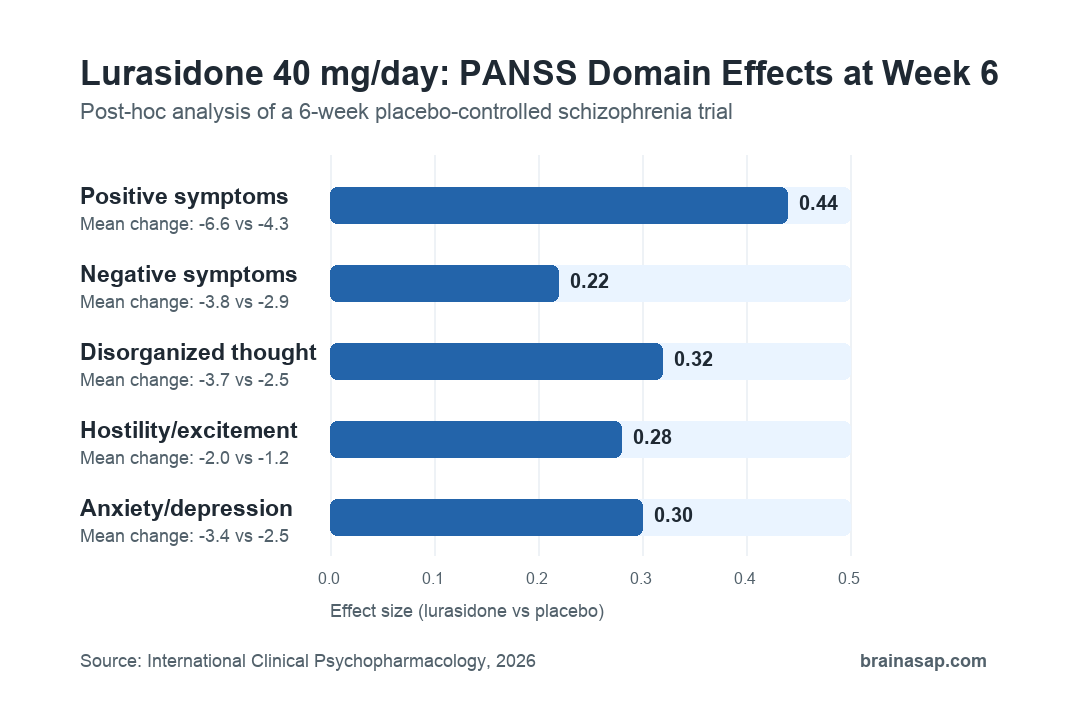
The other domains showed smaller but still significant endpoint effects: 0.22 for negative symptoms, 0.32 for disorganized thought, 0.28 for hostility/excitement, and 0.30 for anxiety/depression. Timing separated the domains, with positive symptoms, disorganized thought, hostility/excitement, and anxiety/depression improving by week 2.
Negative symptoms separated later, beginning at week 4. That slower timing fits the trial population, which was selected mainly for acute positive symptoms rather than for a primary negative-symptom presentation.
The delayed negative-symptom result also keeps the interpretation grounded. In this trial, lurasidone’s clearest early signal was acute symptom reduction; the negative-symptom finding was smaller and depended on a sample that did not start with severe primary negative symptoms.
- Positive symptoms: Delusions and hallucinatory behavior showed significant improvement beginning at week 2.
- Disorganized thought: Conceptual disorganization and preoccupation improved early, with other disorganization items separating later.
- Anxiety/depression: Anxiety separated at week 2 and tension separated at week 3.
Those item-level results are useful because schizophrenia symptoms do not move as one block. A patient can have less hallucination severity while still struggling with attention, social avoidance, or anxiety.
Item-Level PANSS Results Clarified the Clinical Pattern
At week 6, lurasidone significantly improved 5 of 8 positive-symptom items, 4 of 7 disorganized-thought items, 2 of 4 hostility/excitement items, and 2 of 4 anxiety/depression items.
Only one negative-symptom item, active social avoidance, showed significant improvement. Researchers cautioned that many negative-symptom items had low baseline severity, which makes treatment separation harder to detect.
- Social avoidance: Active social avoidance improved from week 2 through week 6.
- Disorganization items: Conceptual disorganization and preoccupation improved early, while poor attention improved later.
- Anxiety and tension: Anxiety and tension improved, but the depression item did not show the same significant endpoint separation.
The study did not show that lurasidone treats every schizophrenia symptom equally. It showed a broader acute symptom pattern than a positive-symptom-only summary would capture.
The Main Limit Is the Post-Hoc Trial Question
This was a post-hoc analysis of a randomized trial, so the original study was not designed primarily around every individual PANSS item.
The trial also tested only 40 mg/day for 6 weeks. It cannot answer whether higher doses would shift specific PANSS domains differently, or whether the same pattern persists during maintenance treatment.
- Enriched entry criteria: Patients were selected for acute positive symptoms, not for predominant negative symptoms.
- Short follow-up: A 6-week trial can measure acute symptom change, but not durable functional recovery.
- Item severity issue: Some nonsignificant PANSS items started near mild severity, leaving less room for measurable improvement.
For clinical interpretation, the finding supports lurasidone as an acute antipsychotic with measurable effects across several PANSS domains. It does not prove that lurasidone is a targeted treatment for primary negative symptoms or long-term cognitive impairment.
Citation: DOI: 10.1097/YIC.0000000000000609. Miura et al. The effects of lurasidone on five symptom domains and individual items in schizophrenia: Post-hoc analysis from Phase 3 study. International Clinical Psychopharmacology. 2026;41:176-183.
Study Design: Post-hoc mixed-model analysis of a 6-week randomized, double-blind, placebo-controlled phase 3 schizophrenia trial.
Sample Size: 478 patients in the intention-to-treat analysis, including 245 assigned to lurasidone and 233 assigned to placebo.
Key Statistic: Week 6 Marder PANSS effect sizes ranged from 0.22 to 0.44 across the 5 symptom domains.
Caveat: The trial was short, used one fixed lurasidone dose, and was enriched for acute positive symptoms rather than primary negative symptoms.