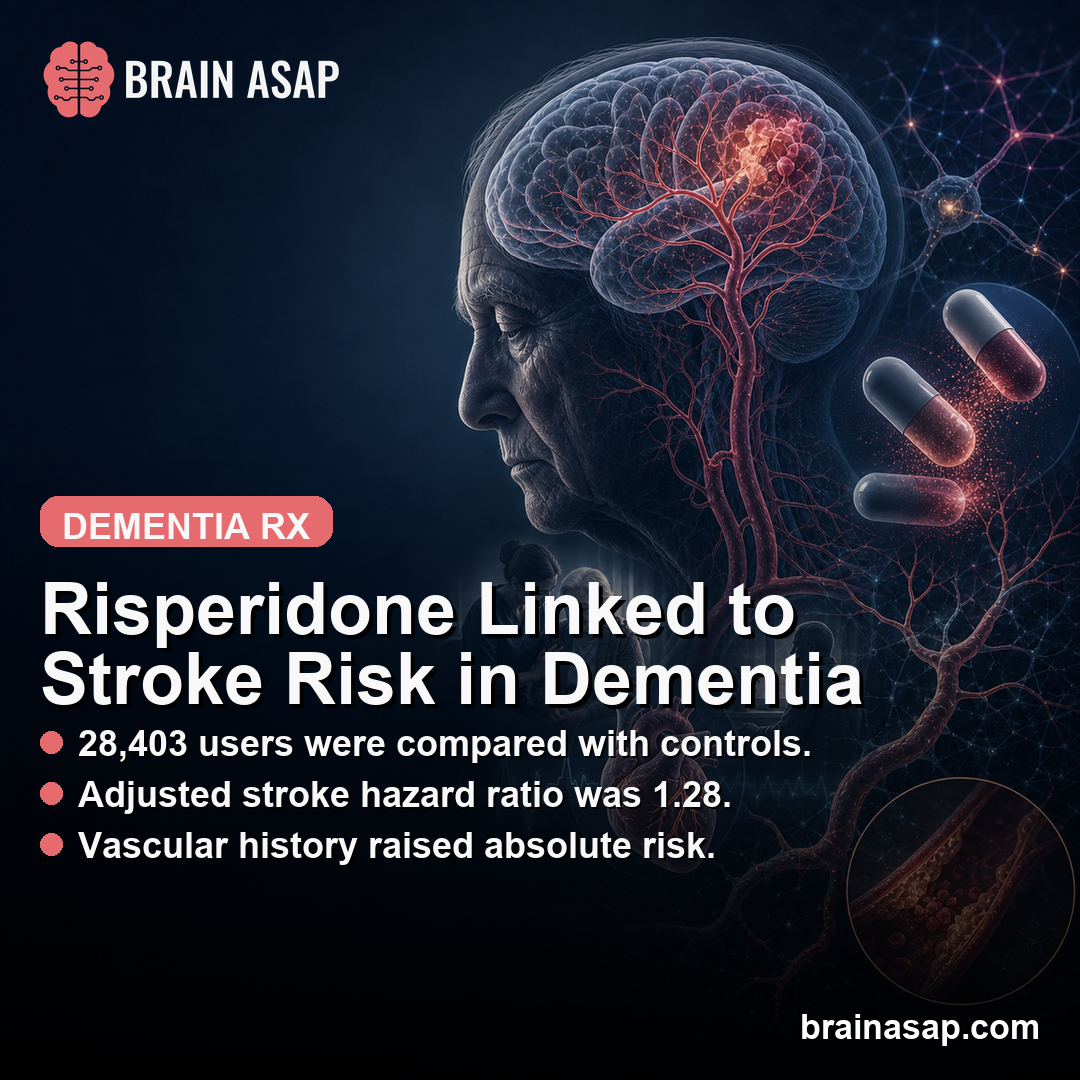
TL;DR: A 2026 population-based matched cohort study in British Journal of Psychiatry found that risperidone use was associated with increased stroke risk, adjusted hazard ratio 1.28, while absolute stroke incidence was especially high in people with prior stroke or cardiovascular disease.
Key Findings
- Matched dementia comparison: The analysis compared stroke risk among risperidone users and matched controls.
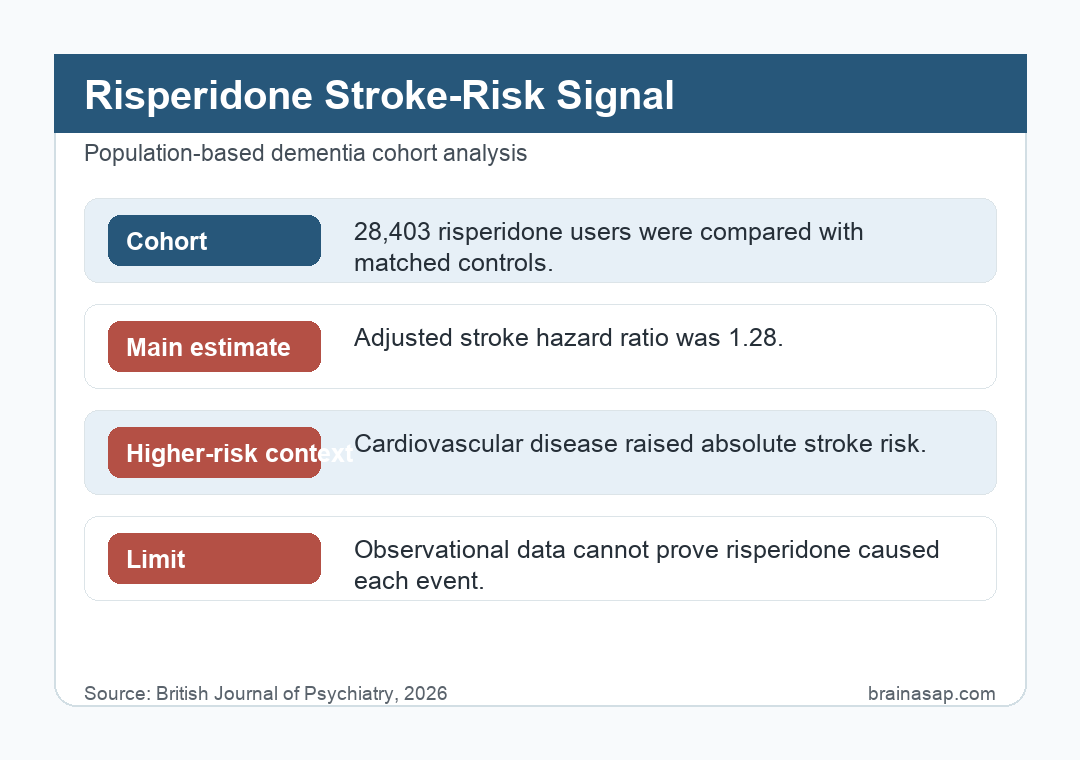
- Large prescribing dataset: It included 28,403 risperidone users and 136,324 matched controls with dementia.
- Main result: Risperidone use was associated with increased stroke risk, adjusted hazard ratio 1.28.
- Second result: Absolute stroke incidence was especially high in people with prior stroke or cardiovascular disease.
- Caution: The study quantifies risk but cannot replace individualized prescribing decisions for severe agitation or aggression.
Source: British Journal of Psychiatry (2026) | Choma et al.
Agitation and aggression are common in dementia, and antipsychotics may be used when symptoms are severe. The safety concern is that antipsychotics can raise stroke risk in a population that may already be vascularly vulnerable.
This British Journal of Psychiatry study estimated risperidone-associated stroke risk with and without prior cardiovascular disease.
Core result: risperidone use was associated with increased stroke risk in dementia, adjusted hazard ratio 1.28. Absolute risk was especially high in people with prior stroke or cardiovascular disease.
Dementia Cohort Compared Risperidone Users With Matched Controls
Design: a dementia cohort study comparing stroke risk among risperidone users and matched controls. Sample: 28,403 risperidone users and 136,324 matched controls with dementia.
The cohort compared risperidone users with matched controls in dementia care. This keeps the result clinically relevant, but still observational.
- Users: 28,403 people with dementia received risperidone.
- Controls: 136,324 matched controls were compared.
- Relative risk: The adjusted hazard ratio for stroke was 1.28.
- Absolute risk: Prior stroke and cardiovascular disease groups had much higher incidence rates.
Risperidone Was Associated With Higher Stroke Risk
The main result is the adjusted hazard ratio: 1.28 for stroke risk. It signals increased relative risk among risperidone users after adjustment.
Absolute incidence matters more for bedside decisions. Prior stroke and cardiovascular disease pushed baseline risk higher, so the same relative increase can mean more real events.
Clinical context: risperidone is not prescribed casually in dementia care. It is usually considered when agitation, aggression, or psychosis creates serious distress or safety risk.
The study’s value is that it separates relative stroke risk from absolute stroke burden. Families need both numbers before weighing medication risk against severe behavioral symptoms.
- Relative-risk anchor: The adjusted hazard ratio was 1.28 for stroke among risperidone users.
- Absolute-risk anchor: Vascular history made the expected event count much higher.
- Prescribing boundary: The result informs consent and monitoring; it does not ban treatment for severe symptoms.
- Next clinical step: Risk discussions should name prior stroke and cardiovascular disease directly.
Measurement detail: a hazard ratio shows proportional change, while incidence rates help clinicians and families estimate practical risk.
The most useful reading is specific: risperidone prescribing in dementia should include explicit stroke-risk communication, especially for people with vascular disease.
Prior Stroke and Cardiovascular Disease Raised Absolute Risk
Relative and absolute risk answer different questions. A hazard ratio shows proportional change; incidence rates help clinicians and families understand practical risk.
The restrained interpretation is that risperidone prescribing in dementia should include explicit stroke-risk communication, especially for vascular-risk groups.
The study does not erase cases where severe agitation or aggression requires treatment. It gives better numbers for weighing that decision.
Prior stroke matters because the same relative increase lands on a very different baseline. A small proportional increase in a low-risk person is not the same as the same increase in someone with vascular disease.
That is why the paper’s subgroup framing is clinically helpful. It pushes the conversation toward absolute event rates, medication alternatives, symptom severity, and monitoring.
- Lower baseline risk: The hazard ratio remains relevant, but the expected number of events is smaller.
- Higher vascular risk: Prior stroke or cardiovascular disease makes the same proportional increase more consequential.
- Clinical discussion: Families need to hear both the symptom-control reason and the vascular-risk tradeoff.
Medication decisions in dementia often happen under pressure. Clear absolute-risk language gives clinicians a way to avoid both extremes: minimizing a real safety signal or turning one observational estimate into a blanket rule.
Best practical use: document the behavioral indication, review vascular history, discuss non-drug options, and revisit the dose, duration, monitoring plan, and caregiver consent after the acute risk period ends.
Observational Dementia Prescribing Data Need Careful Interpretation
Main limitation: the study quantifies risk but cannot replace individualized prescribing decisions for severe agitation or aggression.
- Observational data: Confounding by indication can remain.
- Severity: Agitation severity may differ between treated and untreated groups.
- Benefit-risk: Severe symptoms may still require medication in some cases.
- Subgroups: Absolute risk depends heavily on vascular history.
Observational prescribing data can retain confounding by indication. Sicker or more behaviorally complex patients may be more likely to receive risperidone.
Risperidone Decisions Should Communicate Absolute Stroke Risk
Practical takeaway: dementia prescribing should communicate absolute stroke risk, not just relative hazard ratios.
- Best use: Use the adjusted HR 1.28 as the relative-risk anchor.
- Do not overread: Do not treat the result as a blanket rule that replaces individualized prescribing.
- Next question: Estimate patient-specific absolute risk in groups with prior stroke or cardiovascular disease.
That is the clinically honest version: risk is higher, and the size of that risk depends on baseline vascular vulnerability.
Citation: DOI: 10.1192/bjp.2025.10419; Choma et al.; Risk of stroke associated with risperidone in dementia with and without comorbid cardiovascular disease; British Journal of Psychiatry; 2026.
Study Design: A dementia cohort study comparing stroke risk among risperidone users and matched controls.
Sample Size: 28,403 risperidone users and 136,324 matched controls with dementia.
Key Statistic: Risperidone use was associated with increased stroke risk, adjusted hazard ratio 1.28.
Caveat: Observational prescribing data can retain confounding by indication, especially when treated patients have more severe behavioral symptoms.