
TL;DR: A 2026 fly study in IBRO Neuroscience Reports found that long-term rotenone exposure produced stronger survival, climbing, oxidative-stress, and late immune-gene disruption in male Drosophila than in female flies.
Key Findings
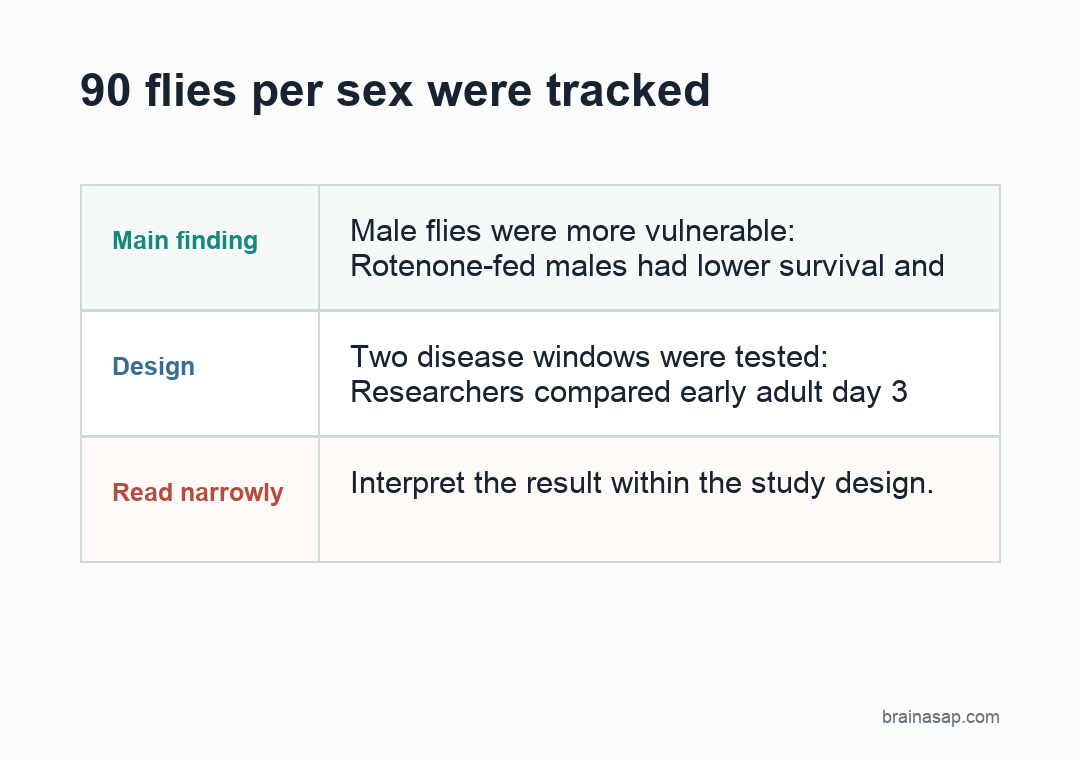
- 90 flies per sex were tracked: Survival assays used three sets of 30 male or female flies after rotenone feeding.
- Two disease windows were tested: Researchers compared early adult day 3 and late adult day 60 responses to model progression over time.
- Male flies were more vulnerable: Rotenone-fed males had lower survival and greater climbing impairment than rotenone-fed females.
- Oxidative stress was sex-skewed: DCFDA and MDA assays showed higher stress and lipid-peroxidation signals in males after rotenone exposure.
- Immune genes changed by timepoint: IMD and Toll pathway transcripts showed different male and female patterns at day 3 versus day 60.
Source: IBRO Neuroscience Reports (2026) | Iyer and Tare.
Rotenone Feeding Modeled Sporadic Parkinson’s Disease in Flies
Rotenone is a pesticide and mitochondrial complex-I inhibitor often used to model Parkinson’s disease biology in animals. It can increase oxidative stress, disrupt energy production, and produce motor impairment.
Iyer and Tare used wild-type Oregon.R Drosophila melanogaster, a fruit-fly model with a short life cycle and established use in neurodegeneration experiments.
The design separated male and female flies from the start. Newly emerged 0- to 1-day-old flies were maintained on standard food or rotenone-containing food, then tested at early and late adult timepoints.
- Survival: three sets of 30 flies per sex, with observation over 60 days.
- Motor function: negative geotaxis, a climbing assay used to detect locomotor impairment.
- Stress biology: DCFDA for reactive oxygen species, MDA for lipid peroxidation, and DNPH for protein carbonylation.
- Gene expression: quantitative PCR for immune, antimicrobial-peptide, and cell-death pathway transcripts.
Male Flies Had Lower Survival and More Climbing Impairment
The clearest behavioral result was male-biased vulnerability. Rotenone-fed males had lower survival than rotenone-fed females during the 60-day observation period.
The climbing assay pointed in the same direction. Rotenone impaired locomotion as early as day 3 and remained evident at day 60, but male flies showed greater impairment than female flies.
Parkinson’s disease is already sex-skewed in humans, with male prevalence often reported above female prevalence. A fly model cannot explain human prevalence by itself, but it can test whether the same toxin exposure produces different biological responses by sex.
The paper’s answer was yes: survival, movement, oxidative stress, and gene expression all separated by sex after rotenone feeding.
Oxidative-Stress Assays Favored a Male-Biased Injury Pattern
The biochemical assays supported the behavioral pattern. DCFDA showed higher reactive-oxygen stress after rotenone exposure, and MDA showed higher lipid peroxidation.
Across the paper’s interpretation, male flies carried the stronger oxidative-stress burden at both the early and late timepoints. Protein carbonylation followed a more mixed pattern, but the overall stress profile still supported male-biased injury.
The oxidative-stress panel is important because rotenone acts through mitochondrial disruption. If male flies lose climbing ability faster while also showing higher oxidative-stress markers, the model links behavior to plausible Parkinson’s disease biology rather than only reporting a movement phenotype.
- DCF-DA: captured reactive-oxygen stress after rotenone exposure.
- MDA: measured lipid peroxidation, a marker of oxidative damage to membranes.
- DNPH: measured protein carbonylation, a marker of oxidized proteins.
IMD and Toll Immune Genes Shifted by Sex and Timepoint
The gene-expression results were not a single on/off immune response. They changed by pathway, sex, and timing.
For the IMD pathway, Relish increased after rotenone exposure in both sexes. The timing differed: female flies showed stronger early Relish upregulation, while male flies showed stronger late upregulation by day 60.
Downstream antimicrobial-peptide transcripts also diverged. At day 60, female flies showed lower Diptericin, Cecropin, and Attacin transcription than age-matched males after rotenone exposure.
The Toll pathway showed another time-dependent pattern. Toll expression increased in both sexes at day 3, but by day 60 male flies showed significant upregulation while female flies showed downregulation after rotenone exposure.
- Early response: several immune transcripts rose in both sexes soon after rotenone feeding.
- Late male response: male flies tended toward stronger late immune-pathway activation.
- Late female response: several antimicrobial-peptide transcripts were lower or differently regulated at day 60.
Cell-Death and Autophagy Genes Add Mechanistic Context
The study also measured genes tied to cell death and autophagy, including HID, reaper, DREDD, ATG5, PINK-1, and Parkin. These pathways sit close to Parkinson’s disease mechanisms because mitochondrial damage, oxidative stress, and impaired protein cleanup can push neurons toward degeneration.
Those gene results supported the same general conclusion: rotenone did not create identical male and female molecular profiles. The model produced sex-specific transcriptional changes across immune and cell-death pathways.
The study is still a fly model. It does not prove that a human Parkinson’s patient will show the same IMD, Toll, or antimicrobial-peptide pattern.
Its value is narrower and useful for preclinical work: sex cannot be treated as a background variable when modeling toxin-linked Parkinson’s disease biology.
Three limits should keep the interpretation grounded:
- Model organism: Drosophila can reveal conserved pathways, but it is not a human brain.
- Toxin model: rotenone captures mitochondrial/toxic stress biology, not every form of Parkinson’s disease.
- Directional reporting: many figure results are pathway-direction findings rather than clinical effect sizes.
The main result is direct: this rotenone model reproduced a male-biased vulnerability pattern and tied it to oxidative stress, immune signaling, and cell-death gene responses over time.
Citation: DOI: 10.1016/j.ibneur.2026.04.001. Iyer and Tare. Gender-specific gene profiling in Drosophila sporadic model of Parkinson’s disease. IBRO Neuroscience Reports. 2026;20:548-558.
Study Design: Rotenone-fed Drosophila melanogaster Parkinson’s disease model comparing male and female survival, climbing, oxidative-stress markers, and gene expression.
Sample/Model: Wild-type Oregon.R flies; survival assays used 90 flies per sex, and molecular assays used three biological replicates.
Key Statistic: Rotenone-fed male flies had significantly lower survival than rotenone-fed females, with survival tested by Gehan-Breslow-Wilcoxon analysis.
Caveat: A toxin-fed fly model can identify sex-specific disease biology, but it cannot directly predict human Parkinson’s disease progression or treatment response.