TL;DR: A 2026 cross-sectional study in BMC Medical Education found that German students in health-related degree programs who had personally experienced discrimination reported lower belonging, lower academic self-efficacy, lower study engagement, and higher general stress than peers without such experiences.
Key Findings
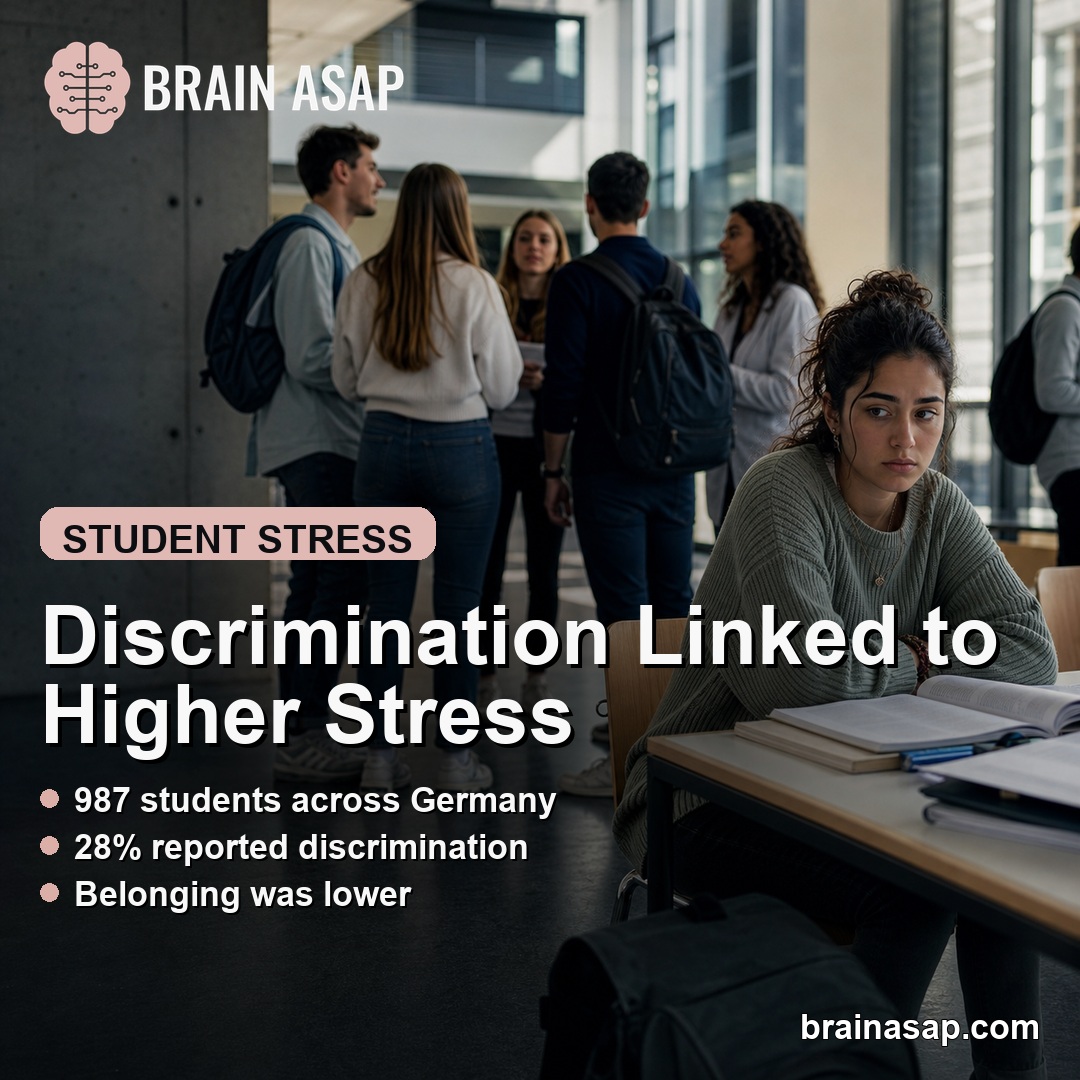
- National survey covered Germany: The online survey included 987 health-related degree students from 83 universities across all 16 federal states.
- 28% reported personal discrimination: The most common reasons were gender (42%), physical appearance (23%), mental health issues (20%), and racial reasons (13%).
- 45% witnessed discrimination: Observed discrimination was most often attributed to racial reasons (40%), gender (38%), physical appearance (35%), and mental health condition (23%).
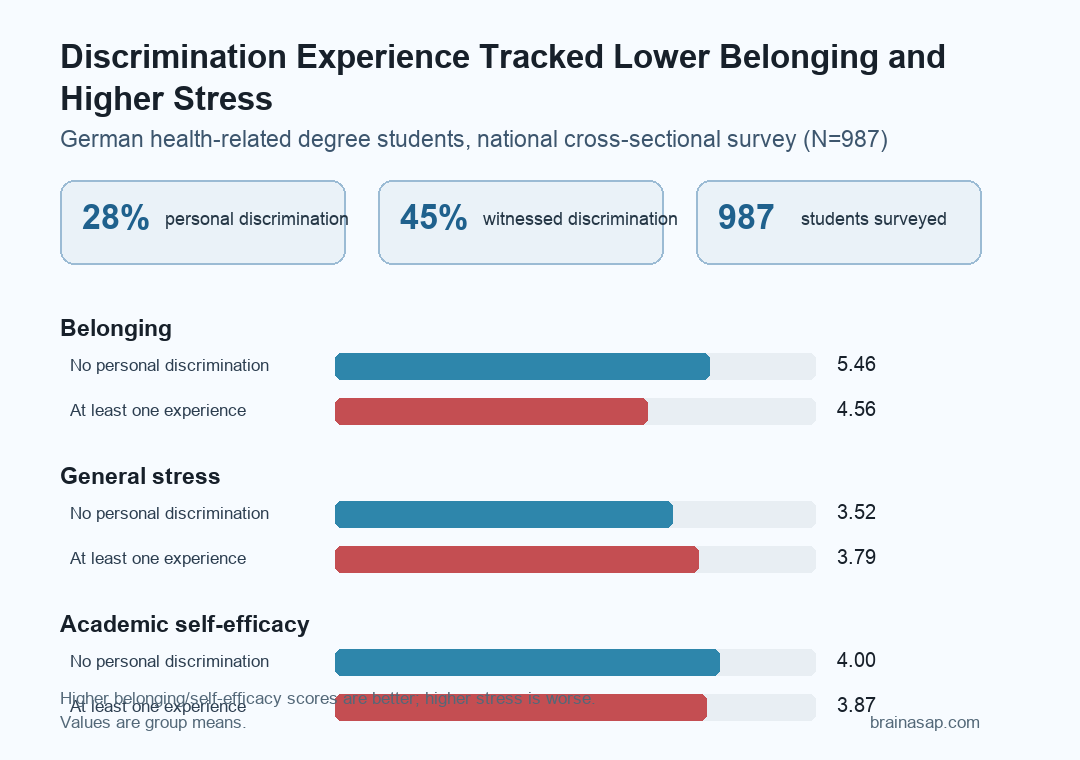
- Belonging was lower: Students with discrimination experience averaged 4.56 on university belonging versus 5.46 among students without personal discrimination experience.
- General stress was higher: The discrimination-experience group reported higher general stress (3.79 vs. 3.52 on a 1-to-5 scale; p < 0.001).
Source: BMC Medical Education (2026) | Hanft-Robert et al.
Diversity climate is the term researchers used for how fairly and inclusively students perceive their university environment. In this study, that climate was measured across age, ethnicity, and gender, then compared with students’ reports of discrimination, belonging, engagement, self-efficacy, and stress.
The survey does not diagnose individual distress. It shows that discriminatory experiences in health-related education were tied to measurable differences in the psychosocial conditions that help students learn and stay engaged.
Discrimination Was Common in Health-Related Degree Programs
The survey was conducted from January to April 2024 and included 987 students in medicine, psychology, health sciences, rehabilitation science, and other health-related programs. Participants came from 83 German universities, giving the analysis a national scope rather than a single-campus view.
Most participants rated the overall diversity climate as moderately to highly positive, but the same dataset showed that discrimination was not rare. 28.4% of students reported at least one personal experience of discrimination in the previous 2 years, and 45% said they had witnessed discrimination at their university.
- Personal discrimination: Reported reasons most often involved gender, physical appearance, mental health issues, or racial reasons.
- Observed discrimination: Witnessed incidents were most often linked to racial reasons, gender, physical appearance, or mental health condition.
- Health impairment context: Nearly half of the sample reported at least one health impairment, with mental health conditions listed by 29.6%.
The combination connects institutional climate to stress, belonging, and student functioning. In health education, those are not abstract campus culture measures; they shape the people training for future clinical, psychological, and rehabilitation work.
Students With Discrimination Experience Rated Diversity Climate Lower
Researchers compared students with at least one personal discrimination experience against students who reported none. The largest differences appeared in perceptions of diversity climate across the measured age, ethnicity, and gender domains.
Students without personal discrimination experience gave higher diversity-climate ratings for age, ethnicity, and gender. Students with discrimination experience gave lower ratings across those domains, with statistically significant group differences and medium-to-large effect sizes.
- Age climate: Ratings were 3.72 without personal discrimination experience versus 3.34 with at least one experience; Hedges’ g was 0.68.
- Ethnicity climate: Ratings were 3.77 versus 3.31; Hedges’ g was 0.75.
- Gender climate: Ratings were 3.97 versus 3.52; Hedges’ g was 0.80, the largest climate contrast.
These are 1-to-5 scale values, so the differences are not small rounding artifacts. They suggest that students who had personally experienced discrimination saw the same university environments as less equitable and less inclusive.
Belonging, Engagement, and Academic Self-Efficacy Were Lower
The psychosocial findings were especially relevant because they moved beyond whether students endorsed diversity in principle. Students with discrimination experience reported weaker day-to-day academic resources.
Belonging to the university showed a clear group difference: 5.46 among students without personal discrimination experience versus 4.56 among students with at least one experience. The effect size was medium, with Hedges’ g of 0.64.
Academic self-efficacy and study engagement also differed. Academic self-efficacy averaged 3.87 in the discrimination-experience group and 4.00 in the no-experience group. Study engagement averaged 4.32 versus 4.63, respectively.
- Academic self-efficacy: Students with discrimination experience reported less confidence in handling academic demands.
- Study engagement: The same group reported lower engagement with their studies, including lower energy, dedication, or absorption.
- University belonging: The strongest study-related contrast was the sense of belonging, which is closely tied to persistence and mental well-being in student populations.
General self-efficacy did not differ significantly. The pattern was not simply that one group reported lower confidence about everything.
The differences were more visible in the university and study context.
General Stress Was Higher, While Academic Stress Was Less Clear
Students with discrimination experience reported higher general stress, averaging 3.79 versus 3.52 on the 1-to-5 stress measure. The group difference was statistically significant at p < 0.001, with a small effect size.
Academic stress moved in the expected direction but did not reach statistical significance. Students with discrimination experience averaged 66.55 on the 0-to-100 academic stress item, compared with 63.40 among students without personal discrimination experience.
That split narrows the result. The study does not show that every stress measure changed.
It shows that discrimination experience was clearly linked to general stress and to several academic-functioning measures, while academic stress was only slightly higher.
Medical and Psychology Curricula Still Had Representation Gaps
The survey also asked students about university supports, teaching materials, infrastructure, and diversity representation. These responses help explain why a generally positive average climate can coexist with frequent discrimination reports.
- Lecturer sensitivity: Nearly half of respondents said lecturers were not sufficiently sensitive to discrimination or did not actively counter it.
- Teaching materials: 60.5% reported that teaching materials did not adequately represent people with diverse characteristics.
- Campus access: Only 36.2% considered campus buildings fully accessible for all individuals.
For health-related programs, those are practical training issues. Students who become clinicians, psychologists, therapists, or public-health workers need learning environments that model how to recognize discrimination and care for varied populations.
Cross-Sectional Survey Design Limits Causal Claims
The main limitation is design. This was a cross-sectional online survey, so it cannot prove that discrimination caused lower belonging or higher stress.
Students with more stress or lower belonging may also be more likely to notice or report problems in the university climate.
The sample was also not evenly distributed across all identity groups. Most participants were female, White, born in Germany, and from middle-class backgrounds.
The diversity-climate scale focused only on age, ethnicity, and gender. Other dimensions, including disability, religion, sexual orientation, caregiving, and socioeconomic status, were not built into the main climate scale in the same way.
Even with those limits, the study gives universities a concrete target: discrimination experience was linked to lower belonging and higher stress in students preparing for health-related careers.
Improving representation in curricula, strengthening anti-discrimination policies, and training staff to respond to discrimination are testable institutional steps, not just symbolic gestures.
Citation: DOI: 10.1186/s12909-026-09806-3. Hanft-Robert S, et al. Diversity climate and discrimination at German universities: a cross-sectional study among students in health-related degree programs. BMC Medical Education. 2026;26:1095.
Study Design: National cross-sectional online survey of health-related degree students in Germany.
Sample Size: 987 students from 83 universities across all 16 German federal states.
Key Statistic: 28.4% reported personal discrimination, and students with discrimination experience reported lower belonging (4.56 vs. 5.46) and higher general stress (3.79 vs. 3.52).
Caveat: The study is observational and cross-sectional, so it identifies associations rather than proving causal effects of discrimination on stress or belonging.