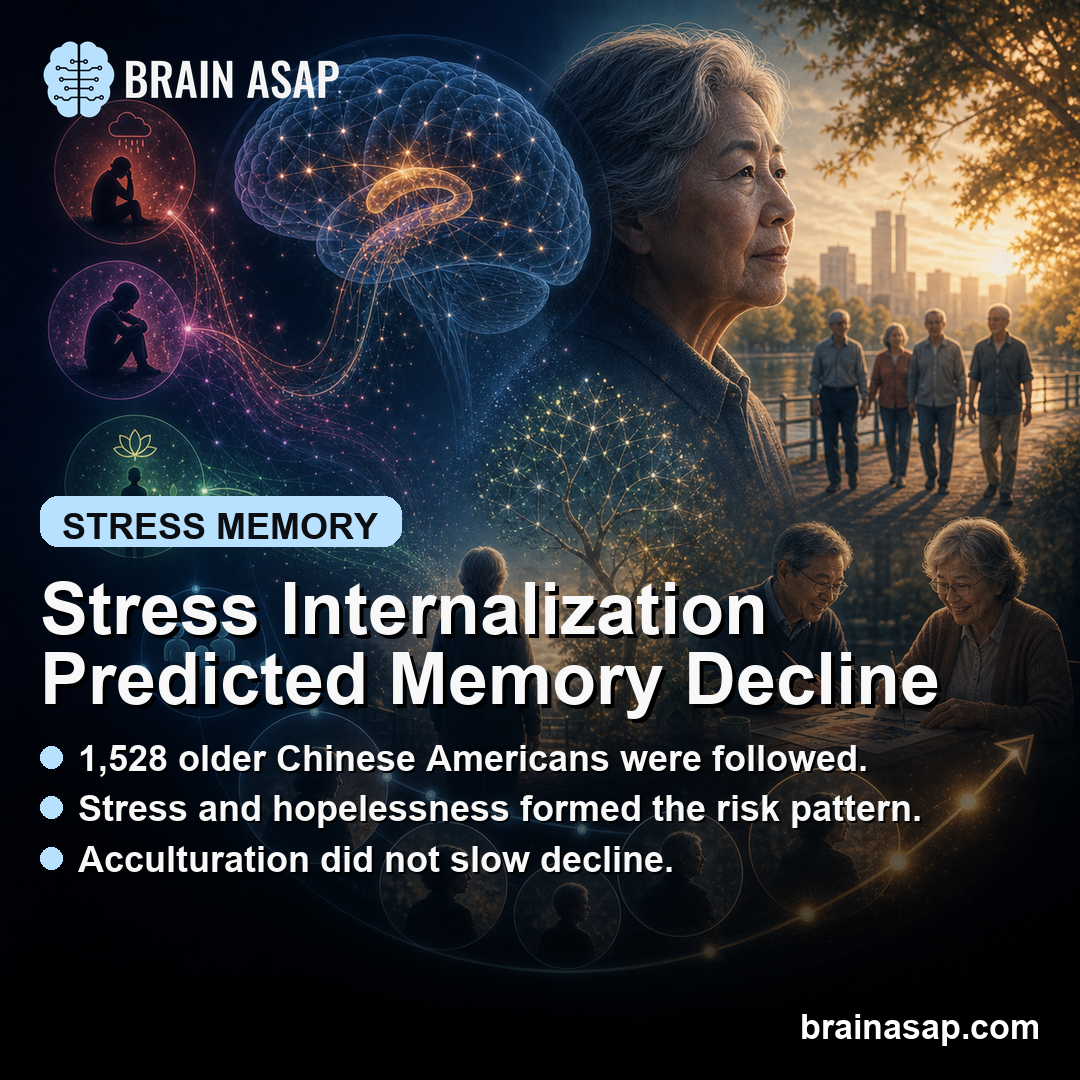
TL;DR: A 2025 study in The Journal of Prevention of Alzheimer’s Disease found that stress internalization, not acculturation or activity engagement, predicted memory decline across three waves in 1,528 older Chinese Americans.
Key Findings
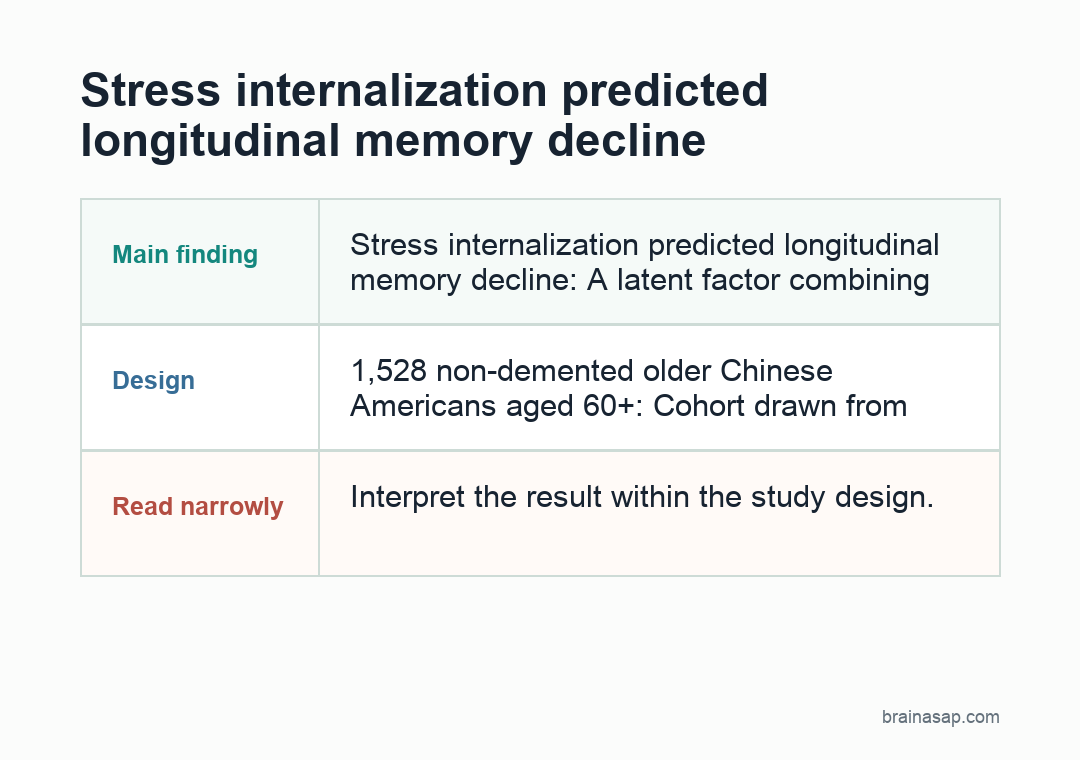
- Stress internalization predicted longitudinal memory decline: A latent factor combining greater perceived stress, greater hopelessness, and lower conscientiousness was the single behavioral/sociocultural variable associated with declining memory over time.
- Acculturation and activity engagement didn’t slow decline: Both were associated with better baseline cognition — but neither predicted slower longitudinal decline. They help where you start, not how steeply you fall.
- Memory was affected; executive function was not: The stress-internalization signal showed up specifically in memory decline, not in executive-function trajectories. Different cognitive domains carry different vulnerabilities.
- 1,528 non-demented older Chinese Americans aged 60+: Cohort drawn from the Chicago metropolitan area through the PINE study, with three measurement waves over multiple years.
- Connection to “model minority” stereotype is hypothesized: The traits driving stress internalization — internalized perceived stress, hopelessness, and rigid conscientiousness patterns — have been associated with the Asian model-minority stereotype, suggesting a culturally specific risk profile.
Source: The Journal of Prevention of Alzheimer’s Disease (2025) | Chen et al.
Cognitive aging research has overwhelmingly focused on European-ancestry populations.
Studies of older Chinese Americans — and immigrant populations generally — have lagged behind, even though the structural and cultural factors shaping aging in immigrant communities can differ substantially from those in mainstream US samples.
The Chen 2025 paper from the Population Study of ChINese Elderly (PINE) closed part of that gap by analyzing what specifically predicts memory and executive function decline in 1,528 older Chinese Americans across three waves of data collection.
Older Chinese American Cohort Tested Memory Decline Predictors
Most large dementia and cognitive-aging cohorts have focused on European-ancestry, English-speaking populations.
The findings — about education, lifestyle, vascular health, social engagement — get treated as universally applicable, but the structural conditions of aging in immigrant communities can include factors most large cohorts don’t capture:
- Bicultural identity and acculturation pressures across multiple decades of life.
- Ethnic enclave living — both protective (community cohesion) and limiting (reduced healthcare access, language barriers).
- Generational expectations shaped by both heritage culture and US cultural pressures.
- Specific stress patterns tied to immigration history, family obligations, and minority status.
The PINE study was designed specifically to capture aging in older Chinese Americans, with measurement instruments adapted to be culturally appropriate.
The 1,528-person sample with three waves of cognitive testing makes it one of the more rigorous datasets available for this population.
The Three Latent Factors That Emerged from the Data
The Chen team did factor analysis on multiple internal (acculturation, behavior, well-being) and external (neighborhood, community) variables to find the underlying constructs. Three main factors emerged:
- Stress internalization — combining higher perceived stress, greater hopelessness, and lower conscientiousness into a single latent dimension.
- Neighborhood/community cohesion — capturing social connection and place-based support.
- External stress alleviation — capturing the use of social, environmental, or behavioral coping strategies.
Of these three, only stress internalization was associated with longitudinal cognitive decline. Neighborhood cohesion and external stress alleviation didn’t predict trajectory.
The Memory-Specific Pattern That Tells You Where the Damage Lands
The cognitive testing in PINE used Chinese-language versions of validated instruments — Mini-Mental State Examination, East Boston Memory Test, Digit Span Backward, and the oral Symbol Digit Modalities Test.
These yield separate measures of memory and executive function.
The stress internalization signal appeared specifically in memory decline. Executive function trajectories didn’t show the same association. This domain specificity changes interpretation:
- Memory decline in older adults is closer to the dementia trajectory than executive function changes are.
- Stress-related memory effects have been documented in HPA axis research — chronic cortisol elevation can damage hippocampal-dependent memory specifically.
- Executive function depends on different circuits — primarily prefrontal — that can be relatively more resilient to chronic stress effects.
The pattern fits a chronic-stress-on-memory mechanism, even though the study can’t directly measure cortisol or hippocampal volume in this dataset.
Model Minority Stress Can Shape Internalized Burden
The authors connect the stress internalization profile to the model-minority stereotype that frames Asian Americans as uniformly high-achieving, hardworking, and self-reliant. The implication of this stereotype is structural:
- It discourages help-seeking. If you’re “supposed to” handle things internally, asking for support — psychological, medical, social — is framed as failure.
- It rewards rigid conscientiousness over flexible coping. The traits that produce career and educational success can also lock people into patterns that don’t adapt as life changes.
- It internalizes systemic stressors rather than externalizing them. When discrimination, financial pressure, or family demands hit, the response gets routed inward rather than outward.
- It produces measurable health consequences over decades. Stress internalization isn’t a personality quirk — in this dataset, it’s the strongest predictor of memory decline trajectory.
The Chen team is appropriately careful: the stereotype connection is interpretive, not directly tested.
But it offers a culturally specific mechanistic explanation for why this particular trait cluster shows up so strongly in this population.
The Acculturation Paradox the Paper Surfaces
One notable finding is what acculturation did not do. Greater acculturation was associated with better baseline cognitive performance — consistent with broad health-and-acculturation literature. But it didn’t predict slower decline.
That’s a more nuanced picture than the simple “acculturation is protective” account.
Higher acculturation can give older adults a head start in cognitive performance — through education, English proficiency, integration into US healthcare systems — but it doesn’t appear to alter the rate at which cognitive function declines once aging-related changes begin.
That distinction affects intervention design.
If the goal is to slow decline rather than improve baseline status, acculturation-focused interventions is not necessarily the right target.
Stress-reduction interventions, particularly those aimed at internalized stress and hopelessness, can have more leverage on the decline trajectory itself.
The Honest Limits of This Cohort
- Selection bias is plausible. PINE recruited from the Chicago Chinese American community; participants who consented and stayed across three waves can differ systematically from those who didn’t.
- Measurement instruments can have cultural limitations. Even adapted versions of cognitive tests carry assumptions that may not translate cleanly across cultures.
- The cognitive battery is limited. More comprehensive cognitive testing can reveal effects on domains this study didn’t capture.
- No biomarker data. The dataset doesn’t include cortisol, neuroimaging, or other biological measures that can directly test the chronic-stress-on-memory mechanism.
- Other Chinese American communities can differ. Chicago is one geographic and cultural context; results from this sample do not necessarily transfer cleanly to other US Chinese American populations or to Chinese populations in other countries.
The Chen paper makes two important contributions for cognitive aging research and mental health care.
First, it identifies a culturally specific risk profile — stress internalization tied to perceived stress, hopelessness, and rigid conscientiousness — that predicts memory decline in older Chinese Americans more strongly than the variables most cognitive aging research focuses on.
Second, it suggests an actionable intervention target. Maladaptive stress internalization is potentially modifiable through culturally appropriate mental health support, stress reduction practices, and interventions that explicitly address the model-minority stereotype’s pressure on help-seeking and coping flexibility.
For dementia prevention research more broadly, the lesson is that population-specific risk profiles matter — and that mainstream cognitive aging research has been missing variables that turn out to be important when you actually look at the populations the mainstream studies underrepresent.
Citation: DOI: 10.1016/j.tjpad.2025.100270. Chen et al. Stress internalization is a top risk for age-associated cognitive decline among older Chinese in the U.S. The Journal of Prevention of Alzheimer’s Disease. 2025.
Study Design: Longitudinal cohort analysis of behavioral and sociocultural factors linked to cognitive trajectories.
Sample/Model: 1,528 older Chinese Americans from the PINE study across three assessment waves.
Key Statistic: Stress internalization predicted memory decline; acculturation and activity engagement were linked to baseline cognition but not decline slope.
Caveat: Observational community-cohort data cannot prove stress internalization caused memory decline.