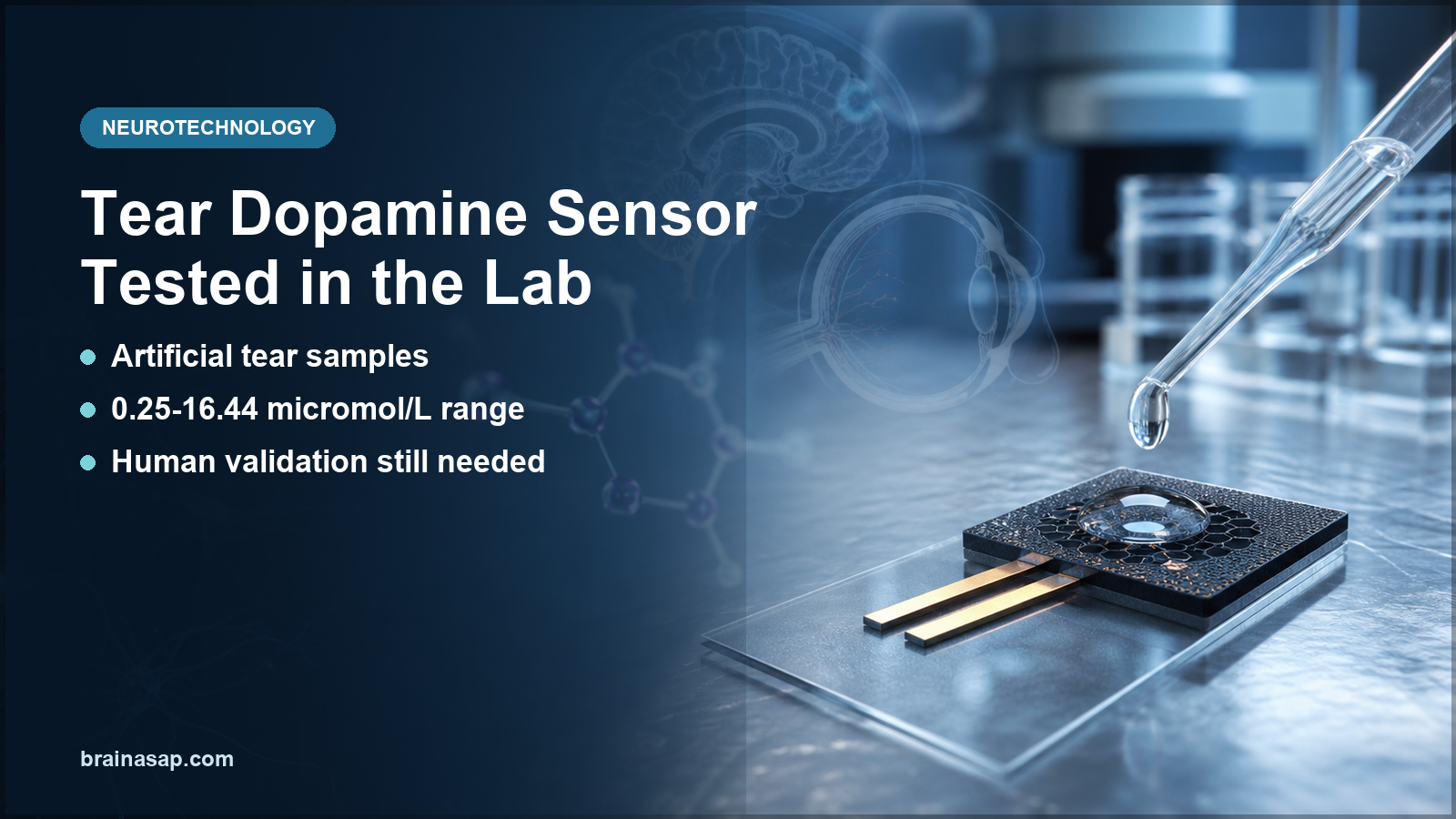
TL;DR: A 2026 laboratory study in ACS Omega reported that a laser-induced graphene sensor detected dopamine across a controlled range in artificial human tears, supporting a possible noninvasive biomarker-monitoring route that still needs real human tear testing.
Key Findings
- Laser-induced graphene sensor: Researchers built a small electrochemical device on a plastic film converted into conductive graphene by laser patterning.
- Artificial tear testing: The validation used laboratory-made tears, not patient tear samples.
- Dopamine detection range: Electrochemical testing showed a linear response from 0.25 to 16.44 micromol/L.
- Selectivity was central: The sensor was designed to detect dopamine while common tear compounds were present.
- Clinical use is not proven: The work supports future point-of-care research, but it does not establish a Parkinson’s disease screening test.
Dopamine is usually discussed as a brain chemical, but this study focused on a simpler measurement problem: whether a tear sample could carry enough measurable dopamine for a compact sensor to detect it.
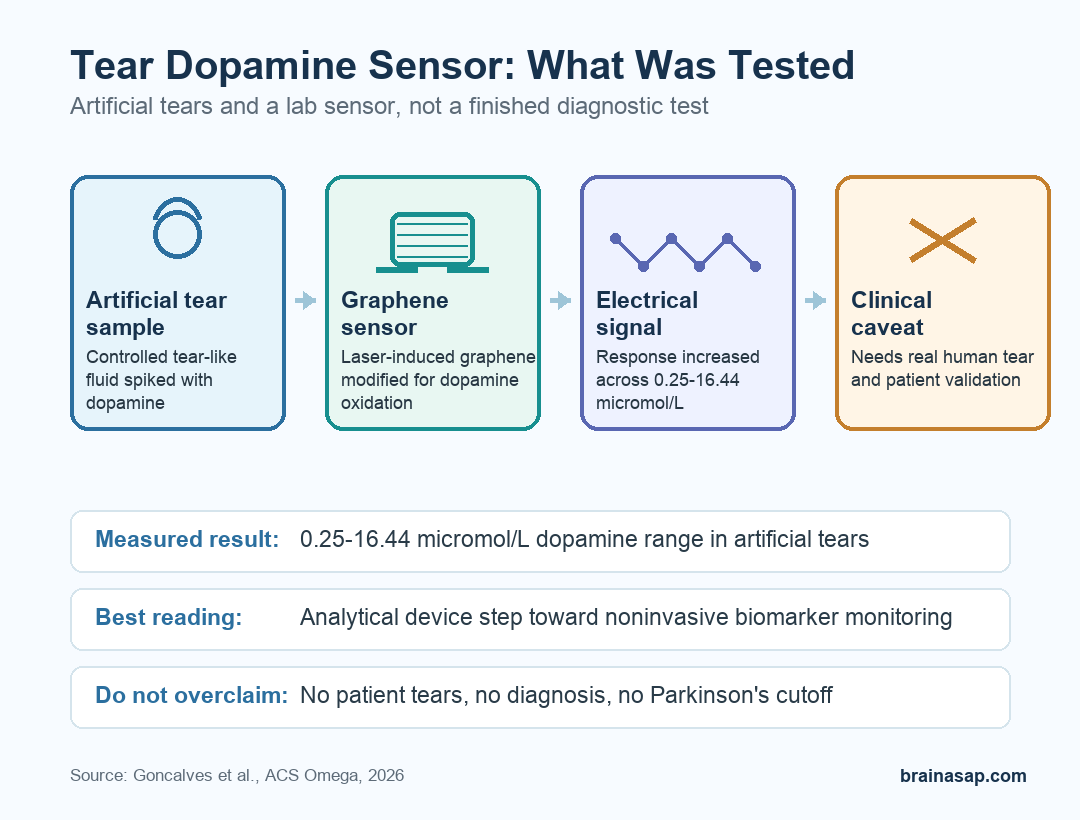
In that laboratory setting, laser-induced graphene, modified with nickel and nitrogen-containing groups, produced an electrochemical response when dopamine was added to artificial tears.
A Tear-Based Dopamine Sensor Was Tested in the Lab
The sensor was not an implanted device and was not tested as a clinical diagnostic tool. Researchers made a small sensing surface by using a laser to convert part of a plastic substrate into porous, conductive graphene.
That surface was then chemically modified to improve electron transfer and create more active sites for dopamine oxidation. In practical terms, the device was built to turn dopamine contact into a measurable electrical response.
The test medium matters. The experiment used artificial human tears, which lets researchers control the chemical environment and ask whether the sensor can work in a tear-like fluid before moving to more variable real samples.
- Target molecule: Dopamine, a neurotransmitter involved in movement, motivation, cognition, and emotional regulation.
- Sample type: Artificial human tears, not tears collected from people with Parkinson’s disease or other neurological conditions.
- Sensor material: Laser-induced graphene functionalized with nickel nitrate and urea.
- Measurement method: Electrochemical testing, including cyclic voltammetry and differential pulse voltammetry.
This sequence places the study in early device validation. It is about analytical performance first, not whether tear dopamine can classify a patient.
The Sensor Detected Dopamine Across a Controlled Range
The headline performance result was the sensor’s linear dopamine response. Electrochemical measurements showed a usable range from 0.25 to 16.44 micromol/L in artificial tears.
That range is important because a biomarker sensor has to do more than react to the target molecule. It needs a response that changes predictably as concentration changes, otherwise the output is hard to interpret.
Researchers also emphasized selectivity. Tear fluid contains multiple compounds that could interfere with a weak electrochemical readout, so the device was tested for whether dopamine remained distinguishable in a more realistic chemical background.
- Detectable concentration change: The sensor response increased across the dopamine range tested in the tear-like solution.
- Low-volume logic: Tears are attractive because they can be collected without blood draws, lumbar puncture, or implanted monitoring.
- Point-of-care goal: A compact sensor could eventually support faster biomarker checks if human-sample performance holds up.
Parkinson’s Relevance Comes From Dopamine, Not Diagnosis
The Parkinson’s disease connection is biologically plausible but should stay narrow. Parkinson’s disease involves dopamine loss in motor circuits, and dopamine abnormalities are relevant to several neurological and psychiatric conditions.
A tear dopamine reading is not a Parkinson’s disease diagnosis. This study did not compare patients with controls, test disease severity, or define a clinical cutoff.
A cleaner interpretation is that tear-compatible dopamine sensing may become one component of future neurological monitoring work. The device still needs validation in real tear samples, across real people, with real-world variability.
- What the study supports: A graphene-based electrochemical sensor can detect dopamine in a controlled artificial-tear setup.
- What it does not show: That tear dopamine alone separates Parkinson’s disease, schizophrenia, depression, or any other condition from healthy variation.
- What comes next: Human tear collection, reproducibility testing, calibration against clinical state, and comparison with existing biomarker methods.
The difference matters because noninvasive biomarkers are easy to oversell. A tear sample is appealing because it is painless and quick, but a convenient sample only helps if the measurement is stable, specific, and clinically interpretable.
Laser-Induced Graphene Made the Device Practical to Build
The material choice is part of the story. Laser-induced graphene can be made by directly patterning carbon-rich plastic with a laser, producing a porous conductive surface without a long cleanroom workflow.
The study’s chemical modification step was meant to improve sensitivity. Nickel and nitrogen functionalization increased electroactive sites and helped the sensor respond more strongly to dopamine oxidation.
For future point-of-care use, the manufacturing approach could matter as much as the raw detection number. A sensor that is small, low-cost, and reproducible is more plausible for bedside or clinic testing than a fragile instrument that only works under narrow lab conditions.
Still, the clinical evidence is early. Artificial tears support controlled validation, but real tears vary by collection method, reflex tearing, eye irritation, medication exposure, hydration, and other biological factors.
The Main Limit Is Human Validation
The study should be read as a sensor-development result. It is not a clinical screening trial, and it does not show that a tear dopamine sensor can predict disease onset before symptoms appear.
The most important next step would be a human-sample study that tests the same device against predefined clinical groups and repeat samples. That would show whether the readout survives outside artificial tears.
- Analytical validation: Repeat the measurement across real tear samples and collection conditions.
- Clinical validation: Compare people with defined neurological diagnoses, relevant controls, and medication-state data.
- Longitudinal testing: Check whether tear dopamine changes track symptoms, treatment response, or disease progression.
- Usability testing: Determine whether the device can be operated reliably in a clinic rather than a specialized lab.
This technical step remains bounded. The strongest claim is specific: a modified laser-induced graphene sensor detected dopamine in artificial tears across a measurable concentration range.
If that performance extends to real tear samples, the work could help move neurological biomarker monitoring toward faster and less invasive testing. Until then, it is best understood as a technical step toward that goal.
Citation: DOI: 10.1021/acsomega.6c03287. Goncalves et al. Toward Non-Invasive Neurological Biomarker Monitoring: Dopamine Sensing in Tears with Laser-Induced Graphene Electrochemical Sensors. ACS Omega. 2026;11:36141-36150.
Study Design: Laboratory electrochemical sensor-development study using artificial human tears.
Sample/Model: Artificial tear samples spiked with dopamine and tested on a laser-induced graphene sensor.
Key Statistic: Dopamine detection showed a linear range of 0.25 to 16.44 micromol/L in the artificial-tear setup.
Caveat: The study did not test patient tears or establish a diagnostic cutoff for Parkinson’s disease or any other condition.