TL;DR: A 2026 case-series study in Translational Psychiatry tested delayed-release oral acetate from apple cider vinegar capsules in 11 young adults taking psychotropic medications and found high adherence, no product-related adverse events, microbiome shifts, and metabolic improvement in 6 participants, but the uncontrolled design means the findings need placebo-controlled testing.
Key Findings
- 11 completers: The analysis included 11 young adults, ages 22-32, who reported weight gain after psychotropic medication use.
- Three-month acetate intervention: Participants took delayed-release apple cider vinegar capsules twice daily, equal to about 30 mL of liquid apple cider vinegar per day.
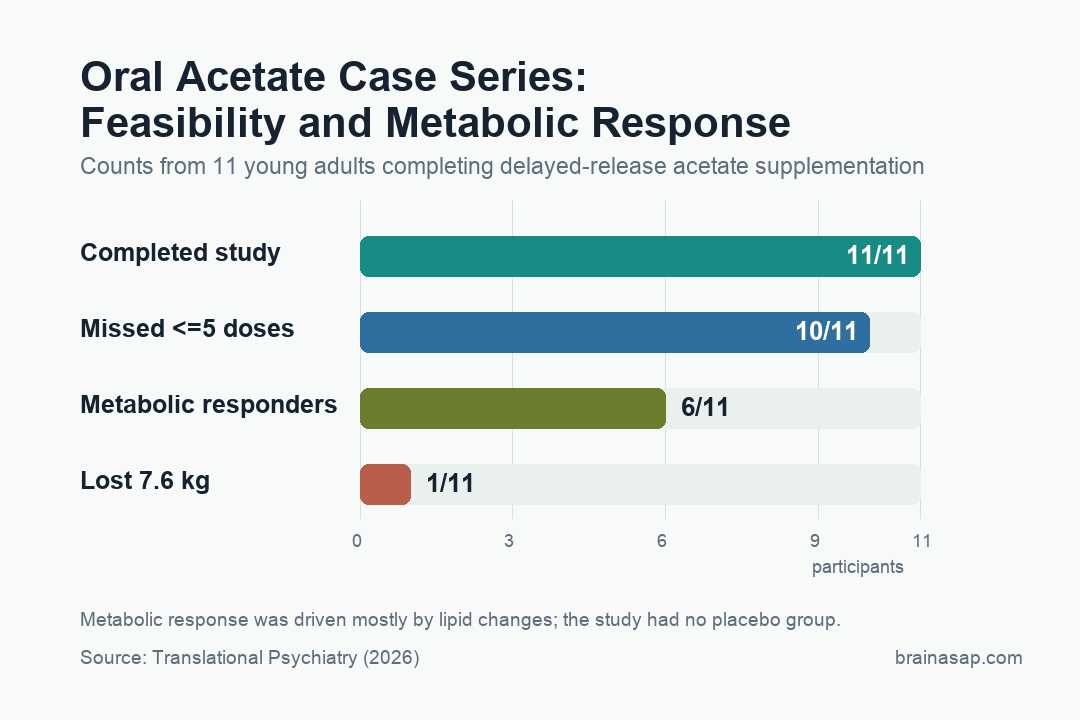
- High feasibility: More than 90% of completers missed five or fewer doses, and no product-related adverse events were reported.
- 6 metabolic responders: 6 participants had meaningful metabolic improvement, mostly through lipid changes, while 1 participant lost 7.6 kg and moved below the obesity BMI threshold.
- Gut microbiome changes: 16S rRNA gene sequencing, a bacterial DNA profiling method, showed taxonomic and inferred functional shifts after supplementation.
Source: Translational Psychiatry (2026) | Al et al.
Oral Acetate Targeted Psychotropic Medication Weight Gain
Oral acetate supplementation was tested as a possible add-on strategy for young adults whose antidepressants, mood stabilizers, antipsychotics, or related medications were linked to weight gain. The paper focused on feasibility first, not proof of clinical efficacy.
Psychotropic medications can be effective for mood and anxiety disorders, but weight gain, dyslipidemia, and other metabolic effects can make treatment harder to continue.
Researchers tested whether acetate, a short-chain fatty acid related to gut microbial metabolism, could shift the gut microbiome and improve metabolic measures in a small case-series design.
The gut-brain axis is relevant here because gut microbes can produce metabolites that interact with inflammation, appetite, metabolism, and behavior. Still, the case series’ strongest claim is narrower: delayed-release acetate capsules were practical to take and were followed by measurable microbiome and lipid changes in some participants.
Delayed-Release Apple Cider Vinegar Capsules Were Used for 3 Months
The study enrolled 12 participants from a first-episode mood and anxiety program in London, Ontario. One person was lost to follow-up, leaving 11 completers in the main analysis.
Participants were 22-32 years old, with an average age of 25.6 years. Everyone had a baseline body mass index, or BMI, above 30 kg/m2, and all reported weight gain that they linked to psychotropic medication.
Researchers used a repeated N-of-1 case-series structure. Each participant had a one-month pre-intervention period, a three-month intervention period, and a one-month post-intervention period.
- Medication context: Participants were taking antidepressants, mood stabilizers, atypical antipsychotics, anxiolytics, psychostimulants, or combinations of these drugs.
- Acetate delivery: Each original capsule contained 500 mg of apple cider vinegar powder, then was placed in a delayed-release capsule intended to bypass stomach dissolution.
- Dose schedule: Participants took three capsules twice daily, approximating 30 mL of liquid apple cider vinegar and about 1.5 mL of acetic acid per day.
- Monitoring: Weekly calls captured missed doses, side effects, medication changes, diet, exercise, sleep, supplement use, and substance use.
The delayed-release design matters because liquid vinegar can be hard to tolerate and is absorbed earlier in digestion. By aiming delivery farther down the gastrointestinal tract, researchers were trying to test acetate as a microbiome-directed intervention rather than just another dietary vinegar exposure.
Adherence Was High and No Product-Related Adverse Events Were Reported
Feasibility was the cleanest outcome. Among completers, 10 of 11 participants missed five or fewer doses during the intervention, and no product-related adverse events were reported.
Participants rated capsule-taking at an average of 3.3 on a 1-to-4 ease scale, where 4 was easiest. Overall study participation scored 3.7, suggesting the visit, sampling, and monitoring schedule was acceptable for this small group.
That practical result is not trivial in a psychiatric-medication context. Any adjunctive strategy that adds daily capsules, stool samples, blood draws, and weekly contact has to clear a usability bar before larger trials make sense.
Feasibility also limits interpretation.
Weekly contact with the research team may itself influence symptoms, adherence, diet, activity, or self-monitoring.
The study design cannot separate acetate’s biological effects from the experience of being closely followed in a research protocol.
6 Participants Had Lipid or Weight Improvements
The metabolic outcomes were mixed but clinically concrete. Researchers classified 6 participants as metabolic responders: five based on lipid improvements and one based on a meaningful BMI reduction.
1 participant lost 7.6 kg and reduced BMI by 2.5 kg/m2, moving from 31.2 to 28.7 kg/m2. Most participants, however, did not show meaningful weight loss, so the study does not support acetate as a proven weight-loss treatment.
Lipid measures drove most of the responder classification. 6 participants who began with clinical-risk lipid profiles had meaningful improvements after the intervention.
- HDL cholesterol: 1 participant moved from an abnormal HDL level of 1.48 mmol/L to a normal level of 1.77 mmol/L.
- LDL cholesterol: All but 2 participants had lower LDL after the intervention, and 3 reached levels below the clinical-risk threshold of 2.6 mmol/L.
- Total cholesterol: 3 participants moved below the 5.2 mmol/L risk threshold.
- No lipid worsening category: No participant shifted from healthy to unhealthy lipid levels during the study.
Researchers used clinically meaningful thresholds rather than only statistical testing. For LDL cholesterol, a reduction of at least 15% counted as meaningful because that is near the lower end of expected effects from bile acid sequestrant medications.
16S rRNA Sequencing Suggested Gut Microbiome Shifts
Researchers collected stool samples and used 16S rRNA gene sequencing, a method that profiles bacterial groups from microbial DNA. 10 participants had both pre- and post-intervention stool samples available.
Baseline microbiomes varied substantially across individuals, which is expected in a small human gut study. Timepoint alone did not significantly explain between-sample beta diversity, but interindividual diversity decreased after the intervention, suggesting some convergence in microbial composition.
Several bacterial taxa shifted after supplementation. Post-intervention increases included genera and species such as Gemmiger, Blautia, Roseburia intestinalis, Bacteroides, and others, while some taxa decreased.
The functional inference was also relevant to cholesterol biology. Predicted microbial functions after intervention included enrichment of penicillin amidase-like activity, which the paper links to bile salt hydrolase-like functions that can affect bile acid handling and cholesterol absorption.
- Butyrate-producing taxa: Blautia, Roseburia, Gemmiger, and Faecalibacterium were discussed because they relate to butyrate production or gut microbial network function.
- Cholesterol pathway clue: Inferred bile-acid-related functions could plausibly fit the lipid improvements, although the study did not directly prove that mechanism.
- Responder phenotype: Metabolic responders and non-responders differed in microbial patterns before and after intervention, including enrichment of Akkermansia muciniphila among responders after supplementation.
Those microbial patterns are hypothesis-generating. Because the study used 16S profiling and inferred functions rather than whole-genome metagenomics, the functional claims should be treated as modeled biological leads rather than direct measurements of microbial activity.
QIDS-SR Depression and OASIS Anxiety Scores Improved in Some Participants
Mood and anxiety were secondary outcomes. Depressive symptoms were measured with the Quick Inventory of Depressive Symptomatology-Self Report (QIDS-SR), a 16-item depression-symptom scale, while anxiety was measured with the Overall Anxiety Severity and Impairment Scale (OASIS), a 5-item anxiety-severity and impairment scale.
9 of 11 participants improved on mood and/or anxiety scores. 2 participants with abnormally high scores moved below the threshold of concern.
Those changes should not be read as evidence that acetate treats depression or anxiety. The participants were not randomized, there was no placebo control, and regular research contact could influence self-reported symptoms.
A cautious interpretation is that the symptom results make larger trials worth considering, especially because metabolic side effects can worsen medication adherence and quality of life. A stronger trial would need blinded assignment, a placebo capsule, longer follow-up, and prespecified psychiatric and metabolic endpoints.
The Acetate Case Series Needs a Placebo-Controlled Trial
The study is best read as an early feasibility and mechanism paper. It supports the idea that delayed-release acetate capsules can be used in young adults on psychotropic medications and may shift metabolic and microbiome measures in some people.
These design limits keep the acetate finding preliminary:
- Small sample: Only 11 participants completed the study, and only 10 had paired stool data.
- No placebo group: Without randomization and blinding, changes in symptoms, diet, activity, and metabolism cannot be assigned confidently to acetate.
- Mixed medications: Participants used different psychotropic medication regimens, which may affect weight, lipids, microbiota, and symptoms differently.
- Short follow-up: The intervention lasted 3 months, with 1 month of follow-up, leaving long-term metabolic and psychiatric effects unknown.
- Modeled microbiome functions: PICRUSt2 inference from 16S data cannot replace direct metagenomic or metabolomic measurement.
Patients should not add apple cider vinegar capsules to psychiatric treatment on their own based on this case series. The next scientific step is a randomized trial testing whether delayed-release acetate can reduce psychotropic-associated metabolic risk while preserving medication adherence and psychiatric stability.
If that trial is done, responder biology should be built into the design. The current case series suggests that baseline microbiome differences may help explain who improves metabolically, but that idea needs a larger sample and direct measurement before it can guide care.
Citation: DOI: 10.1038/s41398-026-04046-x. Al et al. A case-series of oral acetate supplementation for gut microbiota alteration and metabolic improvement in patients with affective disorders on psychotropics. Translational Psychiatry. 2026.
Study Design: Repeated N-of-1 case series with a one-month baseline phase, three-month delayed-release acetate intervention, and one-month post-intervention phase.
Sample Size: 11 completing young adults, ages 22-32, taking psychotropic medications and reporting medication-associated weight gain.
Key Statistic: More than 90% of completers missed five or fewer doses; 6 participants had meaningful metabolic improvement, mostly through lipid changes.
Caveat: Small uncontrolled case series; no placebo group, mixed medication regimens, short follow-up, and inferred microbiome functions.