TL;DR: A 2026 mouse preprint in bioRxiv reported that small-molecule IGF1R inhibitors, drugs that block insulin-like growth factor 1 receptor signaling, protected several healthspan measures in aging mice, but the tested compounds also carried major safety and drug-development problems.
Key Findings
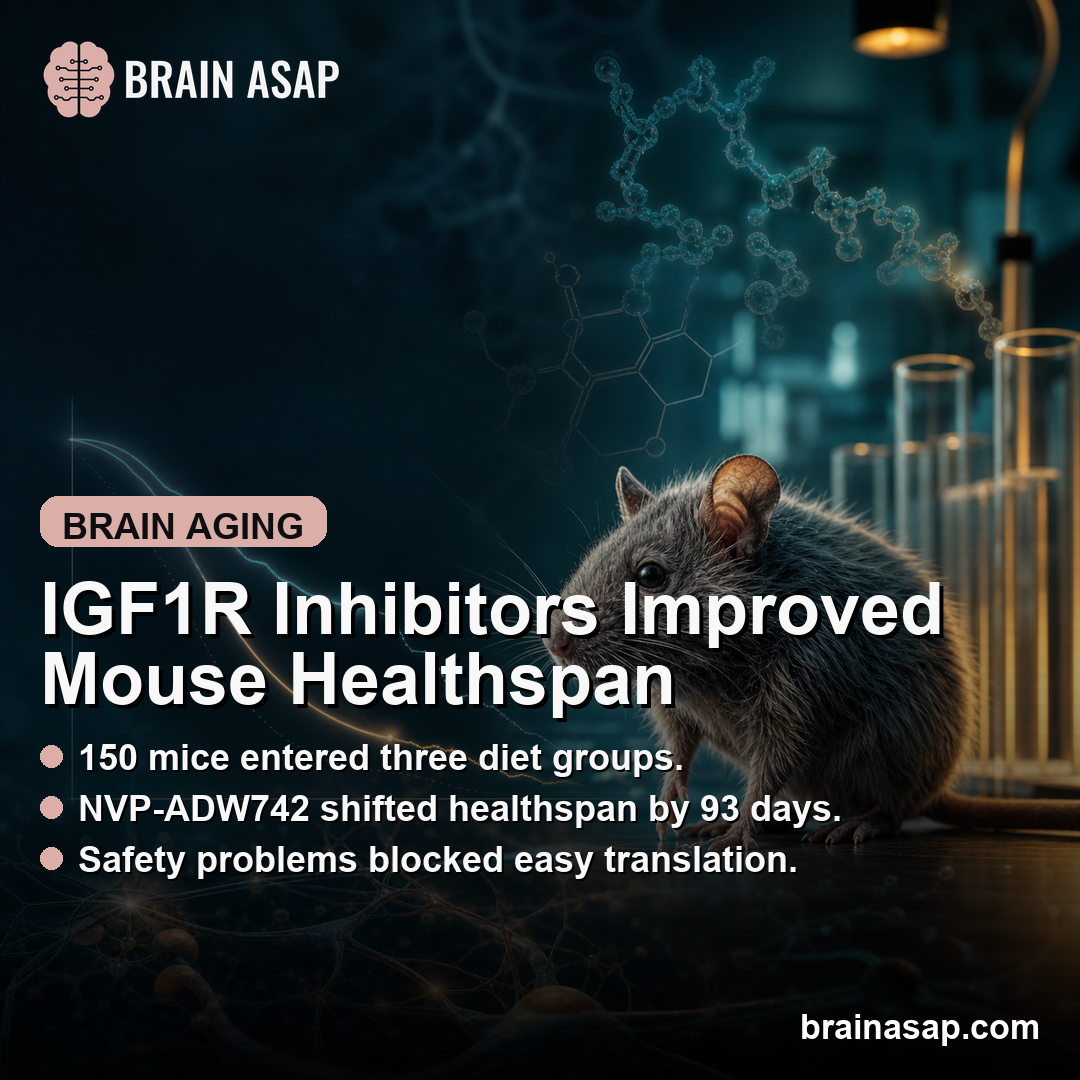
- 150 aging mice: Researchers assigned 55-week-old C57BL/6 mice to control diet, PPP, or NVP-ADW742, with 25 males and 25 females in each treatment group.
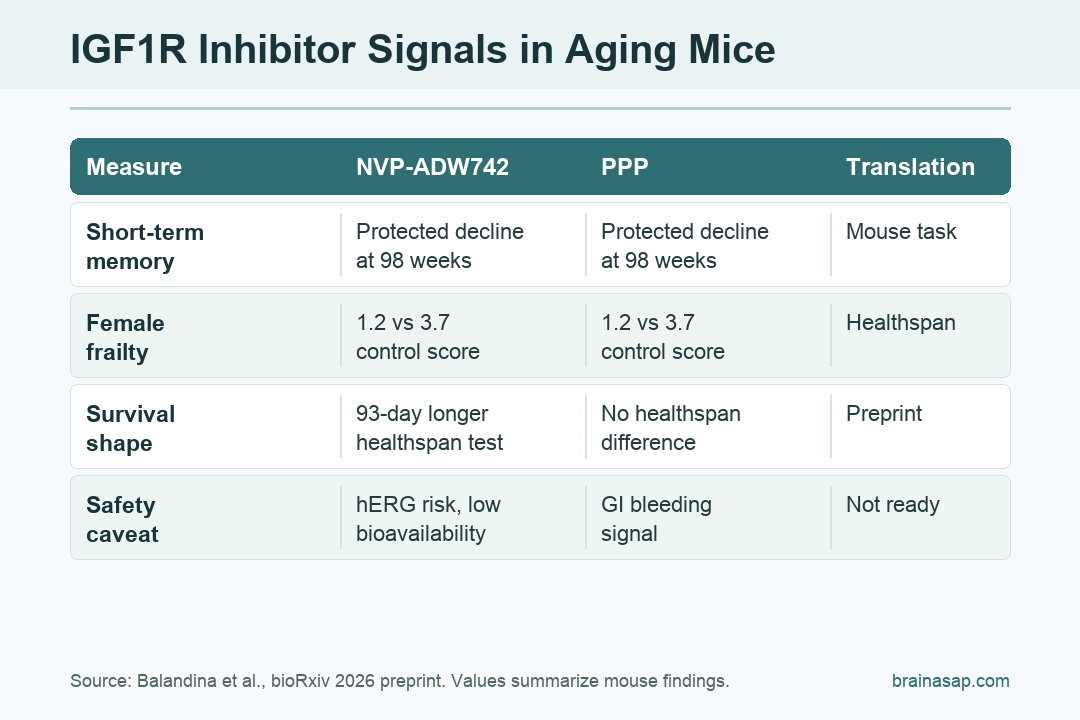
- Memory decline was blunted: At 98 weeks of age, treated mice were mostly protected from the short-term memory decline seen in controls on the Y-maze spontaneous alternation task.
- Female frailty was lower: Female control mice had a frailty score of 3.7 plus/minus 0.3, compared with 1.2 plus/minus 0.2 for NVP-ADW742 and 1.2 plus/minus 0.1 for PPP.
- NVP-ADW742 shifted healthspan: Kaplan-Meier survival did not significantly differ, but NVP-ADW742 mice had a 93-day longer healthspan estimate by the study’s 20th-percentile survival test.
- Safety blocked easy translation: PPP was linked to more gastrointestinal bleeding, while NVP-ADW742 showed hERG cardiac-safety risk, low oral bioavailability, and brain bioaccumulation.
Source: bioRxiv (2026) | Balandina et al.
Insulin-like growth factor 1 receptor (IGF1R) activity sits in a growth and metabolism pathway that has long been tied to aging biology in animal models.
The basic idea is not that growth activity is bad in every context. A pathway useful for development can become less favorable during later-life maintenance.
Researchers tested that idea with two orally delivered IGF1R inhibitors in middle-aged mice. Translation was mixed: several healthspan measures improved, but neither compound looked ready to become a human anti-aging drug.
Two IGF1R Inhibitors Were Fed to Middle-Aged Mice
The longevity experiment began when mice were 55 weeks old, roughly late middle age for this strain. Researchers used powdered diets containing either picropodophyllin (PPP) or NVP-ADW742, then followed survival and repeated health measures.
The design was built around three diet groups:
- Control diet: Mice received the same powdered-food setup without an IGF1R inhibitor.
- PPP diet: Mice received 1 mg/kg body weight per day of picropodophyllin, a compound with known instability concerns.
- NVP-ADW742 diet: Mice received 0.5 mg/kg body weight per day of an IGF1R inhibitor selected from pilot dose-response testing.
Each treatment arm included 25 male and 25 female mice. Researchers measured memory, grip strength, rotarod performance, blood pressure, pulse, glucose tolerance, hair graying, frailty, survival, and gross causes of death.
Short-Term Memory Was Protected in Older Mice
The clearest brain-facing result came from the Y-maze spontaneous alternation test, a short-term memory task based on whether mice naturally explore a new arm of a maze rather than repeating a recent path. Control mice showed age-related decline between 65 and 98 weeks.
Both treated groups were mostly protected from that decline. At 98 weeks, the treated-versus-control difference reached significance in females for NVP-ADW742 (p = 0.003) and PPP (p = 0.03), and in males for NVP-ADW742 (p = 0.02), while the male PPP comparison was weaker (p = 0.06).
The researchers also tested tail-suspension behavior and rotarod motor coordination, but those did not show broad treatment effects. The memory finding therefore should be read as one specific behavioral result, not a general claim that IGF1R inhibition improved every brain-related test.
Female Mice Had Less Frailty and Less Hair Graying
Several aging-phenotype results were strongest in females. At 73 weeks, female control mice had 2.9 plus/minus 0.4% gray hair area, compared with 0.9 plus/minus 0.2 for NVP-ADW742 and 0.6 plus/minus 0.1 for PPP.
Frailty showed a larger separation. The study scored 27 physical signs, including fur condition, skin lesions, body posture, reflexes, vision-related signs, and general condition.
Female controls averaged 3.7, while both treated female groups averaged about 1.2.
The main healthspan pattern was split by outcome and sex:
- Memory: Both sexes showed protection from short-term memory decline on the Y-maze task.
- Glucose tolerance: Treated males showed partial mitigation of age-related glucose-tolerance decline.
- Grip strength: Treated females had less late-life grip-strength decline, with significant differences after 75 weeks of treatment.
- Frailty and fur aging: Female mice showed the clearest reductions in frailty score and hair graying.
NVP-ADW742 Shifted Healthspan More Than Lifespan
Survival is where the interpretation needs care. Standard Kaplan-Meier analysis did not show significant differences between groups, and the study did not find maximum-lifespan differences.
NVP-ADW742-treated mice did have a higher mean longevity value, 892.3 days versus 848.8 days in controls, but that comparison was not conventionally significant (p = 0.06). The stronger claim came from the shape of the survival curve.
Researchers described the NVP-ADW742 curve as more “square,” meaning fewer mice died early in the mortality period and survival stayed closer to the upper end for longer. Their modified healthspan test estimated 93 additional days for NVP-ADW742 compared with controls (p = 0.02).
That healthspan-style finding is not proof that the compound cleanly extends life in a way ready for clinical use. The preprint also reported no healthspan difference between control and PPP groups.
Safety Results Made the Compounds Poor Human Candidates
The most important practical sentence is that these compounds are not clean anti-aging candidates. PPP was associated with more gastrointestinal bleeding, and the researchers linked that concern to PPP instability and possible podophyllotoxin-related toxicity.
NVP-ADW742 had a different problem: the healthspan finding came with a poor drug-likeness profile. The compound had 4.5% oral bioavailability, high efflux in Caco-2 permeability testing, rapid mouse microsome clearance, and hERG activity below 300 nM, a cardiac-safety warning sign.
The translation cautions are specific:
- Preprint status: The paper was posted on bioRxiv and had not been peer reviewed at the time of posting.
- Mouse model: The study used C57BL/6 mice, so the finding is animal healthspan evidence rather than human evidence.
- Compound quality: Both molecules had safety or pharmacology problems that could outweigh any anti-aging effect.
- Development path: The finding supports IGF1R as a possible late-life target, not these exact molecules as ready interventions.
The useful reading is narrow but real: late-life IGF1R inhibition produced measurable healthspan improvements in mice, especially for memory decline and female frailty. The hard next step is finding safer, better-controlled ways to test the pathway.
Citation: DOI: 10.64898/2026.04.13.718278. Balandina et al. Small-molecule IGF1R inhibitors extend healthspan in a mouse model. bioRxiv. 2026.
Study Design: Mouse longevity and healthspan experiment using dietary IGF1R inhibitors beginning in late middle age.
Sample/Model: 150 C57BL/6 mice, with 25 males and 25 females in each of three diet groups.
Key Statistic: NVP-ADW742 was associated with a 93-day longer healthspan estimate versus controls by the study’s 20th-percentile survival test.
Caveat: This is a preprint mouse study, and both tested compounds had safety or drug-likeness problems.