TL;DR: A 2026 double-blind trial in Psychopharmacology found that methylphenidate reduced cheating in healthy adults compared with placebo, contrary to survey respondents’ expectations about smart drugs.
Key Findings
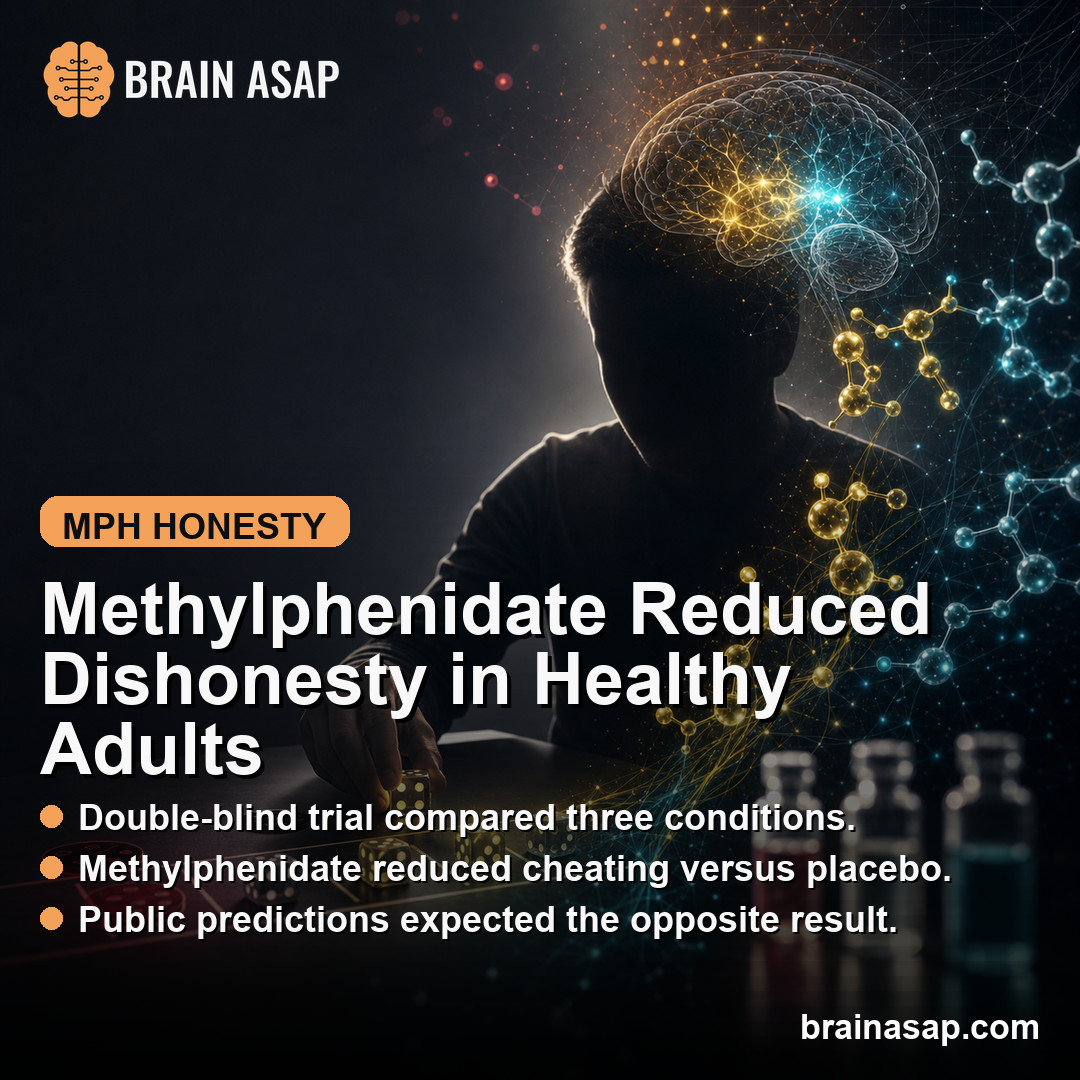
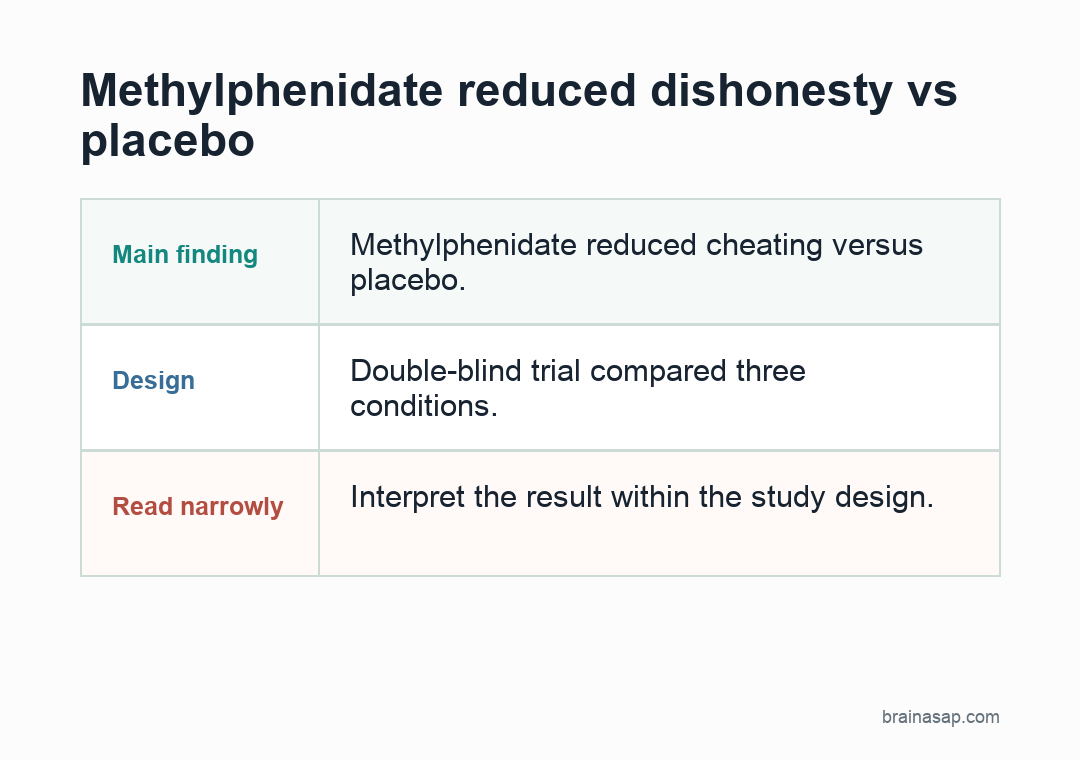
- Methylphenidate reduced dishonesty vs placebo: A double-blind placebo-controlled experiment in healthy adults showed methylphenidate (Ritalin) reduced cheating behavior compared to placebo — the opposite direction from what cognitive-enhancement users would expect.
- Atomoxetine (Strattera) tested as second comparator: The trial included atomoxetine alongside methylphenidate and placebo, helping isolate methylphenidate-specific effects from generic stimulant action.
- US-representative survey contradicted the experimental result: A separate sample of US adults surveyed for their intuitions about smart-drug effects on cheating predicted increased dishonesty — the opposite of what the experiment found.
- The result points to cognition-and-morality overlap: Methylphenidate works on dopaminergic and noradrenergic systems that also support self-control, risk-taking, and moral decision-making.
- Healthy adult sample, lab cheating paradigm: The behavioral measure captured dishonesty in a controlled task setting; whether the same effect transfers to high-stakes real-world cheating is a separate test.
Source: Psychopharmacology (2026) | Kappes et al.
Cognitive-enhancement drug use among healthy adults has been rising for years — college students cramming, professionals chasing focus, parents managing competing demands.
The pharmacology raises a separate issue almost no one tests: what do these drugs do to the part of cognition that involves moral choices? Methylphenidate doesn’t only boost attention.
It affects dopaminergic and noradrenergic systems implicated in self-control, reward valuation, and risk-taking — the same systems involved when someone decides whether to cheat.
Why “Smart Drugs” Have an Underexamined Side Effect
Drug-based cognitive enhancement has become a familiar topic in academic ethics conversations. Most of the debate focuses on a few axes:
- Fairness: If some students or workers use methylphenidate to gain an edge, is that cheating against those who don’t?
- Access: Who can afford prescription stimulants, and does enhancement use widen pre-existing inequalities?
- Safety: Long-term use of stimulants in non-ADHD adults has been undercharacterized.
- Autonomy: Should adults be free to use these drugs even off-label?
One axis the public conversation almost never reaches: do cognitive-enhancement drugs change moral decision-making in ways users don’t intend? Methylphenidate’s pharmacology — blocking dopamine and norepinephrine reuptake — affects brain systems known to participate in honesty, self-control, and risk-taking.
Whether the drug nudges those systems toward more or less ethical behavior is an issue the pharmacology alone cannot answer.
The Kappes team designed an experiment to actually measure it.
The Three-Arm Drug Trial That Tested Cheating Directly
The methodological design was straightforward but rare in this domain:
- Double-blind placebo-controlled experimental design: Neither participants nor researchers knew which drug condition each subject was in.
- 3 arms: Methylphenidate (Ritalin), atomoxetine (Strattera), and placebo. Atomoxetine is another performance-enhancing drug with different pharmacology, included to help isolate methylphenidate-specific effects.
- Lab cheating paradigm: Standardized behavioral tasks where participants could cheat for material gain in ways they thought wouldn’t be detected. This kind of paradigm has been used in moral psychology to measure dishonest behavior under controlled conditions.
- Healthy adults: Not ADHD patients — non-clinical users representative of the cognitive-enhancement population.
What Reduced Cheating on Methylphenidate Probably Means
The directional finding — methylphenidate reducing cheating compared to placebo — runs against the intuitive expectation that performance-enhancing drugs would make users more willing to cut corners. Several mechanistic interpretations are plausible:
- Improved self-control / impulse regulation: Methylphenidate’s effects on dopaminergic and noradrenergic systems include strengthening prefrontal control over impulsive responses. Cheating is an impulse-driven behavior in many lab paradigms; better impulse control could reduce it.
- Sharpened deliberation: If methylphenidate produces more careful, deliberative thinking, participants may be more likely to consider consequences and reputational risk — reducing impulsive dishonesty.
- Altered reward valuation: The drug affects how brain systems weight immediate gain against longer-term considerations. Cheating typically trades short-term reward for moral cost; if the drug reweights this calculation, behavior shifts.
- Reduced risk-taking propensity: Methylphenidate can affect risk-taking under different conditions. If the lab cheating involves perceived risk of detection or self-image cost, reduced risk tolerance could decrease cheating.
The Kappes paper doesn’t fully isolate which mechanism dominates — that remains follow-up work — but the directional finding is clear.
Survey Respondents Expected Methylphenidate to Increase Cheating
The team’s separate survey of a US-representative sample asked people what they expected methylphenidate to do to cheating behavior.
Respondents predicted increased dishonesty — consistent with the broader cultural narrative that performance-enhancing drugs lower ethical standards.
The experimental result was the opposite. Public intuition about smart-drug effects on moral behavior is systematically wrong. That mismatch affects several policy and clinical issues:
- Policy debates rest on intuitions that may be wrong. Academic integrity rules, drug-testing policies, and ethical guidelines for cognitive-enhancement use partly reflect assumptions about what these drugs do — assumptions that don’t match the experimental evidence.
- User decision-making is shaped by these intuitions. People considering whether to use methylphenidate for performance enhancement may anticipate moral side effects that don’t actually occur in the predicted direction.
- The neuroscience of moral cognition is more counterintuitive than the public realizes. Self-control, deliberation, and impulse regulation are wired into systems that performance-enhancing drugs deliberately target.
Why This Doesn’t Mean “Take Ritalin to Be More Ethical”
The careful interpretation is narrow. The result does not show that methylphenidate is a treatment for unethical behavior, that the effect is large enough to change individual moral choices, or that the drug is safe or appropriate for healthy adults.
It also does not settle what happens with chronic use. Tolerance, adaptation, and different motivational settings could change the picture.
What the paper does establish is that moral cognition is not insulated from the same neurochemistry that supports cognitive performance. Drugs that change cognition also change moral behavior — potentially in directions that contradict popular intuition.
The Honest Limits of Lab-Based Cheating Research
Lab cheating is not the same as real-world cheating. Behavioral tasks measure dishonesty under conditions where stakes are modest, detection is symbolic, and identity is partly anonymous.
Financial fraud, plagiarism, and professional misconduct involve social stakes and consequence asymmetries the lab cannot fully recreate.
The sample also matters. These were healthy adults in a single-dose experiment, not ADHD patients on therapeutic methylphenidate, chronic non-medical users, or people making high-stakes professional decisions.
The mechanism remains open. The dishonesty reduction could reflect impulse control, deliberation, reward sensitivity, risk tolerance, or some combination of those systems.
The cultural frame for cognitive-enhancement drugs has been competitive: “this drug helps you do more / faster / better.” This trial adds a quieter point: moral decision-making can move with the same neurochemistry that changes attention and control.
That does not make methylphenidate an ethics drug. It means the smart-drug debate has been operating with incomplete information about moral behavior, not just performance.
Citation: DOI: 10.1007/s00213-026-07059-y. Kappes et al. Beyond attention: methylphenidate reduces dishonesty in healthy adults. Psychopharmacology. 2026.
Study Design: Double-blind placebo-controlled experimental study plus a U.S.-representative expectation survey.
Sample/Model: Healthy adults assigned to methylphenidate, atomoxetine, or placebo in a lab dishonesty paradigm.
Key Statistic: Methylphenidate reduced dishonesty compared with placebo, opposite to public expectations about smart-drug effects.
Caveat: Single-dose lab cheating results may not transfer to chronic use or high-stakes real-world dishonesty.