TL;DR: A 2026 umbrella review in PLOS One pooled Ethiopian systematic reviews and estimated that 22.49% of women had perinatal depressive symptoms, with similar estimates during pregnancy and after birth.
Key Findings
- Eight-review evidence base: Researchers included 8 systematic reviews and meta-analyses covering 28 unique primary studies and 15,592 participants.
- Overall prevalence: The pooled umbrella estimate for perinatal depressive symptoms in Ethiopia was 22.49% (95% CI: 21.38-23.59).
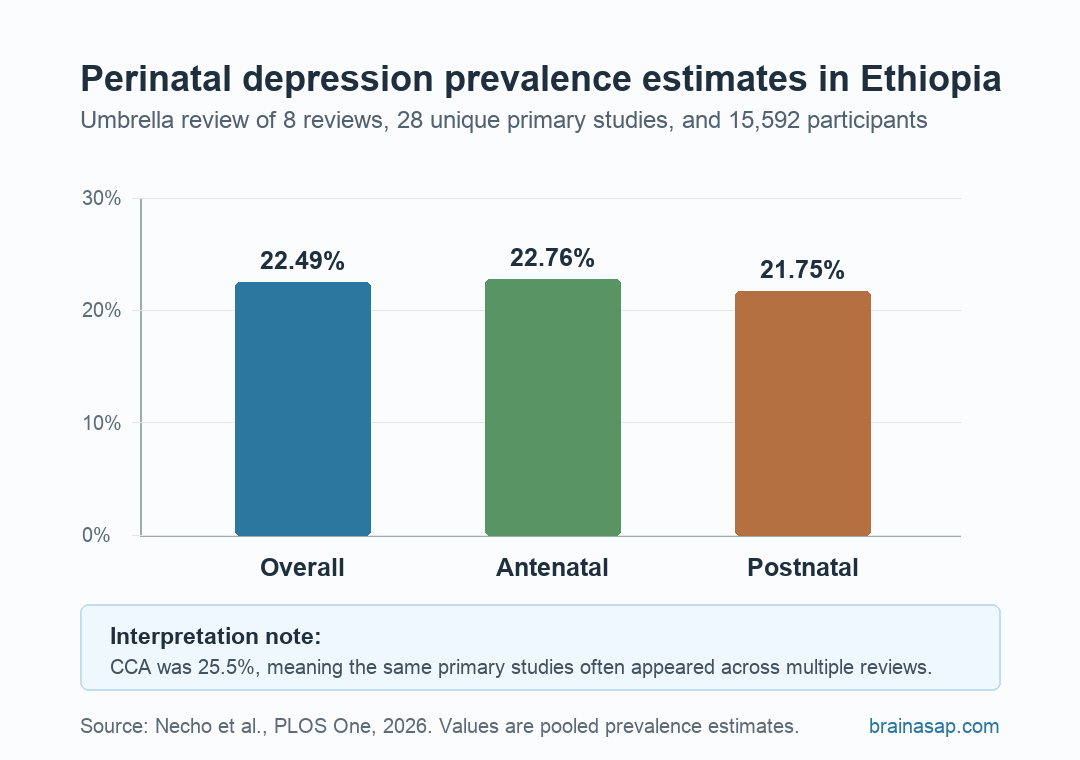
- Pregnancy and postpartum estimates were close: Antenatal depressive symptoms were estimated at 22.76%, while postnatal depressive symptoms were estimated at 21.75%.
- Study overlap was high: The corrected covered area (CCA), an overlap measure for repeated primary studies across reviews, was 25.5%.
- Evidence quality was mixed but not low: Four included reviews were rated high quality by AMSTAR, and four were rated moderate quality.
Source: PLOS One (2026) | Necho et al.
Perinatal depression refers to depressive symptoms during pregnancy or after birth. It matters because maternal depression can affect prenatal care, infant care, family functioning, and a child’s early developmental environment.
The new review focused on Ethiopia, where individual studies and earlier meta-analyses had produced similar but not identical estimates. Researchers used an umbrella review, meaning they reviewed existing systematic reviews and meta-analyses rather than starting with every primary study one by one.
Perinatal Depression Was Estimated in About 1 in 4 Ethiopian Women
The headline estimate was direct: across the included review-level evidence, the pooled prevalence of perinatal depressive symptoms was 22.49%. The confidence interval was narrow, from 21.38% to 23.59%, because the umbrella analysis pooled a large participant base.
The review is not describing a rare edge case. In the pooled Ethiopian evidence, roughly 1 in 4 to 1 in 5 women had depressive symptoms during pregnancy or the postpartum period, depending on the exact study set and measurement tool.
- Overall perinatal estimate: 22.49% of women had depressive symptoms in the umbrella analysis.
- Antenatal estimate: 22.76% had depressive symptoms during pregnancy.
- Postnatal estimate: 21.75% had depressive symptoms after birth.
The pregnancy and postpartum estimates were close enough that the researchers did not frame one period as clearly safer. Screening and support would therefore need to cover both prenatal and postnatal care rather than focusing on only one clinical window.
The Umbrella Review Rechecked Eight Earlier Meta-Analyses
Researchers searched PubMed, EMBASE, and PsycINFO for systematic reviews and meta-analyses on Ethiopian perinatal depression. The final evidence base included 8 reviews, 28 unique primary studies, and 15,592 participants.
An umbrella review can be useful when a field already has several meta-analyses. Instead of producing another isolated estimate, it asks how much the review literature agrees, how much the primary-study base overlaps, and how strong the review methods appear.
- Protocol and reporting: The review used the PRIOR checklist and registered its protocol in PROSPERO as CRD42023495174.
- Quality appraisal: Researchers used AMSTAR, a tool for rating systematic-review methods.
- Overlap check: They calculated corrected covered area (CCA) to test how often the same primary studies appeared across multiple reviews.
That design is important because repeated meta-analyses can create a false sense of independent confirmation. If the same primary studies keep reappearing, several review papers may still rest on a smaller evidence base than the paper count suggests.
High Study Overlap Limited How Independent the Reviews Were
The review found a CCA of 25.5%. CCA stands for corrected covered area, a measure of how much primary-study overlap exists across systematic reviews.
The authors classified this as a very high degree of overlap.
This does not make the prevalence estimate useless. It does mean the eight included reviews should not be read as eight fully separate bodies of evidence.
Some of the same Ethiopian primary studies were counted in more than one review.
- Seven primary studies appeared in one systematic review or meta-analysis.
- Seven primary studies appeared in two reviews.
- Some studies appeared repeatedly, which increased the need for overlap-aware interpretation.
The authors tried to reduce that problem by identifying 28 unique primary studies and by discussing overlap explicitly. For a public-health estimate, that transparency is useful because it separates the size of the review literature from the size of the underlying data.
Antenatal and Postnatal Depression Estimates Were Similar
The pooled antenatal estimate was 22.76%, with a 95% confidence interval from 19.90% to 25.62%. The pooled postnatal estimate was 21.75%, with a 95% confidence interval from 21.03% to 22.48%.
Those figures support a practical interpretation: maternal mental-health screening should not stop at delivery, and it should not wait until after delivery either. The review points toward a continuous care problem across pregnancy and the postpartum period.
Subgroup analysis by the number of primary studies in each review also produced similar estimates. Reviews with 10 or fewer primary studies estimated prevalence at 22.86%, while reviews with fewer than 10 primary studies estimated 22.10%.
Heterogeneity and Cross-Sectional Evidence Keep the Estimate Bounded
The umbrella estimate was high, but the evidence was not perfectly uniform. The overall analysis had significant heterogeneity, with I2 = 96.0%.
That statistic means the review-level estimates varied more than would be expected from sampling error alone.
The authors named several limitations that should stay attached to the result:
- Different tools: Primary studies varied in how they measured depressive symptoms.
- Different study quality: Four included reviews were high quality by AMSTAR, while four were moderate quality.
- Cross-sectional base: Many primary studies were cross-sectional, so they estimated prevalence rather than causal pathways.
- High overlap: The same primary studies appeared across multiple reviews, limiting independence.
A one-study leave-out sensitivity analysis did not identify a single included review that drove the pooled estimate outside the original confidence interval. That supports the stability of the estimate, even though heterogeneity remains a major caveat.
The practical takeaway is not that one number solves Ethiopian maternal mental-health planning. It is that the existing review literature consistently places perinatal depressive symptoms in a high-prevalence range, making routine screening and referral capacity hard to treat as optional.
Citation: DOI: 10.1371/journal.pone.0347570. Necho et al. Prevalence of perinatal depression in Ethiopia: An umbrella review of systematic review and meta-analysis studies. PLOS One. 2026;21(4):e0347570.
Study Design: Umbrella review of systematic reviews and meta-analyses on perinatal depressive symptoms in Ethiopia.
Sample Size: 8 systematic reviews/meta-analyses, 28 unique primary studies, and 15,592 participants.
Key Statistic: Overall pooled prevalence was 22.49% (95% CI: 21.38-23.59), with antenatal and postnatal estimates of 22.76% and 21.75%.
Caveat: High heterogeneity and high primary-study overlap mean the pooled estimate should be used as a planning signal, not as a precise universal rate.