TL;DR: A 2026 preprint in medRxiv reported that REDDI, an interpretable AI pipeline using resting-state magnetoencephalography (MEG), classified four neurodegenerative diseases with mean balanced accuracy of 0.81.
Key Findings
- The dataset covered four disease groups: it included 32 people with mild cognitive impairment, 18 with multiple sclerosis, 20 with Parkinson’s disease, and 39 with amyotrophic lateral sclerosis.
- 163-magnetometer MEG: Resting-state brain activity was recorded with a 163-magnetometer system and source-reconstructed into 116 brain regions.
- 0.81 balanced accuracy: REDDI reached mean balanced accuracy of 0.81 +/- 0.04 across five folds.
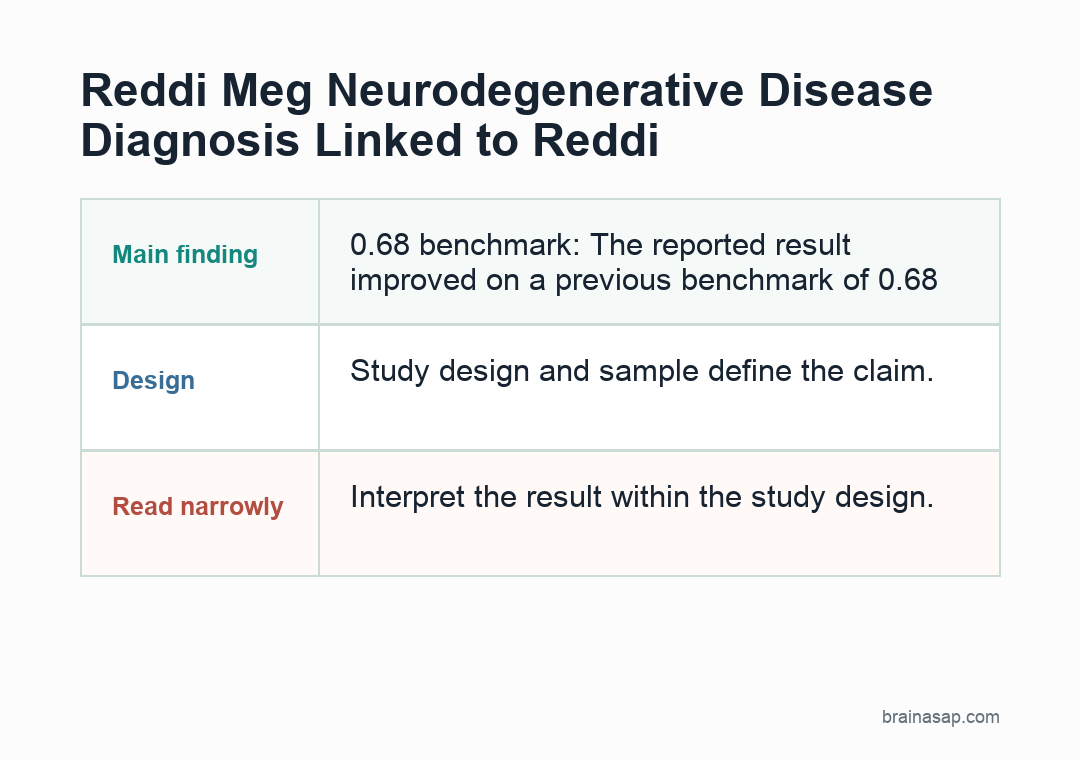
- 0.68 benchmark: The reported result improved on a previous benchmark of 0.68.
- Feature reduction: Feature selection reduced dimensionality by 81% for avalanche-transition matrices and 97% for covariance/correlation matrices.
Source: medRxiv (2026) | Roca et al.
REDDI is an AI pipeline designed to classify neurodegenerative disease from resting brain activity rather than from symptoms alone. The preprint tested whether resting-state MEG could help separate mild cognitive impairment, multiple sclerosis, Parkinson’s disease, and amyotrophic lateral sclerosis.
The problem is clinically relevant because these diseases can all disrupt large-scale brain activity while requiring different care paths. A classifier that only gives a label is not enough; the analysis emphasized interpretability so the model could point to brain regions and connectivity features driving the decision.
REDDI Used Resting-State MEG From Four Disease Groups
The dataset included 109 patients across four diagnoses. Mild cognitive impairment (MCI) is a memory-and-thinking syndrome that can precede dementia; multiple sclerosis (MS) is an immune-mediated demyelinating disease; Parkinson’s disease (PD) affects movement and nonmotor function; amyotrophic lateral sclerosis (ALS) damages motor neurons.
Researchers recorded resting-state MEG, which measures magnetic fields generated by synchronized neural activity. The recordings were cleaned for environmental and physiological artifacts, then reconstructed into 116 anatomical brain regions.
- MCI group: 32 participants, mean age 71.31 years.
- MS group: 18 participants, mean age 45.05 years.
- Parkinson’s group: 20 participants, mean age 64.5 years.
- ALS group: 39 participants, mean age 59.63 years.
Each participant contributed two resting-state recordings. After preprocessing, the clean data were represented as two-minute multivariate time series across the 116 source regions.
Riemannian Geometry Turned Connectivity Matrices Into Classifier Inputs
The central method was Riemannian geometry, a mathematical approach suited to data points that are matrices rather than ordinary flat feature lists. In this case, the matrices summarized how brain regions varied or interacted during rest.
REDDI used several connectivity-style inputs, including covariance matrices, correlation matrices, and weighted avalanche-transition matrices. The goal was to preserve brain-network structure instead of reducing the data to only power in separate frequency bands.
- Covariance matrices: Captured shared activity variation between brain regions.
- Correlation matrices: Captured standardized relationships between regional time series.
- Avalanche-transition matrices: Captured transitions in large-scale activity events across regions.
Feature selection used Kruskal-Wallis statistics and effect-size filtering before classification. That step cut the feature space sharply, by 81% for avalanche-transition features and 97% for covariance or correlation features.
Balanced Accuracy Improved From 0.68 to 0.81
The main performance number was mean balanced accuracy of 0.81 +/- 0.04 in five-fold cross-validation. Balanced accuracy is appropriate here because the groups were uneven in size; it averages performance across classes instead of letting the largest group dominate.
The benchmark compared REDDI against alternative features and classifiers, including power spectral density features, support vector machines, linear discriminant analysis, XGBoost, and neural-network models. The ensemble combined covariance- and correlation-based predictions.
- Main result: The REDDI ensemble reached 0.81 balanced accuracy.
- Prior benchmark: The comparison benchmark was 0.68.
- Model behavior: The small fold-to-fold spread was presented as evidence of low overfitting within this dataset.
This finding is not enough to make MEG a stand-alone diagnostic test in a clinic. It does show that disease-specific information was present in resting brain dynamics in this pooled dataset.
Insula, Cingulate, Motor, and Parietal Regions Drove the Signal
Interpretability was one of the strongest parts of the report. The most discriminative regions were not confined to one disease-specific lesion site; they repeatedly involved distributed brain hubs.
Across feature types, important regions included the right insula, Heschl’s gyrus, precuneus, inferior parietal cortex, supplementary motor areas, paracentral lobules, postcentral cortex, mid-cingulate cortex, parahippocampal gyrus, and occipital regions.
- Motor-network relevance: Parkinson’s disease, ALS, and MS often involve motor impairment, so motor and peri-motor regions are biologically plausible discriminators.
- Association-network relevance: Insular, cingulate, and parietal regions support large-scale integration and may reflect broader network disruption.
- Clinical limitation: Feature importance shows what helped the classifier, not a direct causal mechanism for each disease.
This distributed pattern fits the paper’s main argument: neurodegenerative diseases may leave separable signatures in whole-brain dynamics, even when symptoms overlap.
The Preprint Needs Larger Independent Validation
The strongest limitation is sample size. The classifier was tested on 109 patients, and the MS and Parkinson’s groups were especially small.
The analysis also used cross-validation within the available data, not an external clinical validation cohort collected at new sites. MEG preprocessing, equipment, patient selection, and disease stage can all shift model performance.
- Preprint status: The report had not yet completed peer review at the time of posting.
- Sample imbalance: Disease groups ranged from 18 to 39 participants.
- Translation need: A clinical decision-support tool would need prospective validation against real diagnostic workflows.
For now, REDDI is best read as evidence that interpretable MEG-based AI can separate disease groups in a research dataset. The next test is whether the same pattern holds in larger, independent cohorts.
Citation: DOI: 10.64898/2026.04.10.26350617. Roca et al. REDDI: A Riemannian Ensemble Learning Framework for Interpretable Differential Diagnosis of Neurodegenerative Diseases. medRxiv. 2026.
Study Design: Preprint machine-learning classification study using resting-state MEG data.
Sample Size: 109 patients across MCI, MS, Parkinson’s disease, and ALS groups.
Key Statistic: REDDI achieved mean balanced accuracy of 0.81 +/- 0.04 across five-fold cross-validation, compared with a prior benchmark of 0.68.
Caveat: The model needs independent external validation before clinical diagnostic use.