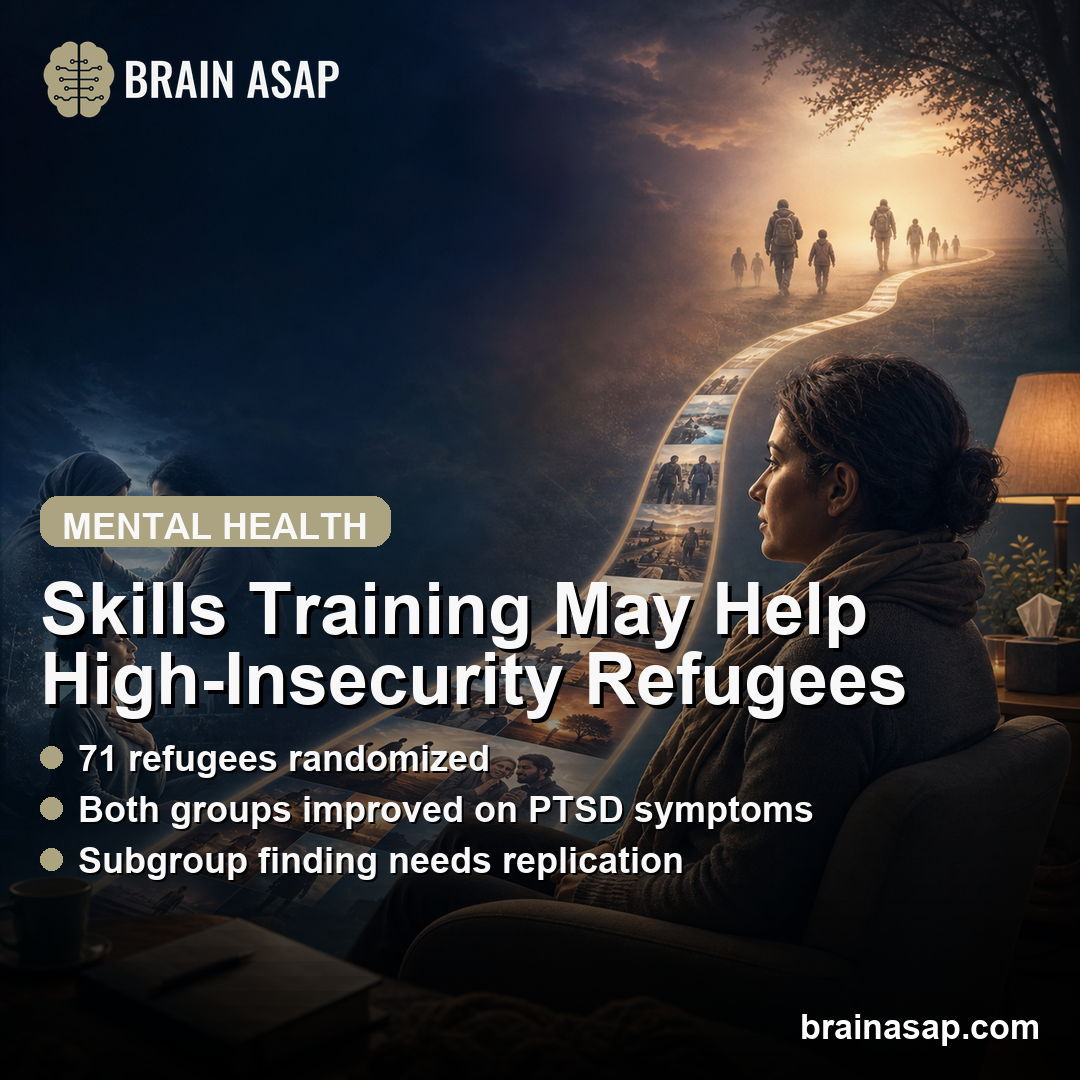
TL;DR: A 2026 randomized pilot trial in European Journal of Psychotraumatology found no overall PTSD advantage when refugee-focused emotion-regulation skills training was added before narrative exposure therapy, but refugees living with high visa or family insecurity showed preliminary self-report gains from the skills-first approach.
Key Findings
- 71 adult refugees were randomized: Participants met DSM-5 criteria for posttraumatic stress disorder (PTSD), a trauma-linked condition involving intrusive memories, avoidance, threat arousal, and mood/cognition changes.
- Both groups received narrative exposure therapy: Narrative Exposure Therapy (NET) helps people build a chronological life narrative that includes traumatic and positive events.
- STAIR-R did not beat supportive problem solving overall: Skills Training in Affective and Interpersonal Regulation for Refugees (STAIR-R) plus NET did not significantly outperform Supportive Problem-Solving (SPS) plus NET at mid-treatment, post-treatment, or 3-month follow-up.
- PTSD symptoms improved in both groups: Clinician-assessed PTSD improved by large within-group effect sizes at 3-month follow-up, g = -1.41 for STAIR-R + NET and g = -1.54 for SPS + NET.
- High-insecurity refugees may need a different front end: Among 16 participants with insecure visa status or separation from all immediate family, STAIR-R + NET produced larger self-reported gains on PTSD, depression, emotion regulation, relationships, and environmental quality of life.
Refugee PTSD treatment has a practical problem: trauma-focused therapy can help, but current stressors do not disappear just because therapy starts. Visa insecurity, family separation, housing instability, and fear for relatives can keep the nervous system on alert.
This trial asked a precise treatment-sequencing question. Would refugees do better if they first learned structured emotion-regulation and interpersonal skills, then moved into trauma narrative work?
STAIR-R and Supportive Problem Solving Were Tested Before NET
Researchers randomly assigned 71 adult refugees or asylum seekers in Australia to 1 of 2 treatment sequences. All participants met DSM-5 criteria for PTSD using the Clinician-Administered PTSD Scale for DSM-5 (CAPS-5), a structured interview for rating PTSD symptoms.
The two treatment routes were similar in length:
- STAIR-R + NET: 6 sessions of Skills Training in Affective and Interpersonal Regulation for Refugees, followed by 7 sessions of Narrative Exposure Therapy.
- SPS + NET: 6 sessions of client-directed supportive problem solving, followed by the same 7-session NET phase.
- Follow-up schedule: Assessments occurred at baseline, post-treatment, and 3-month follow-up, with an additional self-report check between the first phase and NET.
STAIR-R was adapted for refugees. Sessions covered calm breathing, emotional responding, self-care, behavioral activation, positive coping statements, interpersonal emotion regulation, and community connection.
SPS was not a no-treatment comparison. It used supportive counselling and client-directed problem solving for current stressors, while avoiding trauma-memory exposure and formal emotion-regulation skills training.
No Overall PTSD Advantage Emerged for STAIR-R + NET
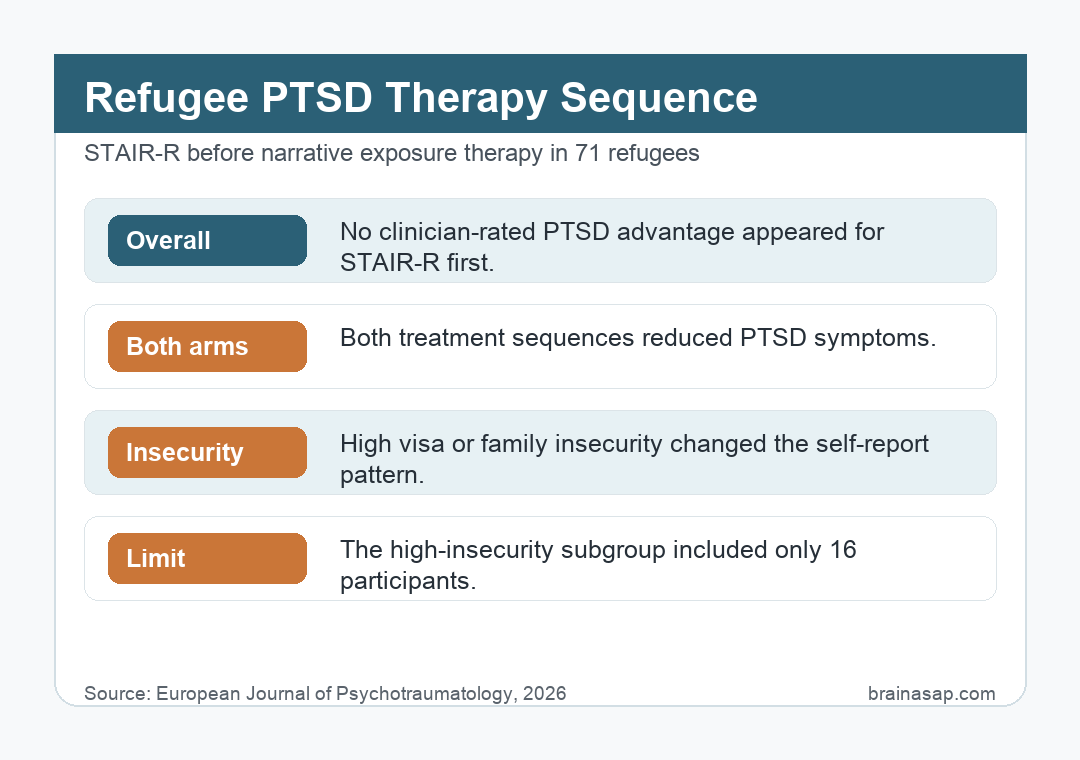
The main comparison was straightforward. STAIR-R + NET did not significantly outperform SPS + NET on clinician-assessed PTSD at mid-treatment, post-treatment, or 3-month follow-up.
Table values at 3-month follow-up showed a small between-group difference on the CAPS score: -2.44 points, p = .417, Hedges’ g = -0.19. That is not evidence of a clinically reliable overall advantage for either front-end treatment.
Self-reported PTSD also showed no overall between-group advantage at 3-month follow-up. The listed between-group difference was 3.97 points, p = .391, Hedges’ g = 0.20.
Both Treatment Sequences Reduced PTSD Symptoms
Absence of a between-group difference still leaves a clinically important within-group change. Both groups improved over time on PTSD symptoms.
At 3-month follow-up, clinician-assessed PTSD showed large within-group gains:
- STAIR-R + NET: Hedges’ g = -1.41 from pre-treatment to follow-up.
- SPS + NET: Hedges’ g = -1.54 from pre-treatment to follow-up.
- Self-reported PTSD: Follow-up gains were smaller but still significant, g = -0.49 for STAIR-R + NET and g = -0.44 for SPS + NET.
The shared improvement supports a simple reading: the shared NET phase may have driven much of the PTSD improvement. Since both groups received NET, the trial cannot isolate NET against no NET.
The trial also had a retention benchmark. 54 participants, or 76.1%, completed all 13 therapy sessions, with no reported difference across conditions.
High Insecurity Changed the Treatment Pattern
The more clinically specific finding came from the exploratory insecurity analysis. Researchers defined high insecurity as insecure visa status or separation from all immediate family.
That subgroup was small: 16 participants. Even so, the pattern was coherent enough to matter for future trials.
Among high-insecurity refugees, STAIR-R + NET showed larger self-reported improvements than SPS + NET at follow-up:
- Self-reported PTSD: Hedges’ g = 1.35 for the between-group difference.
- Depression symptoms: Hedges’ g = 1.11.
- Emotion dysregulation: Hedges’ g = 1.24.
- Relationship difficulties: Hedges’ g = 1.12.
- Environmental quality of life: Hedges’ g = -1.05, with direction reflecting lower problem scores in the STAIR-R + NET group.
Those gains were not mirrored on clinician-administered PTSD. The subgroup finding is therefore best treated as a signal for tailoring, not a settled rule for clinical care.
Skills Training May Help When Current Threat Is Still Active
The high-insecurity result makes clinical sense. People facing unstable visas or total family separation are not only processing past trauma. They are also managing ongoing threat, loss of control, and practical uncertainty.
STAIR-R targets exactly that front-end problem. It teaches regulation through body care, behavior planning, coping statements, and interpersonal support before NET asks people to organize trauma memories into a life narrative.
SPS also addresses current problems, but in a less structured way. For refugees under high insecurity, the structure of STAIR-R may be the active ingredient that helps them stay engaged and use the later trauma-focused phase.
The Trial Was Underpowered for Small Effects
The study was designed for a larger sample. Researchers originally calculated that 128 participants would be needed to detect the expected between-group effect, but COVID-19 disruption and funding limits left a final sample of 71 participants.
That sample size means small overall differences could have been missed. The subgroup analysis is even more fragile because the high-insecurity subgroup included only 16 participants.
The practical takeaway is measured: NET-linked PTSD improvement appeared in both groups, while STAIR-R deserves larger testing as a targeted front-end for refugees living with high insecurity.
Citation: DOI: 10.1080/20008066.2026.2648941. Nickerson et al. Emotion regulation skills training as an adjunctive treatment to narrative exposure therapy for posttraumatic stress disorder (PTSD) in refugees: a pilot randomized controlled trial. European Journal of Psychotraumatology. 2026;17(1):2648941.
Study Design: Randomized parallel pilot trial comparing STAIR-R + NET with SPS + NET.
Sample Size: 71 adult refugees or asylum seekers with PTSD; 35 assigned to STAIR-R + NET and 36 assigned to SPS + NET.
Key Statistic: No significant between-group difference in clinician-assessed PTSD at 3-month follow-up; both groups improved, g = -1.41 for STAIR-R + NET and g = -1.54 for SPS + NET.
Caveat: The trial was underpowered for small overall effects, and the high-insecurity subgroup finding came from only 16 participants.