ECT Looks Safer in the Long Run Than Its Reputation
TL;DR: A British Journal of Psychiatry review argues that modern population-level studies do not support a long-term increase in dementia or major cardiovascular risk after electroconvulsive therapy and instead point toward lower suicide mortality and all-cause mortality in the patients who receive it.
Key Findings
- ECT remission can reach about 60% in severe depression: The review opens from a familiar clinical fact: ECT remains one of psychiatry’s strongest acute treatments for severe, psychotic, suicidal, or treatment-resistant illness.
- Administrative data studies mostly do not show a dementia signal: Across modern adjusted cohort analyses, the authors found no consistent evidence that ECT increases long-term dementia risk after confounding is addressed.
- Major cardiovascular and cerebrovascular events did not rise overall: Population-level studies similarly found no clear long-term increase in stroke, myocardial infarction, or major adverse cardiovascular or cerebrovascular events, though one Danish analysis suggested a short-lived 30-day cardiac risk in medically fragile patients.
- Suicide mortality often fell by 30% to 50%: Four 2025 systematic reviews and several population-level studies linked ECT to substantially lower suicide death, with individual hazard ratios such as 0.56, 0.58, and 0.39 after adjustment.
- All-cause mortality repeatedly moved downward too: The review notes a remarkably consistent 25% to 30% reduction in all-cause mortality across systematic reviews, supported by multiple cohort studies from Taiwan, the United States, Canada, Denmark, Sweden, and the UK.
- The strongest new evidence comes from better causal methods, not new RCTs: Propensity-score matching, weighting, and other modern administrative-data methods are doing work randomized trials cannot practically do for rare and long-term outcomes.
Source: The British Journal of Psychiatry (2026) | Kaster et al.
Electroconvulsive therapy has a large gap between public reputation and modern outcome data. It is often imagined as a treatment whose risks are obvious and whose benefits are mostly anecdotal, yet this review argues that the best modern studies point in the opposite direction.
Why ECT’s Biggest Evidence Problem Was Never Short-Term Efficacy
Psychiatry has not lacked evidence that electroconvulsive therapy works. Trials and meta-analyses have shown for years that ECT can outperform medication and other interventions for severe or treatment-resistant depression, and the review cites remission rates of up to 60% in some depressed populations.
The harder question has always been the patients ask in the consultation room: what happens later? Does ECT increase dementia risk?
Does it provoke major cardiac or cerebrovascular events? And if it rapidly reduces suicidal thinking, does that actually translate into fewer suicide deaths?
Traditional clinical trials are bad at answering those questions. Rare events and long follow-up windows demand huge sample sizes, often across years, which is exactly where administrative health data become useful. That is the methodological pivot this review is built around.
How Modern Health Databases Changed the ECT Risk Conversation
The paper is not a de novo meta-analysis. It is a synthesis of modern observational studies that use large administrative databases together with newer causal-inference tools such as propensity-score matching, propensity-score weighting, and more careful regression adjustment.
The reason is the biggest bias in ECT research cuts against ECT from the start. Patients who receive it are often among the sickest in psychiatry: more suicidal, more treatment resistant, and more medically complicated. If you compare them naively against people who did not receive ECT, you can make the treatment look dangerous simply because the patients were already at higher baseline risk.
The review’s core point is that once modern studies address that confounding more seriously, the result becomes much less alarming than ECT’s public image suggests.
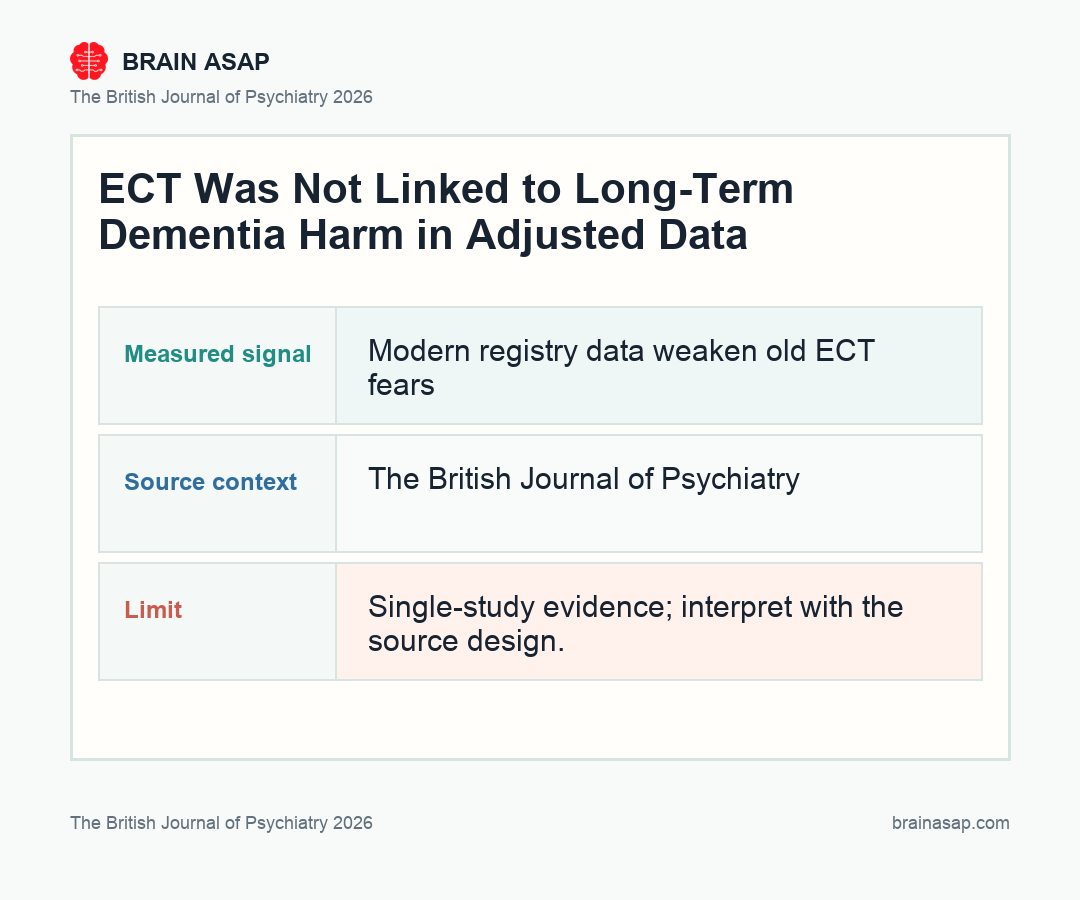
Dementia and Major Cardiac Event Fears Look Weaker in the Newer Data
The section on dementia is one of the most clinically important because cognitive side effects are still the dominant fear many patients bring into the room. The authors argue that the best adjusted studies do not show a consistent increase in long-term dementia risk after ECT.
The same general conclusion holds for major adverse cardiovascular and cerebrovascular outcomes. Across population-level studies, long-term stroke and major cardiovascular event risk did not clearly increase once confounding was handled properly. One Danish analysis did identify a short-term cardiac signal within 30 days among patients with physical comorbidity, but that risk did not persist long term.
The nuance is important. “No major long-run signal” is not the same as “zero medical risk.” The review separates three claims that often get blurred together:
- Dementia: modern adjusted studies do not show a consistent long-term increase.
- Cardiovascular risk: major long-run events do not clearly rise overall, though short-term risk can matter in medically fragile patients.
- Procedure burden: anesthesia, blood-pressure shifts, and transient physiological stress still require careful monitoring.
The review’s argument is that the feared enduring harms are not showing up reliably when the evidence is strongest.
How the Suicide-Mortality Signal Became the Review’s Most Important Claim
The strongest part of the paper may be its synthesis of suicide mortality. Four systematic reviews published in 2025 found that ECT was associated with roughly a 30% to 50% reduction in suicide death. That is a much more consequential endpoint than temporary symptom improvement.
The individual studies the review highlights point the same way. Adjusted hazard ratios for suicide death included 0.56 in an older inpatient mood-disorder sample, 0.58 in another matched cohort, and 0.39 in a Canadian propensity-weighted analysis. Not every study was perfectly aligned, and follow-up duration sometimes changed the apparent effect, but after confounding adjustment the authors note that almost no study found a significant increase in suicide death risk.
The reason is ECT is often reserved for exactly the patients most likely to die by suicide. If those patients end up with lower suicide mortality after treatment, that is not a side note. It is the outcome that most directly tests the common claim that ECT can be life-saving.
All-Cause Mortality is the Cleanest Big-Picture Outcome
Cause-specific mortality can be messy. Suicide coding can vary, and competing-risk problems can complicate interpretation. That is one reason the review leans heavily on all-cause mortality, which is harder to misclassify and captures both benefit and harm in a single metric.
Here again, the signal runs against stigma. The review describes a remarkably consistent 25% to 30% reduction in all-cause mortality across systematic reviews, with multiple population-level studies from several countries pointing in the same direction. Examples include hazard ratios such as 0.54, 0.43, 0.75, 0.74, and 0.81 depending on cohort and design.
No one should read that as proof that ECT itself directly improves every aspect of physical health. The more plausible interpretation is that a treatment that rapidly cuts symptom burden, suicidality, catatonia, or profound psychotic depression may lower the overall risk of dying in a population that starts off extremely unwell.
What Shared Decision-Making Around ECT Should Sound Like Now
The paper does not ask clinicians to stop discussing side effects. Memory problems, post-treatment confusion, anesthesia risks, and the need for careful monitoring all remain real. What it does ask is that those risks be framed against the actual modern evidence rather than against inherited mythology.
That means a more balanced ECT conversation would sound something like this: short-term cognitive side effects are common and important, but current long-term population data do not support a large dementia signal; serious long-run cardiovascular harms are not strongly emerging; and the treatment may actually lower both suicide death and all-cause mortality in the kinds of patients who receive it.
For psychiatry, that is a meaningful shift. The debate is no longer just whether ECT works acutely. It is whether clinicians, patients, and policymakers are still underestimating one of the few interventions in severe mental illness that may improve survival as well as symptoms.
Paper: Electroconvulsive therapy: improved understanding of long-term risks and benefits from advances in administrative health data. The British Journal of Psychiatry. 2026.. DOI: 10.1192/bjp.2026.10613
Authors: Kaster et al.
Study Design: Updated three-level meta-analysis
Sample Size: ECT remission can reach about 60% in severe depression: The review opens from a familiar clinical fact: ECT remains one of psychiatry’s strongest acute treatments for severe, psychotic, suicidal, or treatment-resistant illness.
Key Statistic: Administrative data studies mostly do not show a dementia signal: Across modern adjusted cohort analyses, the authors found no consistent evidence that ECT increases long-term dementia risk after confounding is addressed.