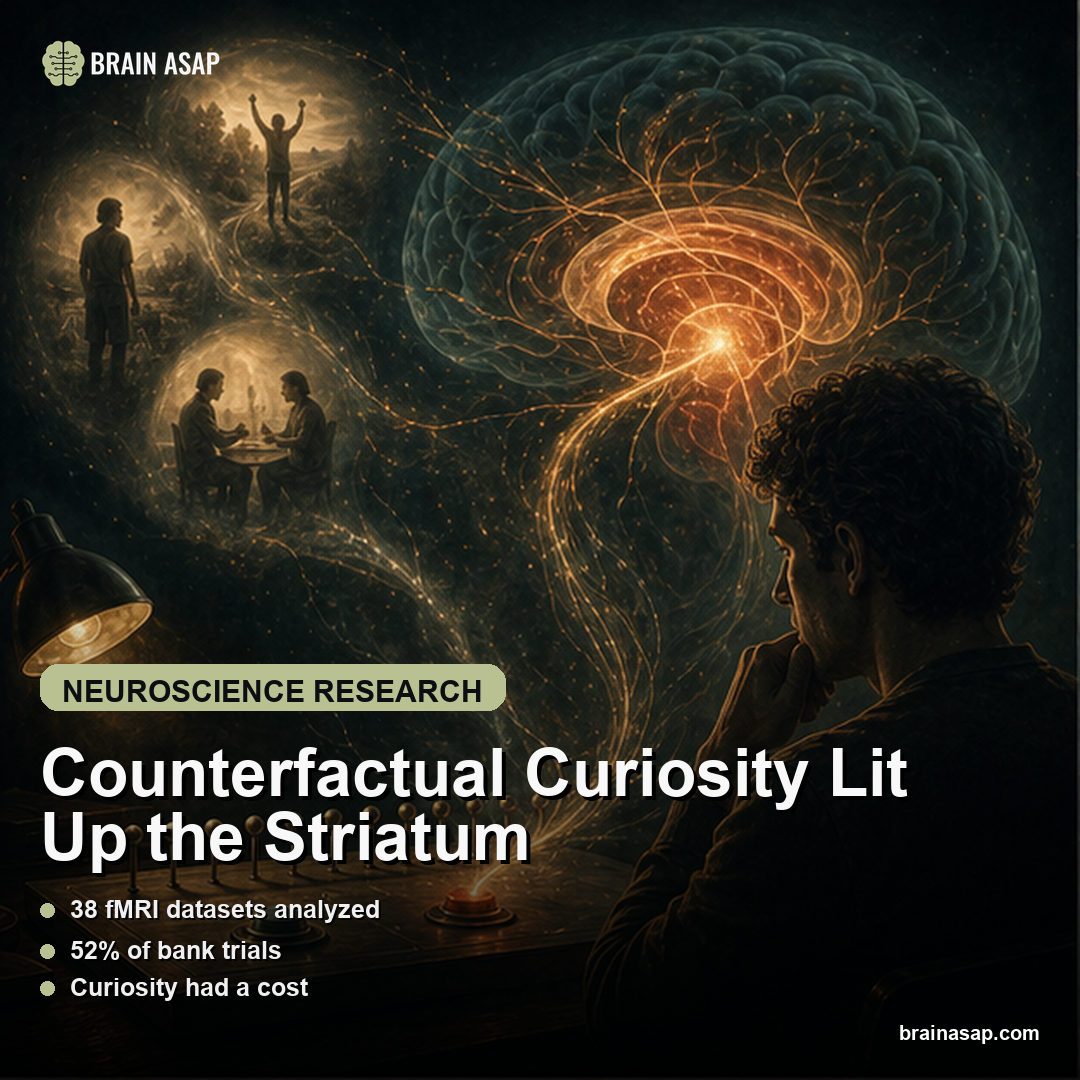
Counterfactual Curiosity Lit Up the Striatum
TL;DR: People paid a waiting cost to reveal a missed payoff in a balloon task, and reward-related striatum activity tracked both the choice to know and the size of the missed opportunity.
Key Findings
- Functional MRI kept 38 usable datasets: The study recruited 41 participants and excluded 3 for missing ratings or excessive movement. Functional MRI tracks blood-flow changes as a proxy for brain activity.
- Counterfactual information was chosen in 52% of bank trials: Participants often chose to see the hidden balloon limit even though it did not help the next balloon.
- Curiosity carried an emotional cost: Participants reported stronger negative emotion after learning how much more they might have won.
- The caudate tracked the choice to know: Reward-related striatal activity increased when participants decided to seek counterfactual information.
- Missed gains activated caudate and nucleus accumbens: Larger revealed missed opportunities produced stronger responses in reward-related regions.
Source: Social Cognitive and Affective Neuroscience (2026) | Lau et al.
Regret hurts, but people still go looking for it. After a choice is over, many of us want to know the alternate outcome: the house we missed, the stock we did not buy, the answer we almost gave.
This fMRI study turns that everyday impulse into a neural question. Why would the brain treat counterfactual information, information about an outcome that can no longer be chosen, as something worth pursuing?
A Balloon Task Made the Alternate Outcome Measurable
The researchers used an adapted Balloon Analogue Risk Task. In the standard version, a participant pumps a virtual balloon to earn points, but the balloon can pop if pushed too far.
In this version, participants banked their points and then chose whether to see the balloon’s hidden limit. That hidden limit revealed how many more points were available if they had kept pumping.
- Pump the balloon: each pump increased possible reward while also raising risk.
- Bank the trial: participants kept the points if they stopped before the hidden pop point.
- Choose whether to wait: after banking, they could spend time to reveal the counterfactual limit.
The reveal was emotionally meaningful but strategically useless. Each balloon had its own hidden limit, so knowing the previous limit did not tell participants how to play the next trial.
That design separated counterfactual curiosity from ordinary learning. If the reveal had helped participants predict the next balloon, the brain response is plausibly explained as strategy. Here, the information mainly answered a “what if?” question.
The task also made the counterfactual concrete. Participants were not asked to imagine an alternate life path; they saw a precise number showing how far they could have gone on that trial. That precision made regret measurable enough to study inside the scanner.
People Chose Useless Information About Half the Time
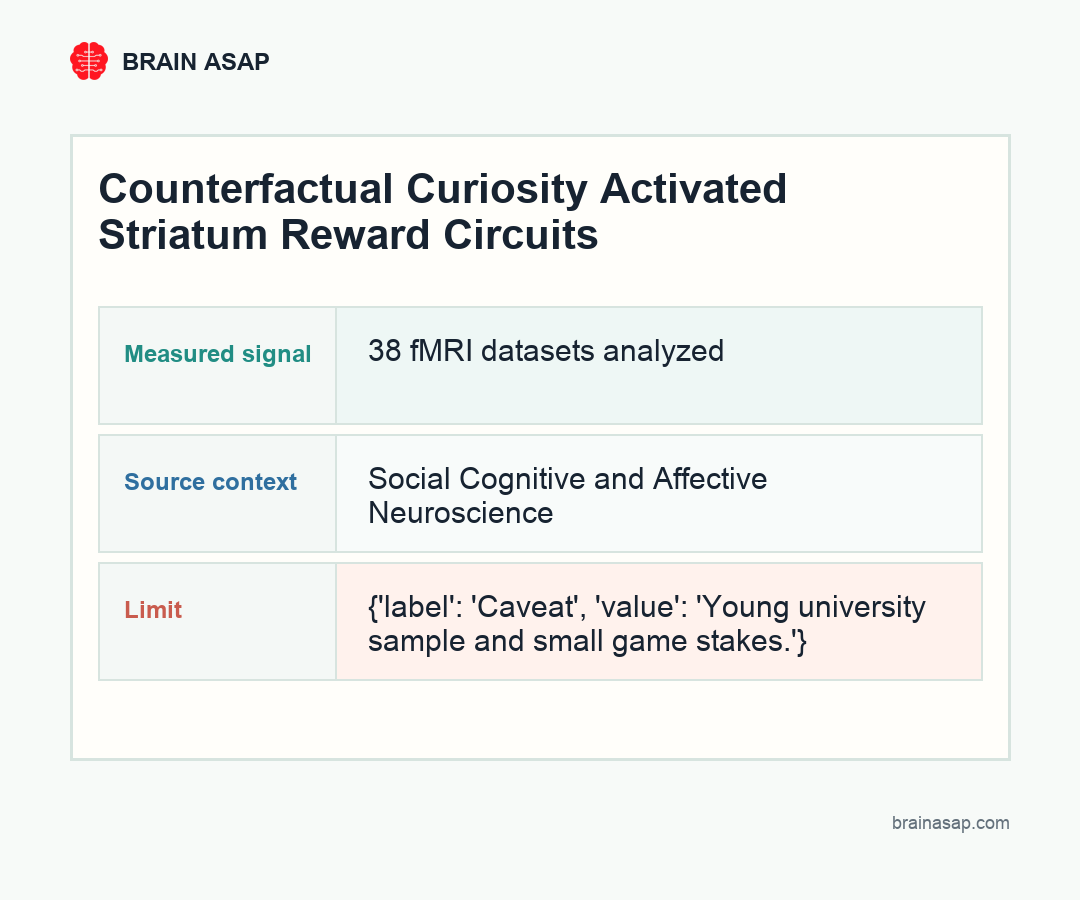
The final fMRI sample included 38 young adults. Participants chose to see the counterfactual outcome in about 52% of bank trials, despite a waiting cost of up to 6 seconds.
That behavior is important because the information was not free. Participants paid with time, and the answer could make them feel worse by revealing a larger missed gain.
They were more likely to seek the reveal when the stakes were higher and the waiting cost was lower. That pattern makes the behavior look like motivated wanting rather than idle curiosity.
The waiting cost is important because it turns curiosity into a choice with friction. Participants were not simply shown the answer; they had to decide whether the answer was worth a small delay.
That waiting cost also helps separate curiosity from automatic checking. If people still choose the reveal when it slows them down, the information has motivational value strong enough to compete with impatience.
The Caudate Activated Before the Answer Arrived
The caudate is part of the striatum, a set of deep brain structures involved in reward, motivation, action selection, and learning. In this study, the caudate was more active when participants chose to seek counterfactual information.
The reward-related response appeared during the choice to know, before the person learned whether the answer would be satisfying or painful.
The finding supports the idea that curiosity can have incentive value. The brain may treat information itself as something to pursue, even when that information has no practical use and carries emotional risk.
This is why the caudate result is so useful. It places counterfactual curiosity inside a reward-and-motivation system instead of treating it as a purely reflective or intellectual habit.
The fMRI result also fits prior work on curiosity as incentive salience, the “wanting” component of motivation. People can want information before they know whether the content will feel good.
Missed Gains Also Pulled in the Nucleus Accumbens
After the reveal, activity depended on what the counterfactual showed. When participants discovered that they could have won more points, the caudate and nucleus accumbens responded more strongly.
The nucleus accumbens is another striatal region strongly tied to reward and motivation. Its involvement helps explain why a painful answer can still feel compelling: the missed opportunity is processed through reward circuitry, not only through regret or disappointment.
The behavioral ratings showed a real emotional cost: participants felt more negative emotion after seeking counterfactual information. The same reveal can satisfy the urge to know and create regret.
Counterfactual Curiosity Is Different From Useful Learning
Some curiosity is adaptive because it improves future decisions. A student checks an explanation, a clinician reviews a missed diagnosis, or a trader studies a bad call to improve the next one.
The balloon task separated that adaptive learning story from pure counterfactual curiosity. The hidden limit was random from trial to trial, so the reveal did not help participants predict the next balloon.
That separation is why the study is interesting. It shows that the motivational pull of “what could have happened” can survive even when the answer has no strategic value.
The Study Explains the Pull, Not Every Real-Life Regret
The sample was young, university-based, and the stakes were game points. A lab balloon task is not the same as checking an ex-partner’s life, reviewing a financial miss, or replaying a medical decision.
Still, the mechanism travels surprisingly well. Counterfactual checks often promise closure while risking pain. The striatum result suggests that the drive to resolve the alternate outcome can be rewarding before the answer is even known.
The result does not make curiosity bad. It shows that curiosity has more than one flavor. Some information helps us learn; some information mainly rewards the urge to know; some does both while leaving us with regret.
That distinction can help explain why counterfactual checking becomes sticky. Once the alternate outcome is available, the decision is no longer only about usefulness. It is also about whether the brain wants uncertainty resolved.
That has obvious limits, but it clarifies everyday behavior. Rechecking a missed opportunity can feel irrational from a planning perspective while still making sense as reward-driven information seeking.
The study also leaves open whether people can learn to regulate this pull. A future experiment could test whether reminders about emotional cost, mindfulness strategies, or repeated exposure to useless counterfactuals changes the choice to reveal the alternate outcome.
That would move the work closer to habits people recognize outside the scanner: checking a result that cannot be changed, then paying for the answer with frustration, rumination, or regret.
Paper: Role of the striatum in counterfactual information seeking. Social Cognitive and Affective Neuroscience. 2026;21(1):nsag012. DOI: 10.1093/scan/nsag012
Authors: Lau et al.
Study Design: fMRI decision-making study using an adapted Balloon Analogue Risk Task.
Sample Size: 38 analyzed participants after exclusions from 41 recruited participants.
Key Statistic: Participants sought counterfactual information in 52% of bank trials, and caudate/nucleus accumbens activity tracked information seeking and missed-opportunity size.
Caveat: Young university sample and game-point stakes; the result explains a mechanism, not every real-world regret decision.