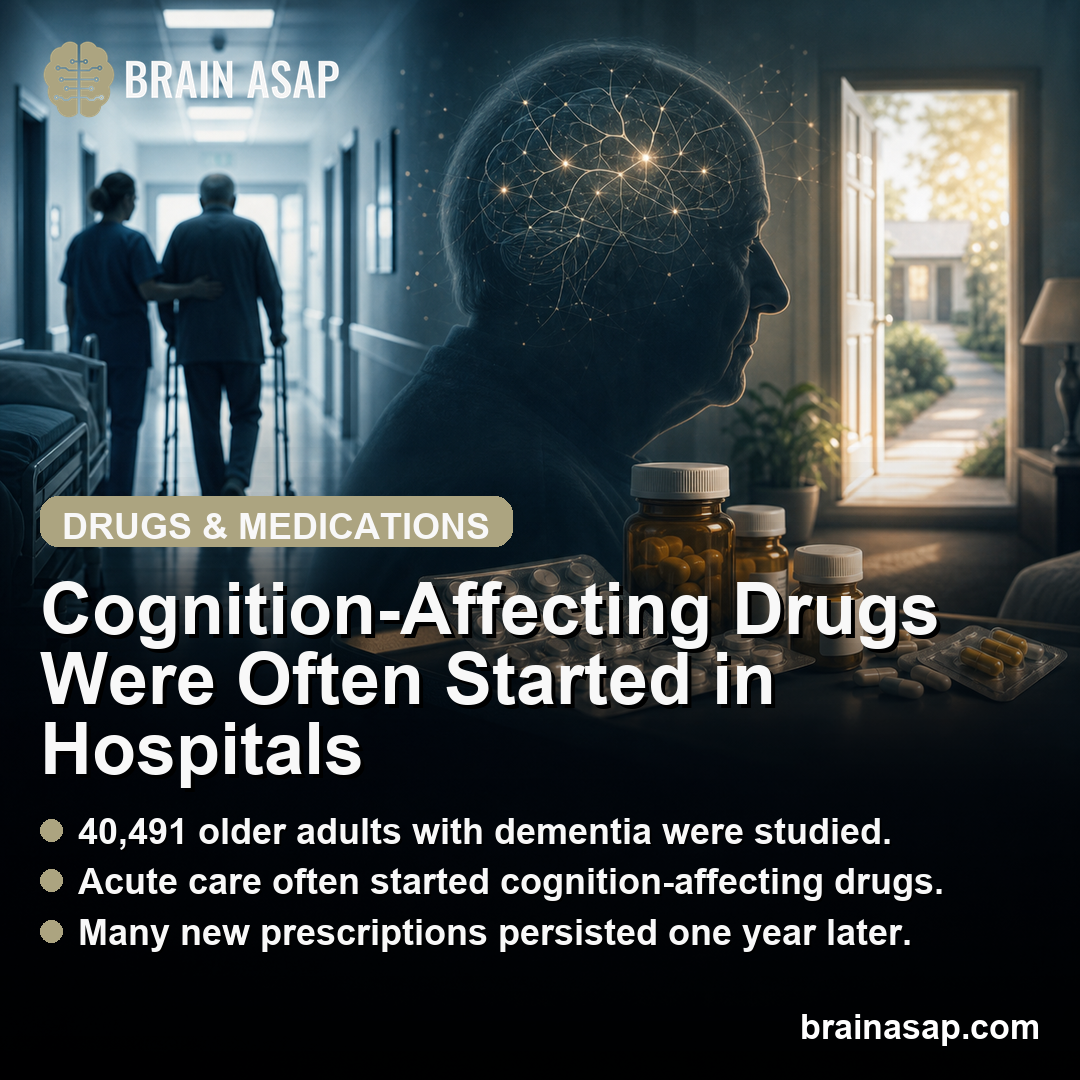
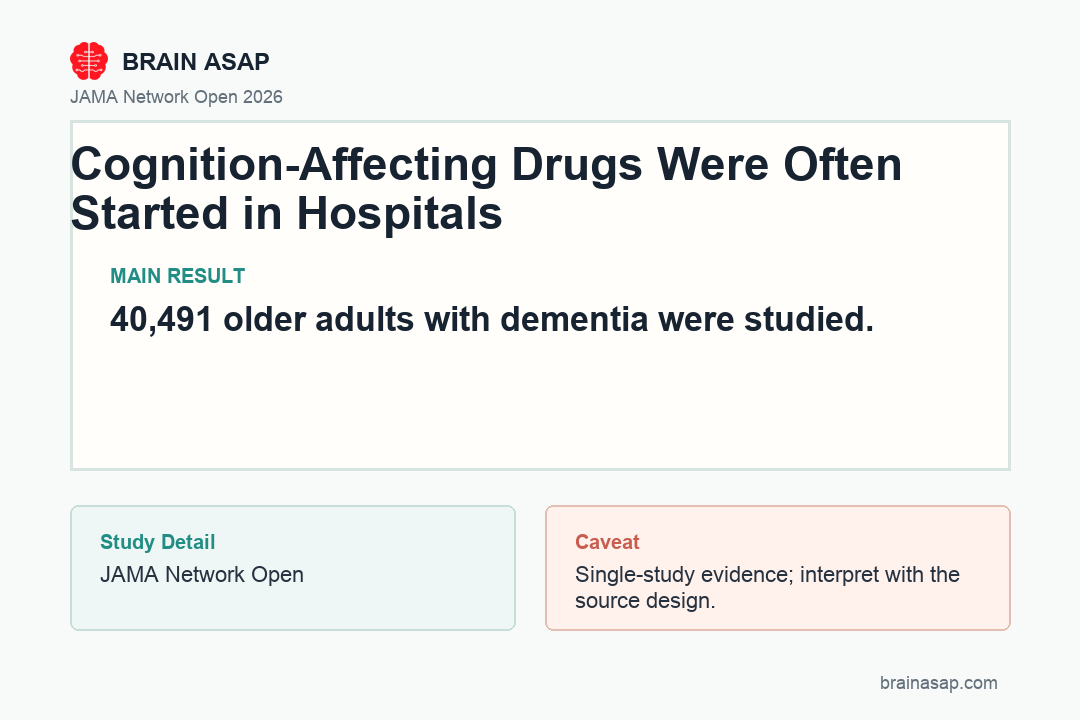
TL;DR: A 2026 study in JAMA Network Open analyzed Medicare claims for adults 66+ from 2008 to 2021 and found that cognition-altering medications — antipsychotics, benzodiazepines, hypnotics, anticholinergics — were disproportionately initiated in emergency rooms, hospitals, and skilled nursing facilities rather than doctors’ offices, especially in dementia patients (43% of antipsychotic starts vs 22% of overall visits), with over half of dementia patients still taking the medication a year later.
Key Findings
- Acute and post-acute settings disproportionately initiated cognition-altering meds: 43% of antipsychotic prescriptions in dementia patients were initiated in acute/post-acute settings, while only 22% of overall patient visits in dementia patients were to such settings.
- Dementia patients were the highest-risk subgroup: 22% of dementia patients received a new prescription for these medications in acute/post-acute settings vs 14% of cognitively unimpaired adults.
- Prescriptions were “sticky” and persistent: 51% of dementia patients started on these medications were still taking them a year later, vs 38% of cognitively unimpaired adults.
- Four medication classes analyzed: Benzodiazepines, nonbenzodiazepine hypnotics, antipsychotics, and anticholinergics — each independently associated with falls, delirium, and confusion in older adults.
- Medicare-linked Health and Retirement Study cohort: Adults 66+ followed across 13 years of Medicare fee-for-service claims, with prescription initiation tracked by clinical setting.
- Implication: target deprescribing efforts at acute/post-acute settings: If most risky prescriptions start in ERs, hospitals, and skilled nursing facilities, that is where reduction interventions should be focused.
Source: JAMA Network Open (2026) | Ly et al.
Antipsychotics, benzodiazepines, sleep medications, and anticholinergic drugs are widely prescribed in older adults despite known harms: increased fall risk, delirium, confusion, and hospitalization.
Public-health and clinical efforts have been pushing to reduce prescriptions of these cognition-altering medications, but the question of where they actually get started has been understudied.
This UCLA research letter mapped the clinical settings where new prescriptions are initiated, with a particular focus on dementia patients who are most vulnerable to the side effects.
Medicare Claims Linked to the Health and Retirement Study, 2008-2021
The team led by Dr. Dan Ly at UCLA’s David Geffen School of Medicine analyzed a long-running cohort linked to Medicare claims data.
The study design:
- Cohort: Health and Retirement Study (HRS) participants aged 66+ linked to Medicare fee-for-service claims.
- Time window: January 1, 2008 through December 31, 2021.
- Medication classes: Benzodiazepines, nonbenzodiazepine hypnotics, antipsychotics, and anticholinergics — the four major classes affecting cognition in older adults.
- Primary measurement: Clinical setting where each new prescription was initiated (acute/post-acute settings including ERs, hospitals, and skilled nursing facilities vs doctors’ offices).
- Patient stratification: Three groups — no cognitive impairment, cognitive impairment but not dementia (CIND), and dementia.
The methodological comparison was initiation location versus the baseline distribution of patient visits. If 43% of antipsychotic starts happen in acute settings while only 22% of dementia visits are to those settings, the over-representation is the actionable signal.
Acute Settings Initiated Far More Cognition-Altering Prescriptions Than Their Visit Share Predicts
The over-representation pattern was clearest in the dementia subgroup.
The acute/post-acute initiation rates by patient group:
- Dementia patients: 22% received new prescriptions in acute/post-acute settings.
- Cognitive impairment but not dementia (CIND): 17%.
- No cognitive impairment: 14%.
The dementia-vs-baseline contrast for antipsychotics specifically:
- 43% of antipsychotic prescriptions in dementia patients started in acute/post-acute settings.
- Only 22% of overall visits in dementia patients were to those settings.
The roughly 2-fold over-representation is the empirical anchor of the paper’s policy claim. Dementia patients were getting started on antipsychotics in ERs, hospitals, and nursing facilities at a rate far above what their normal visit pattern would predict.
The Prescriptions Were “Sticky” Across the Year
Drug initiation in acute settings might be defensible if the prescriptions were short-term and discontinued at discharge. The data show otherwise.
One-year persistence rates:
- No cognitive impairment: 38% still taking the medication a year later.
- CIND: 44% still taking it.
- Dementia: 51% still taking it.
The persistence pattern matters because antipsychotics and benzodiazepines can affect cognition, increase delirium risk, and increase fall risk in older adults. The combination of high initiation in acute settings plus high one-year persistence means temporary safety prescriptions in ERs and hospitals can become long-term parts of older adults’ medication lists.
Why Acute Settings Are the Locus
The clinical context behind the over-representation is straightforward:
- Acute behavioral crises: Hospitals and ERs often face severe agitation, especially in dementia patients with sundowning or delirium.
- Immediate safety pressure: Clinicians may use antipsychotics or sedatives to ensure short-term safety in chaotic settings.
- Limited follow-through: Discharge planning rarely includes a structured deprescribing step, so the temporary fix becomes a permanent part of the medication list.
- Skilled nursing facilities continue the pattern: Post-acute facilities receive patients already on these medications and often continue them by default.
That picture explains why office-based deprescribing efforts have had limited impact — they are operating downstream of where the prescriptions actually start.
Claims-Based Inference, Last-Setting Assumption, and Provider Characteristics Stay Open
- Claims-based design: The analysis used Medicare claims rather than direct chart review. The data captured what was billed, not necessarily the full clinical context that drove the decision.
- Last-setting assumption: The researchers assumed the last clinical setting before the prescription appeared was where it was initiated. Some prescriptions may have been initiated elsewhere and continued from the last visit.
- Provider characteristics not analyzed here: Whether specific provider types or training levels disproportionately initiate these medications is the next research question.
- Clinical justification not assessed: The Ly team’s prior work found up to 70% of CNS-active medication prescriptions lacked a documented clinical indication. Whether the acute-setting initiations in this dataset would meet a documented-indication standard was not directly evaluated.
- No randomization: Patients are not randomly assigned to acute vs office settings, so the comparison reflects where prescriptions happened, not which setting causes more prescribing.
Deprescribing Efforts Should Be Targeted at ERs, Hospitals, and Skilled Nursing Facilities
The actionable framing follows from the over-representation pattern:
- Acute and post-acute settings are the highest-leverage targets: Interventions to reduce risky cognition-altering prescriptions will have the greatest impact if focused on ERs, hospitals, and skilled nursing facilities, not on outpatient deprescribing alone.
- Dementia patients warrant the closest attention: The over-representation was largest in this subgroup, who are also most vulnerable to the side effects.
- Discharge protocols need a deprescribing step: A structured medication review before transition out of acute care could prevent temporary prescriptions from becoming permanent ones.
- Skilled nursing facility intake protocols matter: SNFs receiving patients already on these medications could implement default review-and-discontinue protocols rather than continuing prescriptions by inertia.
The policy implication is direct: acute and post-acute care settings are the first places to target if the goal is to prevent risky short-term prescriptions from becoming persistent medication use.
Citation: DOI: 10.1001/jamanetworkopen.2026.10234. Ly D, Yang A, Leng M, Sarkisian C, Damberg C, Mafi JN. Initiation Setting and Persistence of Medications Affecting Cognition in Older Adults. JAMA Network Open. 2026.
Study Design: Retrospective claims-based analysis using Health and Retirement Study (HRS) participants aged 66+ linked to Medicare fee-for-service claims from 2008 to 2021.
Sample Size: Adults 66+ in the HRS-Medicare linked dataset, stratified by no cognitive impairment, CIND, and dementia.
Key Statistic: 43% of antipsychotic prescriptions in dementia patients initiated in acute/post-acute settings vs 22% of overall dementia visits to those settings; 51% of dementia patients started on these medications still taking them a year later vs 38% in cognitively unimpaired adults.
Caveat: Claims-based analysis cannot capture full clinical context; last-setting assumption may misclassify some initiations; provider-level characteristics not analyzed; documented clinical indication not assessed; no randomization, so the over-representation is descriptive, not causally interpreted.