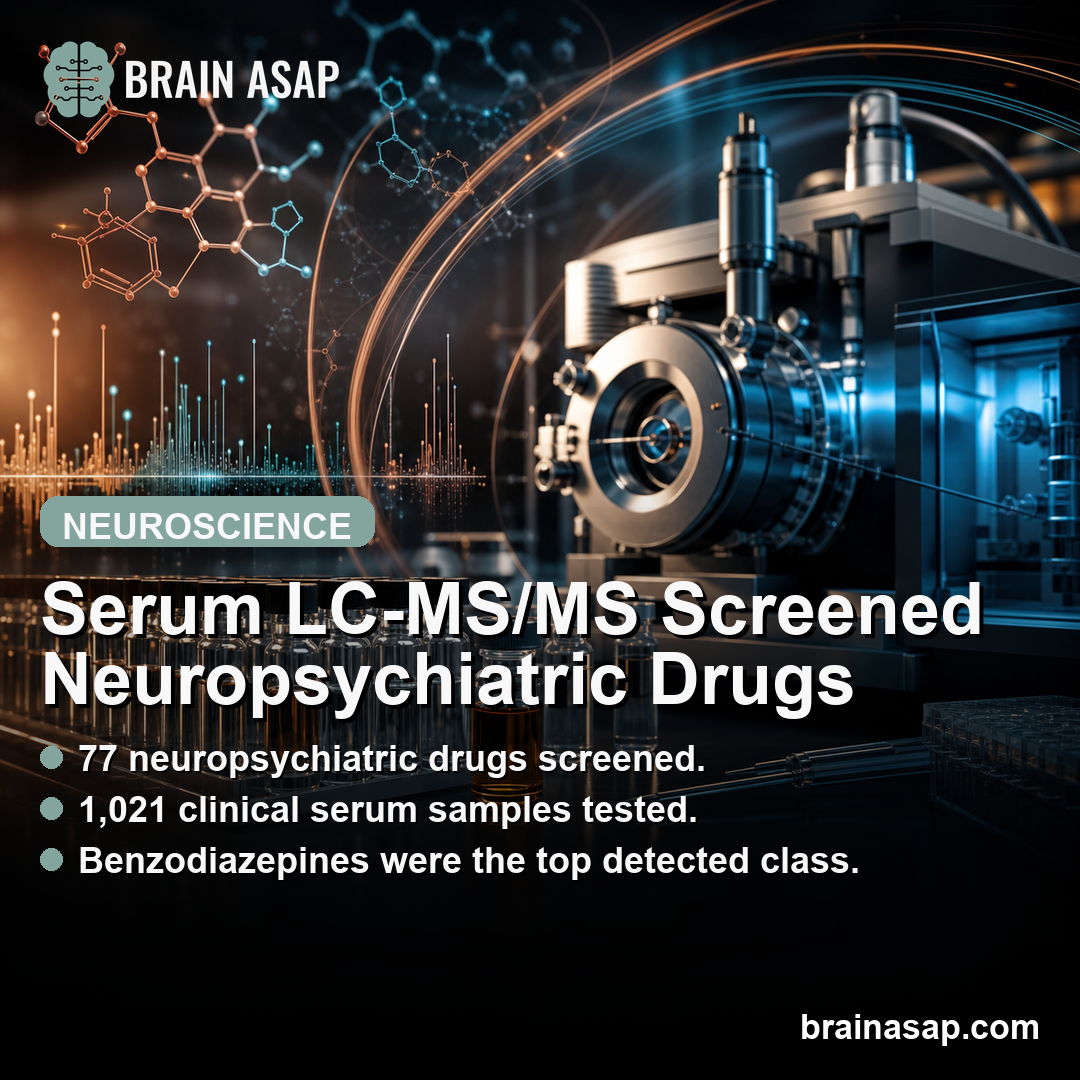
TL;DR: A 2026 study in Drug Design, Development and Therapy validated liquid chromatography-tandem mass spectrometry (LC-MS/MS), a high-specificity lab method, to screen serum for 77 neuropsychiatric drugs and then applied it to 1,021 clinical specimens over 3 years.
Key Findings
- 77 drugs screened: Researchers developed a serum LC-MS/MS method for simultaneous qualitative identification of neuropsychiatric medications and related analytes.
- 20 microliters of serum: The method used a small sample volume and simple protein precipitation, with preparation time under 15 minutes per batch.
- 1,021 specimens tested: The assay was applied to clinical serum specimens collected during 3 years of use.
- Strong validation metrics: Mean recovery was 93.1%, matrix effects averaged 99.9%, and accuracy testing showed 100% agreement for 60 analytes.
- Benzodiazepines led detections: The most frequently detected drug classes were benzodiazepines at 37.9%, antidepressants at 30.7%, and antipsychotics at 19.7%.
Source: Drug Design, Development and Therapy (2026) | Chong et al.
Neuropsychiatric drug screening is not only about illicit drug detection. In psychiatric and neurologic care, clinicians may need to know whether a patient took a prescribed drug, missed it, combined it with another medication, or arrived with acute intoxication.
The Chong study focused on serum rather than urine. Serum testing better reflects current exposure, while urine can remain positive after a drug has already moved out of the clinically immediate window.
Serum Screening Targeted Current Neuropsychiatric Drug Exposure
Many central nervous system drugs have narrow practical margins. Benzodiazepines, antidepressants, antipsychotics, anticonvulsants, and sedative-hypnotics can help patients when used correctly but can also contribute to overdose, sedation, dependence, or confusing emergency presentations.
Routine immunoassays are fast, but they are limited by cross-reactivity and by the number of compounds included in the test. LC-MS/MS offers higher chemical specificity and can screen many analytes in one run.
Researchers designed the assay for broad clinical use. The method covered 77 neuropsychiatric drugs, including medications relevant to psychiatry, neurology, emergency medicine, adherence monitoring, and intoxication workups.
The serum emphasis is important. A positive serum result can support a near-term medication history, while a negative or unexpected result can raise concern about non-adherence, undisclosed use, or timing differences.
That distinction is especially relevant for drugs that change alertness, coordination, mood, seizure threshold, or breathing. In those situations, knowing what is present in serum can help clinicians separate a psychiatric relapse, neurologic event, medication effect, or mixed intoxication.
Serum testing also fits adherence work. If a patient is prescribed an antipsychotic, antidepressant, or anticonvulsant but the expected compound is absent, the lab result can support a more direct medication conversation.
That conversation can be safer when framed clinically rather than punitively. Non-adherence may reflect side effects, cost, confusion, sedation, symptom relapse, or a deliberate decision that the treatment team needs to understand.
LC-MS/MS Method Used 20 Microliters and a 15-Minute Run
The analytical workflow used liquid chromatography-tandem mass spectrometry (LC-MS/MS). Liquid chromatography separates compounds in the sample, and tandem mass spectrometry identifies them by ion transitions and product-ion spectra.
The method used 20 microliters of serum, a small volume for clinical testing. Sample preparation relied on simple protein precipitation and took less than 15 minutes per batch.
- Chromatography time: Separation was completed in 15 minutes.
- Identification strategy: Multiple reaction monitoring was followed by information-dependent enhanced product-ion scans.
- Low concentration support: The method was configured to detect low-concentration analytes while limiting false-positive triggers from background noise.
Those details shape clinical adoption because an assay cannot only work under ideal research conditions. It must fit routine laboratory handling, small sample volumes, and complex serum chemistry.
The method also used multiple transitions and enhanced product-ion scans to strengthen identification. That extra confirmation helps when chemically related drugs or metabolites can otherwise look similar in a busy clinical laboratory.
Validation Showed 93.1% Recovery and 99.9% Matrix Effects
Human serum contains proteins and lipids that can interfere with mass-spectrometry assays. The study therefore evaluated precision, accuracy, recovery, matrix effects, selectivity, and interference.
Validation results were broadly supportive. Mean recovery was 93.1%, and mean matrix effects were 99.9%, suggesting the sample matrix did not strongly distort the assay response on average.
Accuracy was assessed for 60 of the 77 analytes and showed 100% agreement. Calculated concentration precision had coefficients of variation below 30%, while retention-time precision stayed below 1.5%.
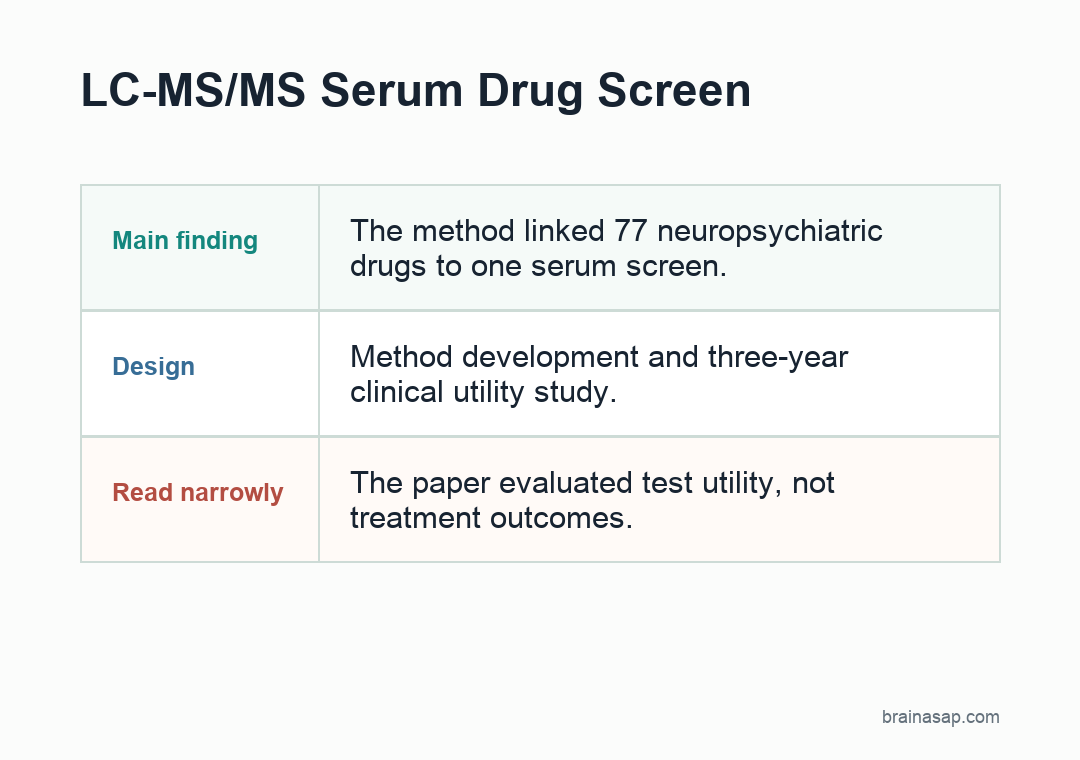
This was a qualitative identification method, not a full therapeutic drug monitoring panel for every medication. Still, accurate identification can answer the immediate question of whether a drug is present in serum.
Qualitative screening can therefore sit upstream of more targeted testing. A broad screen can identify likely exposures first, then clinicians can order quantitative confirmation when dose, toxicity threshold, or therapeutic range becomes the key decision.
This staged approach is common in laboratory medicine. Broad identification narrows the field, and narrower quantitative assays answer more specific clinical questions once the likely compound is known.
Benzodiazepines Were the Most Commonly Detected Class
After validation, researchers applied the method to 1,021 clinical serum specimens. Most orders came from psychiatry and neurology outpatients, but emergency medicine specimens had a higher positivity rate despite fewer orders.
The detected drug-class pattern matched common clinical concerns. Benzodiazepines accounted for 37.9% of detected classes, followed by antidepressants at 30.7% and antipsychotics at 19.7%.
- Common benzodiazepine marker: Clonazepam or 7-aminoclonazepam appeared in 10.2% of specimens.
- Common sedative finding: Lorazepam appeared in 10.0% of specimens.
- Clinical use case: The assay helped verify medication history, non-adherence, and possible acute intoxication.
Emergency presentations can be difficult because sedation, confusion, agitation, seizure risk, or respiratory depression may have several possible causes. A broad serum screen can narrow the medication part of that differential.
Outpatient use is different but still important. Psychiatry and neurology clinics often manage polypharmacy, and a broad screen can show whether a medication list matches current exposure better than patient recall alone.
Polypharmacy also increases the chance of unexpected combinations. A serum screen can reveal sedatives, antidepressants, antipsychotics, or anticonvulsants that may contribute to falls, confusion, or treatment nonresponse.
Broad Drug Screens Need Clinical Context to Avoid Overinterpretation
The study supports broad-spectrum serum screening as a laboratory tool, but the result still needs clinical context. Detection does not automatically prove toxicity, and non-detection does not exclude earlier use outside the serum detection window.
Medication timing, dose, metabolism, liver function, sample timing, and co-ingested substances all affect interpretation. A serum result works best when combined with history, prescription records, symptoms, and other laboratory findings.
The practical gain is speed and scope. A method that screens many neuropsychiatric drugs from a small serum sample can help clinicians reconcile what a patient was prescribed, what is present now, and whether the medication pattern fits the clinical presentation.
The study also shows why broad panels need local validation. A 77-analyte method has clinical value only if the laboratory can demonstrate acceptable recovery, interference handling, retention-time stability, and identification performance for the compounds it reports.
For psychiatric and neurologic care, that kind of assay can make drug exposure less guesswork-heavy. The study’s strongest contribution is showing that a broad serum LC-MS/MS panel can be validated and used at clinical scale.
Citation: DOI: 10.2147/DDDT.S585730. Chong et al. Targeted Comprehensive Screening of Neuropsychiatric Drugs in Serum by LC-MS/MS: Method Development and Three-Year Clinical Utility. Drug Design, Development and Therapy. 2026.
Study Design: Analytical method development, validation, and retrospective clinical utility evaluation.
Sample Size: 1,021 clinical serum specimens tested over 3 years.
Key Statistic: The assay screened 77 analytes; benzodiazepines were the most frequently detected class at 37.9%.
Caveat: Serum detection identifies current exposure but must be interpreted with timing, dose, symptoms, and clinical history.