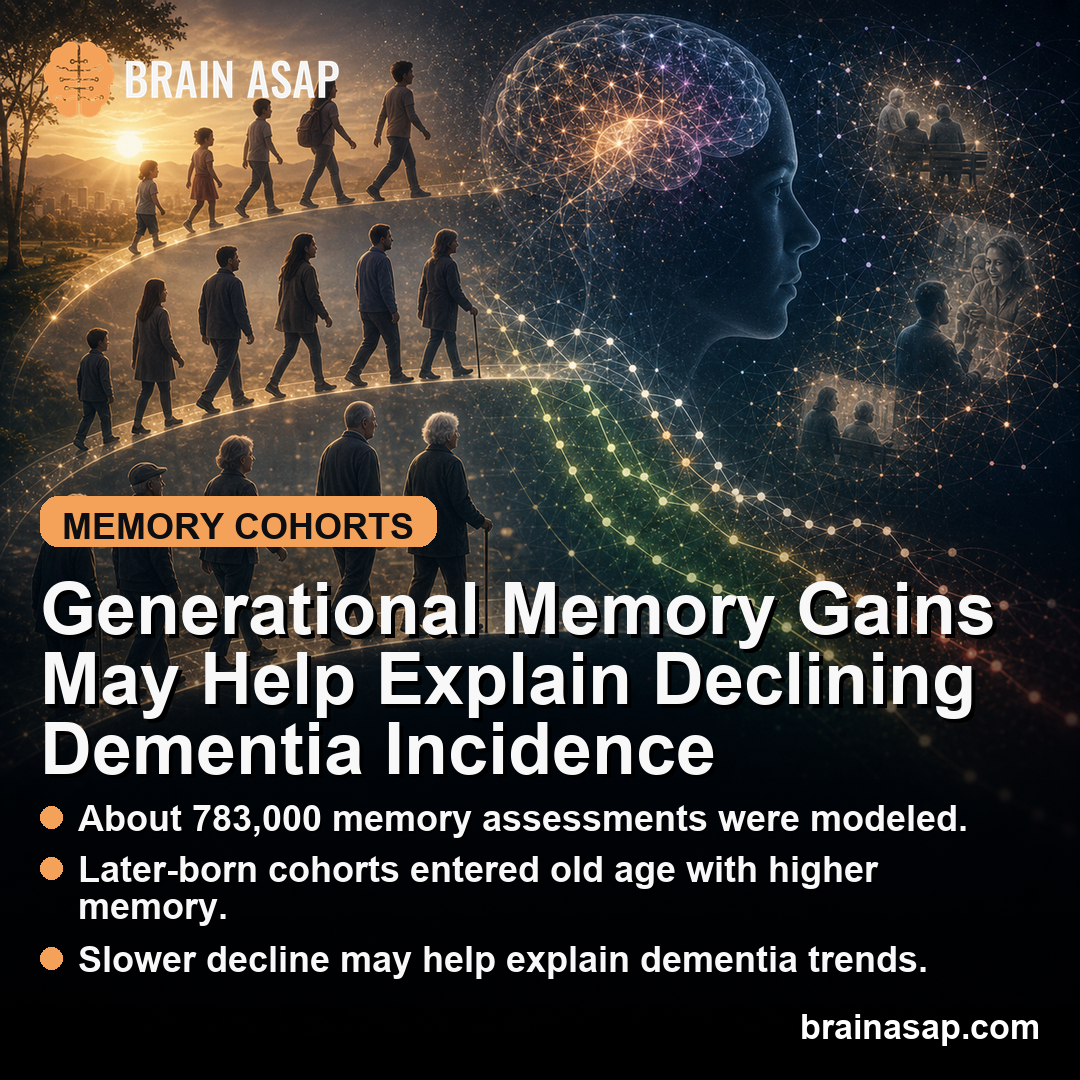
TL;DR: A 2026 preprint longitudinal cohort analysis in medRxiv found that later-born cohorts showed higher memory levels entering old age and slower rates of memory decline, while the projected 20-year cohort advantage at age 80 was large enough in the model to account for a reported 13% per-decade decline in dementia incidence.
Key Findings
- Birth-cohort modeling: Researchers compared memory level, memory decline, and dementia-incidence trends across cohorts.
- Large memory dataset: The analysis used about 783,000 episodic memory assessments from about 219,000 people.
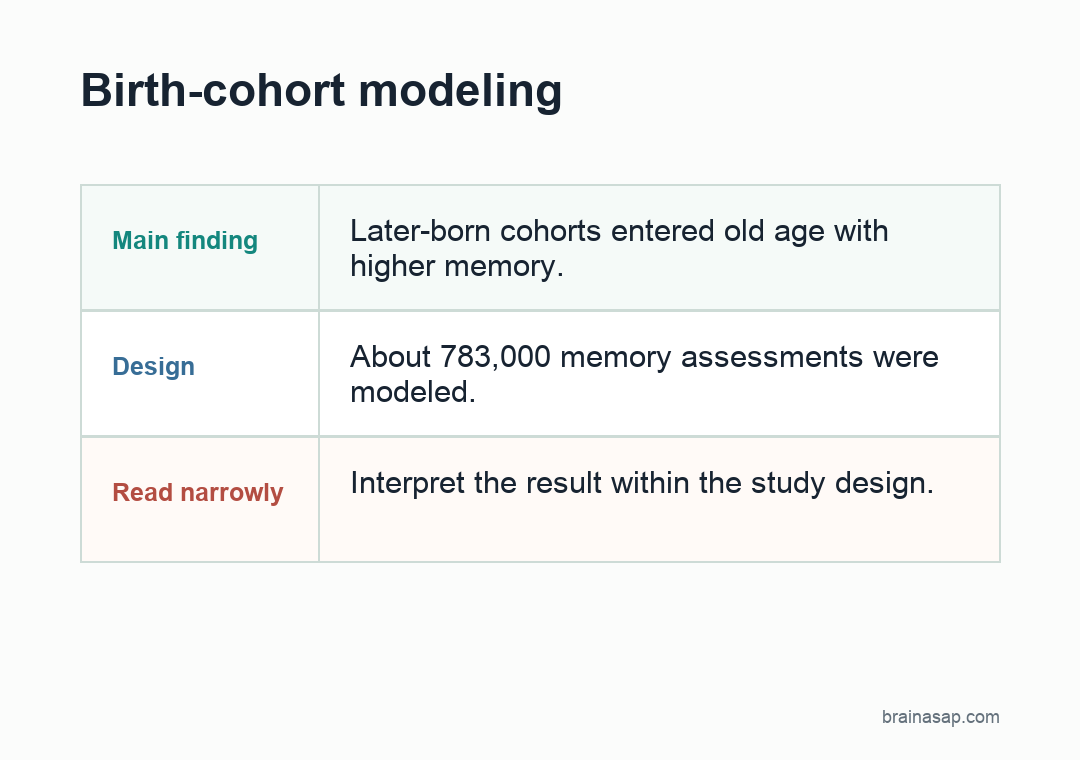
- Main result: Later-born cohorts showed higher memory levels entering old age and slower rates of memory decline.
- Incidence model: The projected 20-year cohort advantage at age 80 was large enough to account for a reported 13% per-decade decline in dementia incidence.
- Caution: Memory trends can help explain dementia incidence trends but do not prove the whole population-level cause.
Source: medRxiv (2026) | Fjell et al.
Dementia incidence has declined in several Western populations, but the reason remains debated. Possibilities include better education, cardiovascular health, cognitive reserve, survival patterns, and diagnostic changes.
This preprint focused on memory itself. It asked whether later-born cohorts enter old age with stronger memory and then decline more slowly.
The important claim is population-level: later-born cohorts entered old age with higher memory levels and slower memory decline. The analysis asks whether those cohort gains help explain falling dementia incidence.
Five Cohorts Provided 783,000 Memory Assessments
Design: a cohort modeling study of birth-cohort differences in memory level, memory decline, and dementia-incidence trends. Sample: about 783,000 episodic memory assessments from about 219,000 people across five longitudinal cohorts.
The study drew on five cohorts and a very large memory-assessment pool. Large-scale repeated testing helps birth-cohort modeling, but it still cannot isolate every historical cause of dementia trends.
Episodic memory is a practical outcome for this question because it changes before many dementia diagnoses. Cohort-level memory shifts can therefore appear before clinical incidence changes are fully visible.
The analysis also treats memory as a population measure, not just an individual test score. Education, vascular health, occupational complexity, nutrition, and survival all shape the average cognitive baseline that later cohorts bring into old age.
- Scale: The analysis used about 783,000 memory assessments.
- People: About 219,000 individuals contributed data.
- Cohorts: Five longitudinal cohorts were included.
- Outcome: The focus was episodic memory level and stability.
Later-Born Cohorts Entered Old Age With Higher Memory
The main result is the cohort pattern: higher memory at older ages and slower decline among later-born groups. The cohort pattern is consistent with changing cognitive reserve before diagnosis.
The projected 20-year cohort advantage at age 80 was large enough in the model to account for a reported 13% per-decade decline in dementia incidence. That is an explanatory model, not a single-cause proof.
Measurement detail: memory assessments can capture population shifts before dementia is diagnosed. They do not fully explain vascular care, education, survival, diagnosis practices, or competing mortality.
The finding gives dementia-incidence decline a measurable cognitive pathway. The model links cohort memory level, memory slope, and reported incidence decline instead of treating the trend as a vague public-health improvement.
- Population anchor: About 219,000 people contributed memory data across five cohorts.
- Measurement anchor: The main outcome was episodic memory level and change over time.
- Model anchor: The projected age-80 cohort advantage matched a reported dementia-incidence decline.
- Boundary: The model does not identify which education, vascular, lifestyle, or survival factors produced the memory advantage.
Next test: the strongest follow-up would connect cohort memory gains to specific drivers such as education, blood pressure treatment, smoking decline, physical activity, and diagnostic practice.
A second follow-up would test whether the same memory advantage appears outside Western cohorts. A global version of the analysis would show whether the pattern reflects broad prevention gains or region-specific history.
Policy relevance: if cohort memory advantages track education, vascular prevention, or later-life health access, dementia prevention becomes a long-run population project rather than only a clinic-by-clinic treatment problem in older adults over time.
Memory Decline Was Slower in Later Cohorts
Memory assessments can capture population shifts before dementia is diagnosed. They do not fully explain vascular care, education, survival, diagnosis practices, or competing mortality.
The clearest interpretation is that generational memory gains are one plausible contributor to declining dementia incidence, not the whole explanation.
The finding is still important because it connects prevention to population conditions across the life course, not only late-life clinical treatment.
Dementia Incidence Trends Have Multiple Explanations
Main limitation: memory trends can help explain dementia incidence trends but do not prove the whole population-level cause.
- Preprint status: The analysis needs peer review.
- Population scope: Western cohort trends do not necessarily generalize globally.
- Dementia diagnosis: Incidence depends on clinical and diagnostic context.
- Mechanism: Education, vascular health, and survival all remain candidate explanations.
Dementia incidence is shaped by many forces. Memory trends are one plausible piece, but not the whole mechanism.
Population Memory Gains Fit Dementia Prevention Models
Practical takeaway: dementia prevention partly depends on cohort conditions that improve memory before old age.
- Best use: Use the memory-cohort pattern as one explanation for falling dementia incidence.
- Do not overread: Do not treat it as proof that memory gains alone caused the population trend.
- Next question: Test which education, vascular, lifestyle, and social factors explain the cohort memory advantage.
This keeps the result bounded without pretending a complex population trend has one cause.
Citation: DOI: 10.64898/2026.04.14.26350835; Fjell et al.; Generational gains in memory capacity and stability may account for declining dementia incidence rates; medRxiv; 2026.
Study Design: A cohort modeling study of birth-cohort differences in memory level, memory decline, and dementia-incidence trends.
Sample Size: About 783,000 episodic memory assessments from about 219,000 people across five longitudinal cohorts.
Key Statistic: Later-born cohorts showed higher memory levels entering old age and slower rates of memory decline.
Caveat: The model links memory trends to dementia-incidence trends but does not prove a single population-level cause.