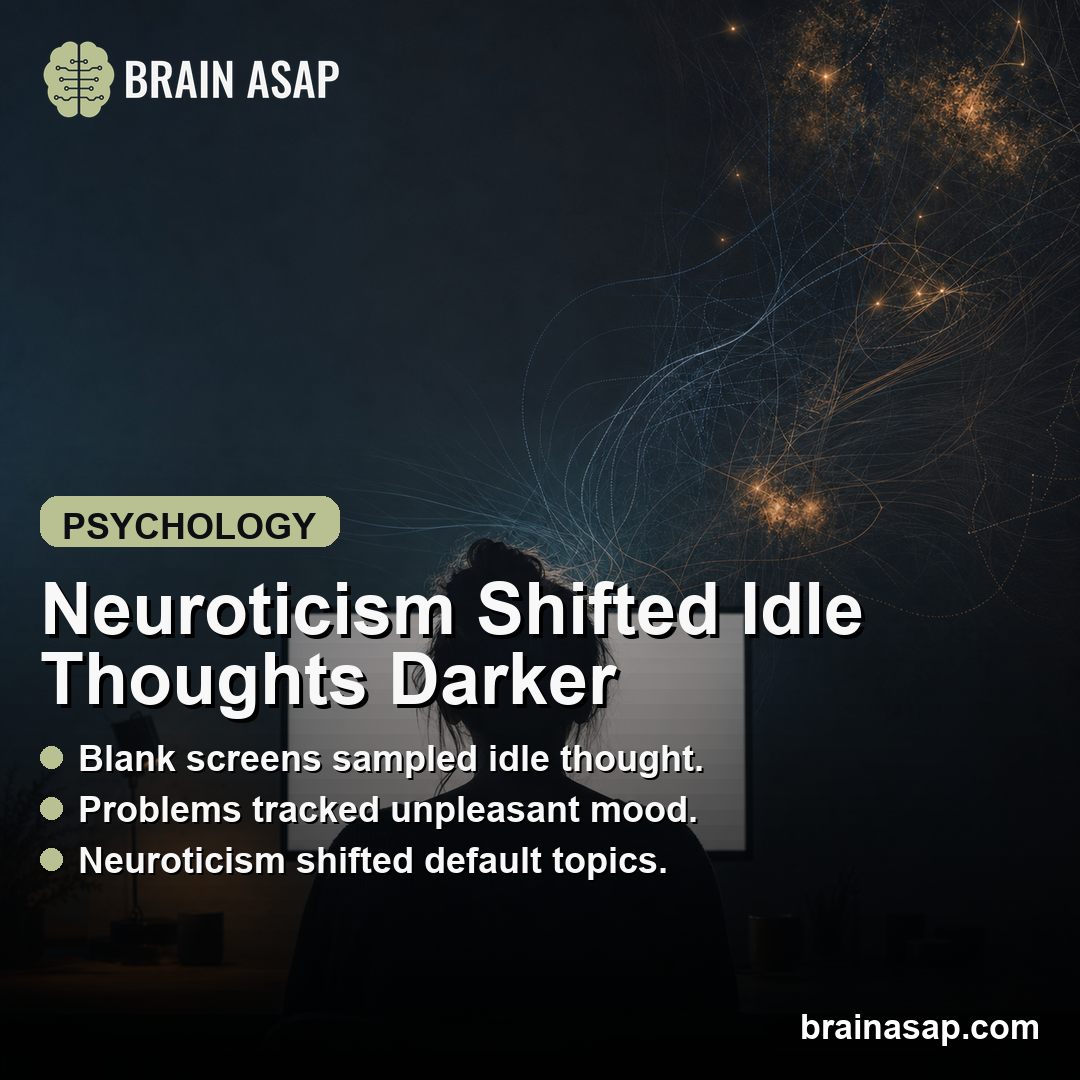
TL;DR: A 2026 study in Personality and Individual Differences found that people higher in neuroticism reported more problem- and uncertainty-focused thoughts during blank-screen rest periods, which tracked with more unpleasant feelings.
Key Findings
- Neuroticism was tested during idle thought: researchers used a blank-screen paradigm to sample what participants thought about when they had no task to perform.
- Problem thoughts tracked unpleasant mood: thinking about problems was linked to more unpleasant feelings during the same rest intervals.
- Positive topics tracked pleasant mood: thinking about good things, goals, or relationships was generally linked to more pleasant feelings.
- Higher-neuroticism participants defaulted darker: they reported more problem and uncertainty thoughts and fewer positive thought categories across the two studies.
- The design was correlational: the experiments measured default thought tendencies, but they do not prove that changing idle thoughts would directly lower neuroticism or distress.
Source: Personality and Individual Differences (2026) | Asad et al.
Blank-Screen Rest Made Default Thoughts Measurable
Neuroticism is a personality trait marked by greater vulnerability to stress, anxiety, sadness, and negative affect. Most research explains that vulnerability by looking at reactions to threats or stressful events.
This study tested a quieter possibility: people high in neuroticism may feel worse partly because their minds drift toward darker topics even when nothing stressful is happening.
Researchers used a blank-screen thought-sampling paradigm. Participants sat alone, stared at a mostly blank screen, and then rated what had been going through their minds during short rest periods.
The method matters because it shifts the question from “how did this person react to a negative event?” to “what does this person’s mind do when no task is imposed?”
Two Student Samples Rated Their Own Idle Thoughts
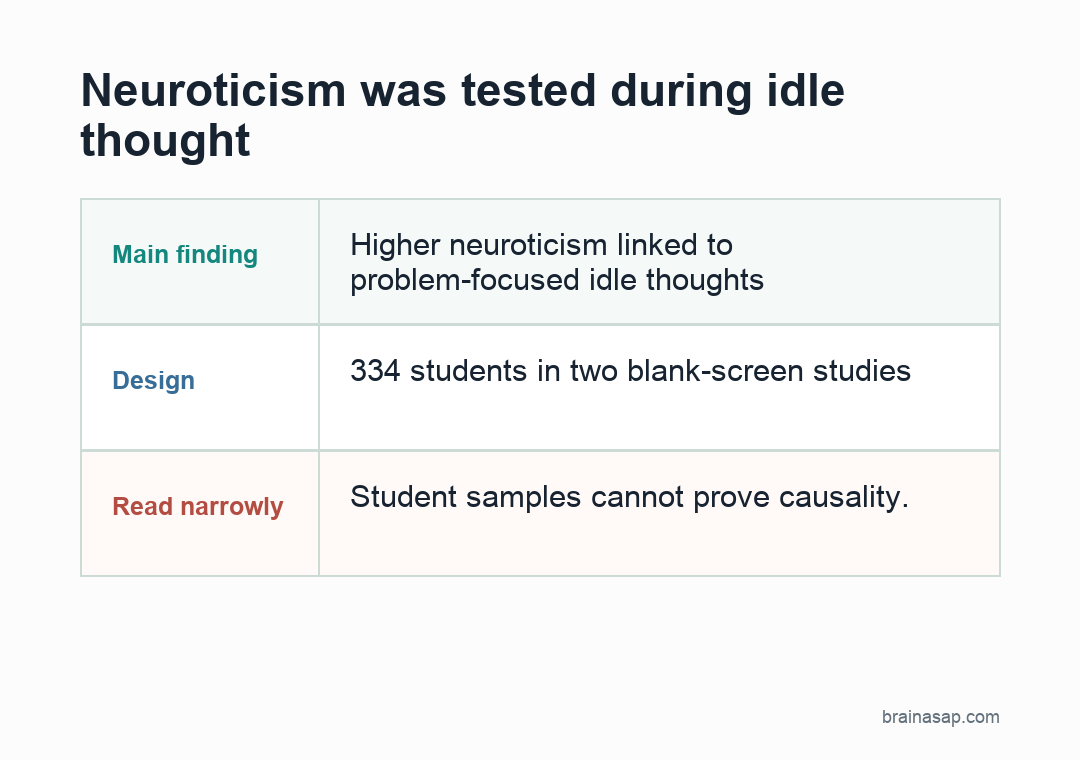
The research included 334 college students across two experiments. The first study had 154 participants; the second had 180 participants.
Both studies measured neuroticism first, then asked participants to complete blank intervals and report their thought content and momentary feelings.
- Study 1: participants completed six blank intervals lasting from 20 to 140 seconds, then rated thoughts about themselves, relationships, good things, and problems.
- Study 2: participants completed twelve blank intervals and used 0-100 sliding scales, with added categories for goals and uncertainties.
- Shared outcome: participants rated how pleasant or unpleasant they felt around the same rest periods.
The design did not require participants to solve a problem or respond to emotional images. It sampled spontaneous thought under low-stimulation conditions.
Problem and Uncertainty Thoughts Carried the Negative Pattern
Across the experiments, thought content and mood moved together in a direct way. Problem-focused thoughts predicted more unpleasant feelings, while good-things thoughts predicted more pleasant feelings.
The second study expanded the pattern. Thoughts about goals and relationships were linked to pleasant feelings, while thoughts about uncertainties were linked to unpleasant feelings.
Higher-neuroticism participants showed the expected default tendency:
- More negative default content: they spent more idle time thinking about problems and uncertainties.
- Less positive default content: they spent less idle time thinking about goals, good things, and relationships.
- More unpleasant affect: the thought pattern helped explain why higher neuroticism tracked with worse feelings during the task.
The study suggests a specific cognitive route from trait neuroticism to unpleasant feeling: resting attention may drift toward personally negative topics.
The Finding Fits Default-Mode and Mind-Wandering Research
The paper links older personality theories with newer work on mind-wandering and the default mode network, a brain network often active when people are not focused on an external task.
The study measured self-reported thought content during rest, not brain activity. The brain-network link is background context for why idle cognition is scientifically useful.
The evidence supports three concrete points:
- Idle moments are not empty: participants generated measurable streams of thought during brief blank intervals.
- Thought topics had emotional tone: positive and negative topics tracked pleasant and unpleasant feelings in the expected directions.
- Personality shaped the stream: higher neuroticism was associated with a more negative default thought mix.
This gives neuroticism research a target that sits between trait questionnaires and clinical symptoms. The target is the person’s default thought content under quiet conditions.
The Study Does Not Prove a Treatment Path Yet
The strongest limitation is that the study was correlational. Researchers did not experimentally train participants to change their idle thoughts, so the data cannot prove that thought redirection would reduce neuroticism or distress.
The sample also matters. Both experiments used college students, so the findings need replication in broader age groups, clinical populations, and real-world settings outside a lab room.
Several boundaries keep the result proportional:
- Measurement boundary: thought reports were self-ratings after short intervals, not continuous recordings of cognition.
- Population boundary: the participants were students, not a representative clinical sample.
- Causal boundary: the study cannot separate whether negative idle thoughts cause unpleasant mood, reflect it, or reinforce it over time.
Those limits do not make the result unimportant. They define the next step: testing whether default thought patterns are stable across days and whether changing them affects later mood.
Neuroticism May Involve What the Mind Chooses by Default
Neuroticism may involve more than stronger reactions to bad events.
It may also involve a default attentional pull toward problems, uncertainties, and fewer positive themes when the mind is left alone.
That framing helps explain why high-neuroticism people can feel distressed without an obvious trigger. The trigger may be internal thought content rather than an external stressor.
For mental-health research, the blank-screen paradigm gives a controlled way to study that internal trigger. It can test whether personality-linked thought streams predict anxiety, depression, or daily mood shifts better than standard questionnaires alone.
Citation: DOI: 10.1016/j.paid.2026.113726. Asad MR, Fereidouni H, Robinson MD. Dark thoughts: Default thought tendencies as a function of neuroticism. Personality and Individual Differences. 2026.
Study Design: Two laboratory thought-sampling studies using blank-screen rest intervals, self-rated thought categories, neuroticism questionnaires, and momentary pleasantness ratings.
Sample Size: 334 college students across two experiments: 154 participants in Study 1 and 180 participants in Study 2.
Key Statistic: Higher neuroticism was linked to more problem and uncertainty thoughts during idle intervals, while positive thought categories tracked more pleasant feelings.
Caveat: The studies were short laboratory experiments in student samples and cannot prove that changing idle thought content would reduce neuroticism or distress.