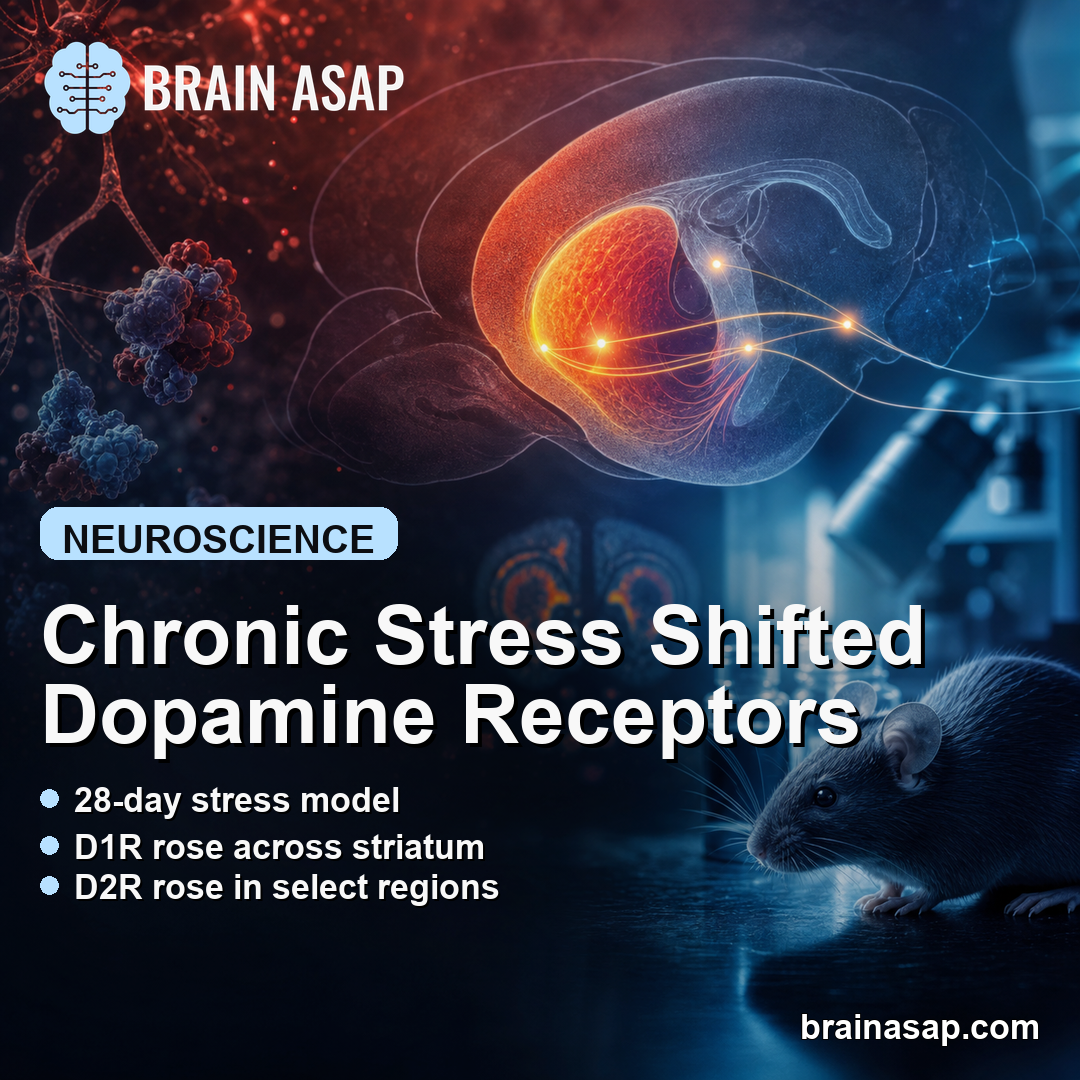
TL;DR: A 2026 mouse study in Neurochemical Research found that 28 days of unpredictable chronic mild stress increased dopamine D1 receptor binding across the striatum and raised dopamine D2 receptor binding only in selected regions, regardless of fatty acid-binding protein 7 gene deletion.
Key Findings
- Adult male mice were exposed to 28 days of unpredictable chronic mild stress or kept in nonstress control housing.
- Dopamine D1 receptor binding increased across every analyzed striatal region, plus the olfactory tract and substantia nigra reticular.
- Dopamine D2 receptor binding increased only in the dorsal caudate putamen, ventral caudate putamen, and olfactory tract.
- FABP7 deletion did not change the stress effect, suggesting other fatty acid-binding proteins may compensate in this dopamine pathway.
- The study used male mice only and did not directly measure behavioral symptoms or stress biomarkers in this experiment.
Source: The paper tested dopamine receptor binding after a chronic-stress paradigm in wild-type and fatty acid-binding protein 7 knockout mice.
Chronic Stress Increased Dopamine D1 Binding Across the Striatum
Dopamine signaling helps regulate motivation, reward learning, movement, stress response, and mood. In this study, researchers asked whether chronic stress changed dopamine receptor binding in brain regions tied to reward and habit circuitry.
The model was unpredictable chronic mild stress (UCMS), a 28-day mouse paradigm often used to study depression-related biology. The stressors changed from day to day, so the animal could not adapt to one repeated condition.
The strongest result involved dopamine D1 receptors (D1R). After UCMS, D1R binding was higher in every analyzed striatal region, including dorsal and ventral caudate putamen subregions and the nucleus accumbens core and shell.
- Dorsal medial caudate putamen: D1R binding was 27.1% higher in stressed mice.
- Nucleus accumbens core: D1R binding was 31.8% higher in stressed mice.
- Olfactory tract: D1R binding was 34.2% higher in stressed mice.
- Substantia nigra reticular: D1R binding was 43.3% higher in stressed mice.
That broad D1R shift matters because D1-linked signaling is often framed as part of the brain’s action-promoting or “go” pathway. In stress and reward biology, a broad increase in D1 receptor availability can change how strongly motivational circuits respond to cues and reinforcement.
D2 Receptor Binding Rose in Fewer Brain Regions
Dopamine D2 receptors (D2R) increased in fewer regions after chronic stress, but the measured changes were still sizable: 33.9% in the dorsal caudate putamen, 37.9% in the ventral caudate putamen, and 24.8% in the olfactory tract.
Other regions did not show a significant D2R change. That included the dorsal medial, dorsal lateral, ventral medial, and ventral lateral caudate putamen subdivisions, plus the nucleus accumbens core and shell.
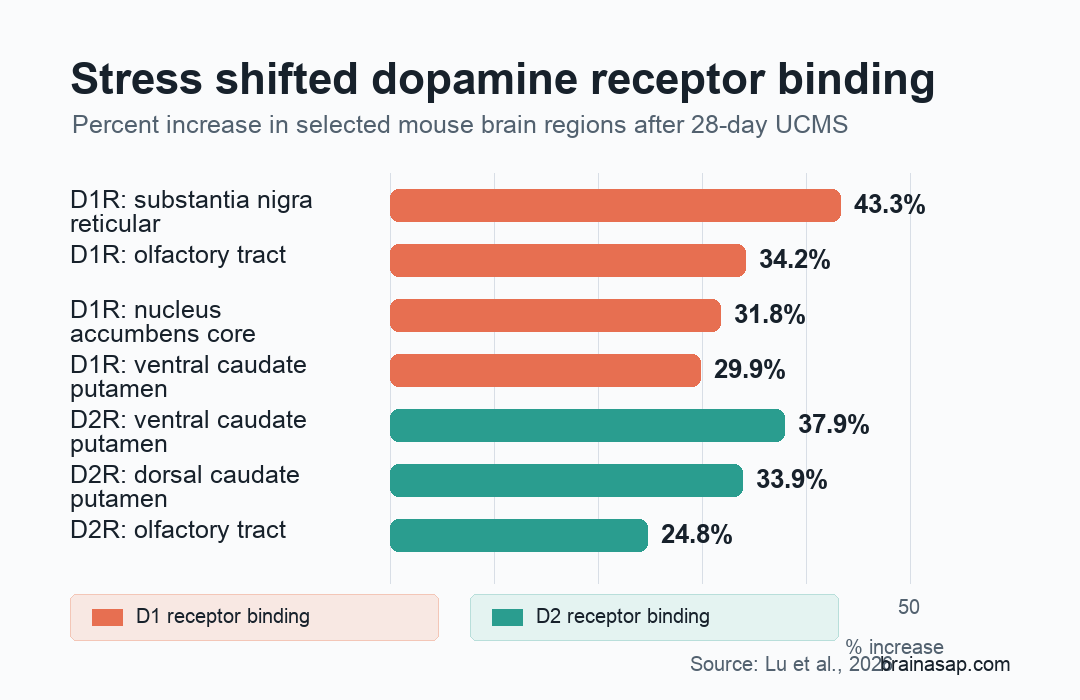
The receptor data point to a D1-heavy stress shift rather than a uniform dopamine-receptor increase. The paper’s discussion connects that imbalance to depression and substance-use vulnerability, but those clinical links remain interpretation rather than proof from this experiment.
FABP7 Deletion Did Not Explain the Dopamine Shift
The second question was whether the stress effect depended on fatty acid-binding protein 7 (FABP7), a lipid-transport protein found largely in astrocytes and neural progenitor cells. FABP7 can influence endocannabinoid handling, and endocannabinoid signaling interacts with dopamine systems.
Researchers compared normal mice with FABP7 knockout mice. If FABP7 were necessary for the dopamine-receptor response, stress would be expected to affect those genotypes differently.
That is not what happened. The main stress effect appeared regardless of genotype. In the statistical models, FABP7 deletion did not significantly change D1R binding or D2R binding across the examined regions.
- Stress was the main driver: UCMS predicted higher D1R binding broadly and higher D2R binding in selected regions.
- Genotype was not the main driver: FABP7 deletion did not produce a significant overall receptor-binding effect.
- Compensation remains possible: The researchers suggest that other fatty acid-binding proteins, especially FABP3 or FABP5, may help maintain dopamine signaling when FABP7 is absent.
This is a useful negative result. It narrows the likely mechanism from “FABP7 alone controls the stress response” toward a broader lipid-transport and endocannabinoid-dopamine network.
The Olfactory Tract Result May Relate to Avoidance Learning
The olfactory tract stood out because both D1R and D2R binding increased there after UCMS. This region is part of ventral striatal circuitry and receives dopamine input related to odor-reward and odor-danger learning.
The authors note that D1R expression in the olfactory tract can help encode whether an odor predicts reward or punishment, while D2R activation in some olfactory tract subdivisions has been linked to aversive and avoidance behavior in mice.
The stressed mice in this experiment were not directly shown to avoid odors. The study measured receptor binding, not behavior.
Even with that boundary, the olfactory tract finding gives the receptor data a plausible circuit context.
- D1R increase: May reflect stronger cue-linked motivational signaling after stress.
- D2R increase: May reflect a compensatory or avoidance-linked change in selected regions.
- Regional specificity: The same stress paradigm did not raise every dopamine receptor in every region.
Chronic stress did not simply suppress dopamine biology. In this study, it reshaped dopamine receptor availability in a region-specific way.
The Main Limits Are Sex, Behavior, and Stress Biomarkers
The experiment used adult male mice. That limits what can be inferred about female mice or sex-based differences in stress biology.
The researchers also did not measure behavioral outcomes or stress biomarkers in this experiment. UCMS is a standard stress paradigm, but this paper did not directly report corticosterone, depression-like behavior, sucrose preference, or similar endpoints from the same animals.
Finally, receptor binding is a biological readout, not a clinical diagnosis. The findings can help explain how chronic stress might alter reward and motivation circuits, but they do not show that the same receptor pattern causes major depressive disorder or substance use disorder in people.
The main takeaway is narrow but clear: in this mouse model, chronic stress broadly increased D1 receptor binding and selectively increased D2 receptor binding, and the receptor pattern did not depend on FABP7 deletion.
Citation: DOI: 10.1007/s11064-026-04753-3. Lu et al. Unpredictable Chronic Mild Stress Upregulates Dopamine Receptor Expression Independent of Fatty Acid-Binding Protein 7 Gene Deletion. Neurochemical Research. 2026;51:143.
Study Design: Mouse stress-model experiment using in vitro autoradiography to measure dopamine receptor binding.
Sample Size: Adult male wild-type and FABP7 knockout mice, with 9-10 mice per treatment group.
Key Statistic: D1R binding increased across all analyzed regions after UCMS, while D2R binding increased in the dorsal caudate putamen, ventral caudate putamen, and olfactory tract.
Caveat: The study used male mice only and did not directly measure behavior or stress biomarkers in this experiment.