TL;DR: A 2026 prospective observational study in BMC Pulmonary Medicine found that patients recovering at home after day-case video-assisted thoracoscopic surgery (VATS) wedge resection steadily increased their step counts over 4 weeks, while lower early activity was linked to poorer 6-minute walk recovery and higher preoperative anxiety.
Key Findings
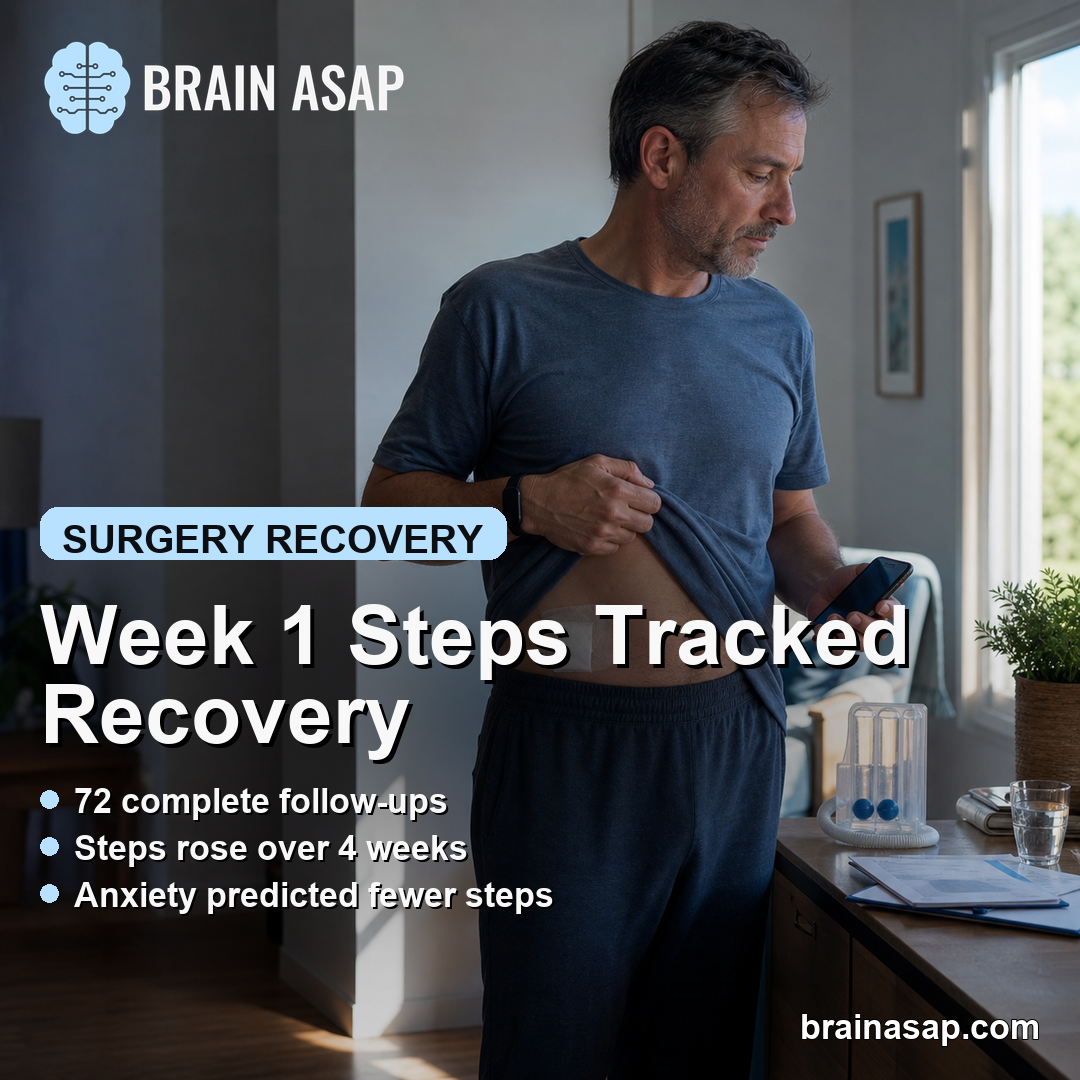
- 72 complete follow-ups: Of 82 day-case VATS wedge resection patients, 72 had complete 4-week activity, function, mental-health, and quality-of-life data.
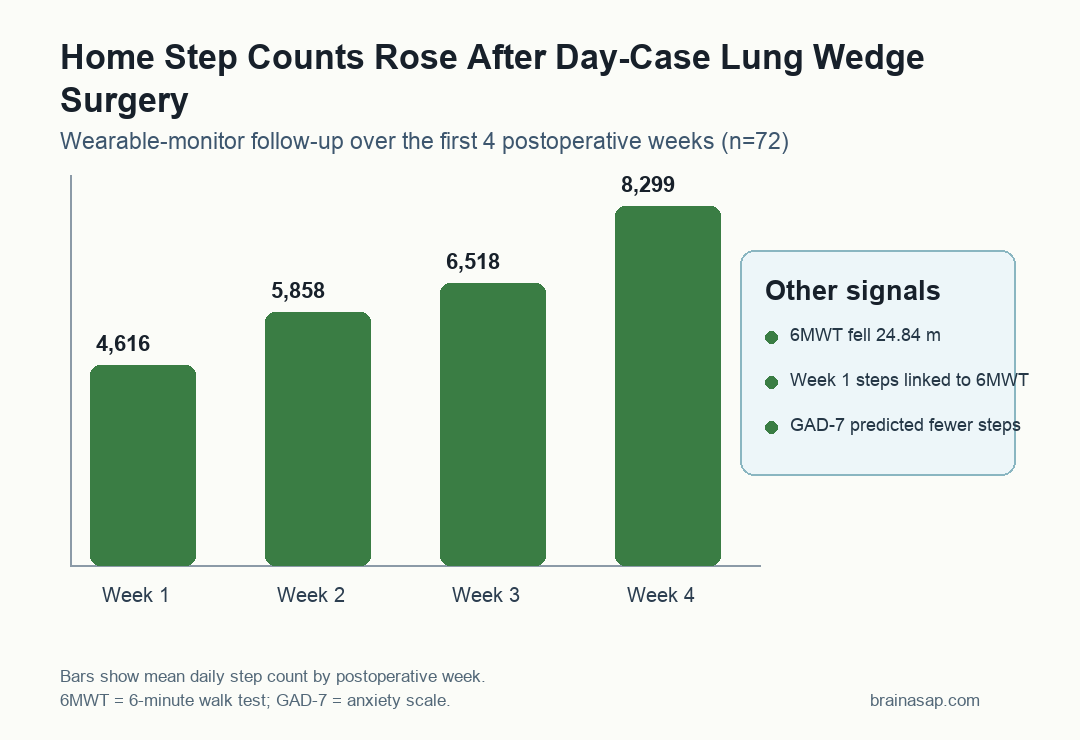
- Step counts rose weekly: Mean daily steps increased from 4,616 in week 1 to 8,299 in week 4, approaching the 7,000-10,000 step range often cited for healthy adults.
- Capacity lagged behind activity: The 6-minute walk test declined from 572.89 m before surgery to 548.05 m at week 4 (p = 0.043).
- Early steps tracked later walking: Week 1 mean daily step count correlated with preservation of 6-minute walk performance at week 4 (rho = 0.369; p = 0.035).
- Anxiety predicted lower activity: Higher preoperative GAD-7 anxiety scores were associated with fewer week 1 steps (beta = -0.45; 95% CI, -0.94 to -0.09; p = 0.02).
Source: BMC Pulmonary Medicine (2026) | Wang et al.
Day-case VATS wedge resection means selected lung surgery patients leave the hospital within 23 hours after minimally invasive wedge removal of lung tissue. That shift puts much of early recovery at home, where clinicians cannot rely only on inpatient observation.
This study used wrist-worn Actigraph accelerometers to measure activity during the first postoperative month. It paired those objective movement data with walking capacity, respiratory muscle strength, anxiety, depression, sleep quality, dyspnea, and health-related quality of life.
Home Step Counts Rose During the First 4 Postoperative Weeks
The cohort was a relatively fit surgical group. Among the 78 pathology-confirmed malignant cases, the mean age was 50.4 years, all tumors were stage IA, and all operations were VATS wedge resections.
The complete-case recovery analysis used 72 patients. Wearable compliance was strong enough for interpretation: 88.9% met weekly compliance in weeks 1 and 2, 83.3% in week 3, and 77.8% in week 4.
- Week 1: Mean daily step count was 4,616, with moderate-intensity activity averaging 131 minutes per day.
- Week 2: Mean daily steps increased to 5,858, while light-intensity activity dropped from the unusually high week 1 level.
- Week 4: Mean daily steps reached 8,299, and moderate-to-vigorous physical activity averaged 169 minutes per day.
Vigorous-intensity activity remained at zero across the 4-week follow-up. The recovery pattern was not a return to hard exercise; it was a steady increase in ordinary home movement and moderate activity.
Walking Capacity Remained Below Preoperative Baseline
The important clinical contrast is that daily activity improved faster than formal physical capacity. At week 4, the 6-minute walk test (6MWT), a timed walking test of functional exercise capacity, remained lower than the preoperative baseline.
Patients walked 572.89 m before surgery and 548.05 m at week 4, a mean change of -24.84 m. Maximal expiratory pressure also declined, from 107.56 to 97.89 cmH2O.
- 6MWT: The decline was statistically significant (p = 0.043), suggesting incomplete exercise-capacity recovery.
- MEP: Maximal expiratory pressure declined by about 9.0% (p = 0.001), pointing to respiratory muscle impact.
- Dyspnea: Modified Medical Research Council dyspnea grades 1-2 increased from 5.56% before surgery to 30.56% at week 4.
Peripheral strength was mostly preserved, and anxiety and depression scores did not worsen significantly. Quality-of-life measures were mixed: EQ-VAS fell from 90 to 85, while SF-12 improved from 76.25 to 82.50.
Week 1 Step Count Signaled Later Functional Recovery
Researchers tested whether early home movement related to later recovery. Week 1 mean daily step count was significantly correlated with change in the 6MWT by week 4, with Spearman’s rho = 0.369 and p = 0.035.
That result suggests week 1 steps may help identify patients whose walking capacity is being preserved versus patients who need more rehabilitation attention. The correlation did not extend broadly to every outcome.
- Walking capacity: Week 1 steps correlated with preservation of 6MWT performance.
- Respiratory strength: Week 1 steps were not significantly correlated with MIP or MEP change.
- Mental-health scales: Week 1 steps were not significantly correlated with GAD-7 anxiety or PHQ-9 depression score changes.
The narrower interpretation is useful. A wearable step count was not a complete recovery score, but it helped identify one important physical endpoint.
Higher Preoperative Anxiety Predicted Fewer Week 1 Steps
The mental-health finding came from baseline predictors of early postoperative activity. Among the variables tested, preoperative GAD-7 anxiety score was the only significant predictor of mean daily step count during postoperative week 1.
The association was negative: higher anxiety scores predicted fewer early steps. The regression estimate was beta = -0.45, with a 95% confidence interval from -0.94 to -0.09 and p = 0.02.
- Not age or BMI: Age, body mass index, smoking, education, employment, and comorbidity were not significant predictors in the univariate models.
- Not baseline walking: Preoperative 6MWT was not a significant predictor of week 1 steps in this analysis.
- Anxiety signal: The GAD-7 result points to psychological readiness as a possible early rehabilitation factor after ambulatory lung surgery.
The anxiety result is still observational. Baseline anxiety identified patients who tended to walk less during the first week at home, after a procedure designed for very early discharge.
Ambulatory Surgery Recovery Needs Both Activity and Capacity Measures
The study supports a practical distinction. Step counts can look reassuring by week 4, yet the 6MWT and respiratory muscle measures can still show incomplete recovery.
For clinicians, that argues against using home activity alone as proof of full functional return. A patient may be walking more at home while still having reduced exercise capacity, more dyspnea, or lower expiratory muscle strength.
For patients, the finding is less about chasing a universal step target and more about trajectory. A week 1 step count may help flag who is recovering smoothly and who might benefit from earlier rehabilitation follow-up, especially when anxiety is already elevated before surgery.
Single-Center Observational Design Limits the Claim
The study was prospective, used objective wearable data, and followed patients through the first 4 postoperative weeks. Still, it was a single-center observational study, not a randomized test of an activity intervention.
The cohort was also selected: these were early-stage lung cancer patients well enough for day-case VATS wedge resection, mostly with good baseline pulmonary function. The findings may not apply to older, frailer, inpatient, or more advanced lung-surgery populations.
The useful clinical message is specific: in this ambulatory wedge-resection group, home step counts rose quickly, formal capacity lagged, and preoperative anxiety marked lower early movement. That combination gives rehabilitation teams measurable signals to watch during the first month after discharge.
Citation: DOI: 10.1186/s12890-026-04481-y. Wang Q, et al. Physical activity, functional capacity, and mental health during the first postoperative month in patients undergoing ambulatory pulmonary wedge resection: a prospective observational study. BMC Pulmonary Medicine. 2026.
Study Design: Prospective observational study of home-based recovery after day-case VATS wedge resection.
Sample Size: 82 operated patients for safety analysis; 72 patients with complete 4-week activity, function, mental-health, and quality-of-life data.
Key Statistic: Mean daily steps increased from 4,616 in week 1 to 8,299 in week 4, while week 1 step count correlated with 6MWT preservation at week 4.
Caveat: The single-center observational design cannot prove that increasing steps caused better functional recovery or that treating anxiety would increase activity.