TL;DR: A 2026 systematic review in PLOS One found that ketogenic diet therapies were linked to more 50% seizure reductions in drug-resistant epilepsy, with clearer evidence in children and more uncertainty for near-complete seizure control, side effects, adherence, and quality of life.
Key Findings
- 17 randomized trials were included: The review screened 1,193 records after duplicates and included 11 pediatric trials plus 6 adolescent/adult trials of ketogenic diet therapies for drug-resistant epilepsy.
- Children had the clearest 50% seizure-reduction result: Across 786 children, ketogenic diet therapies produced a relative risk of 4.06 for at least 50% seizure reduction, equal to about 37 more children per 100 compared with usual care.
- Adults and adolescents also showed a 50% reduction benefit: Across 494 patients, ketogenic diet therapies produced a relative risk of 7.73, equal to about 16 more patients per 100 reaching at least 50% seizure reduction.
- Near-complete seizure reduction was less certain: In children, about 6 more per 100 may reach at least 90% seizure reduction, but certainty was low. In adults and adolescents, evidence for that outcome was very uncertain.
- Safety and patient-centered outcomes were thin: Pediatric trials did not show a clear adverse-event increase, adult/adolescent safety estimates were imprecise, and quality-of-life, cognition, hospitalization, status epilepticus, and survival outcomes were sparse.
Source: PLOS One (2026) | Vaccarezza et al.
Ketogenic Diets Target a Hard-to-Treat Epilepsy Group
Drug-resistant epilepsy usually means seizures continue after appropriately chosen antiseizure medicines have failed. The review notes that roughly 30% of people with epilepsy develop this treatment-resistant pattern, which is why non-drug options remain clinically important.
Ketogenic diet therapies are high-fat, low-carbohydrate dietary treatments designed to shift metabolism toward ketone use. They include the classic ketogenic diet, medium-chain triglyceride diet, modified Atkins diet, and low-glycemic-index therapy.
The review did not treat these diets as wellness trends. It asked whether randomized trials show meaningful seizure reduction in people whose epilepsy had already resisted medication.
17 Trials Compared Ketogenic Therapy With Usual Care
Researchers searched Embase, PubMed/Medline, LILACS, and the Cochrane Library, then updated the search in June 2025. Eligible randomized controlled trials had to last at least 28 days.
The final evidence base covered 17 randomized trials:
- 11 trials in children: These included classic ketogenic, medium-chain triglyceride, modified Atkins, and low-glycemic-index approaches.
- 6 trials in adolescents or adults: Most adult trials tested modified Atkins-style approaches against standard care.
- Follow-up ranged from 6 to 24 months: Outcomes were analyzed separately for children and for adolescents/adults.
Separate age-group analyses were important because pediatric ketogenic therapy has a longer clinical history. Adult and adolescent evidence remains smaller and less complete.
Children Were More Likely to Reach 50% Seizure Reduction
The clearest pediatric result was the standard epilepsy-trial benchmark of at least 50% seizure-frequency reduction. Across 786 children in 9 trials, ketogenic diet therapy had a relative risk of 4.06 for reaching that outcome.
In absolute terms, about 37 more children per 100 would reach at least 50% seizure reduction with ketogenic therapy than with usual care. The evidence certainty was rated moderate, mainly downgraded because diet trials cannot easily blind families or clinicians.
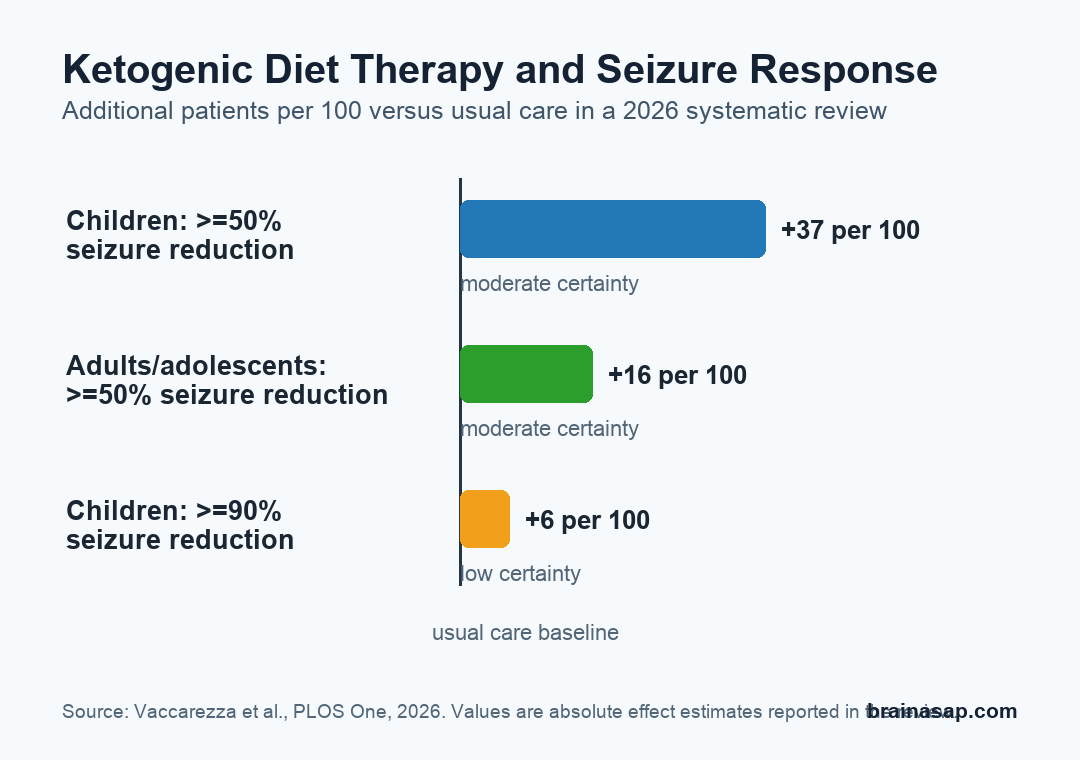
The stronger outcome, at least 90% seizure reduction or seizure freedom, was less secure. Across 759 children in 10 trials, ketogenic therapy may help about 6 more children per 100 reach that threshold, but the evidence was rated low certainty because the confidence interval reached the line of no effect.
Adults and Adolescents Had a 50% Reduction Result With Wider Uncertainty
The adult/adolescent findings moved in the same direction for the 50% seizure-reduction endpoint. Across 494 patients in 5 studies, ketogenic diet therapy had a relative risk of 7.73 for at least 50% seizure reduction.
Translated into absolute terms, about 16 more adults or adolescents per 100 may reach that response level compared with usual care. The authors rated this evidence as moderate certainty, but the estimate was wide.
The near-complete seizure-reduction question was much weaker in older patients:
- Only 3 studies reported the outcome: The total adult/adolescent sample for at least 90% reduction was 301 patients.
- Events were sparse: The review noted that only one intervention arm in one study reported events for this threshold.
- Certainty was very low: The effect could not be interpreted as a reliable adult seizure-freedom estimate.
That means the practical adult takeaway is narrower: ketogenic therapy may help some patients cut seizure frequency substantially, but the evidence does not yet prove durable near-complete control.
Side Effects and Dropout Rates Need Better Evidence
Diet therapy is not a passive intervention. Families and patients have to plan meals, restrict carbohydrates, monitor symptoms, and keep the diet going long enough for seizure outcomes to matter.
In children, adverse events did not clearly differ from usual care. The pooled relative risk was 1.03, with low-certainty evidence.
In adults and adolescents, the evidence was very low certainty, and the confidence interval was too wide to rule in or rule out important harms.
The review named gastrointestinal symptoms as the main adult/adolescent side-effect cluster:
- Nausea, vomiting, or reflux
- Diarrhea, constipation, or abdominal pain
- Weight loss
Dropout was also uncertain. Pediatric trials suggested ketogenic therapy might slightly increase dropout, while adult/adolescent estimates were very imprecise.
Adherence is clinically important because a dietary therapy can look effective among people who stay on it, while still being difficult to sustain in routine care.
Quality of Life and Cognitive Outcomes Remained Sparse
The review is useful because it separates seizure-count evidence from broader patient outcomes. Seizure frequency matters, but families also care about quality of life, cognition, behavior, hospitalizations, and long-term survival.
Those outcomes were not well answered. Pediatric quality-of-life and developmental data were too heterogeneous for strong conclusions.
One pediatric trial reported no broad quality-of-life differences at 12 months, except domains favoring medication for temperament/mood and peer relationships. Another reported parent-observed improvements in alertness, activity, sleep, social interaction, and behavior.
No evidence was identified for hospitalization rates, status epilepticus, or overall survival. Ketogenic diet therapies appear to improve the chance of meaningful seizure reduction, especially in children.
The evidence is much thinner for the outcomes that define daily life beyond seizure counts.
Citation: DOI: 10.1371/journal.pone.0333334. Vaccarezza MM, Sanguine VL, Balaciano G. Ketogenic diet therapies for the treatment of drug-resistant epilepsy in children and adults: A systematic review. PLOS One. 2026;21(7):e0333334.
Study Design: Systematic review of randomized controlled trials comparing ketogenic diet therapies with usual care for drug-resistant epilepsy.
Sample Size: 17 randomized trials after screening 1,193 records; 11 pediatric trials and 6 adolescent/adult trials.
Key Statistic: About 37 more children per 100 and 16 more adults/adolescents per 100 may reach at least 50% seizure reduction with ketogenic therapy.
Caveat: Evidence was strongest for 50% seizure reduction; near-complete seizure reduction, side effects, adherence, quality of life, cognition, hospitalization, and survival remain less certain.